
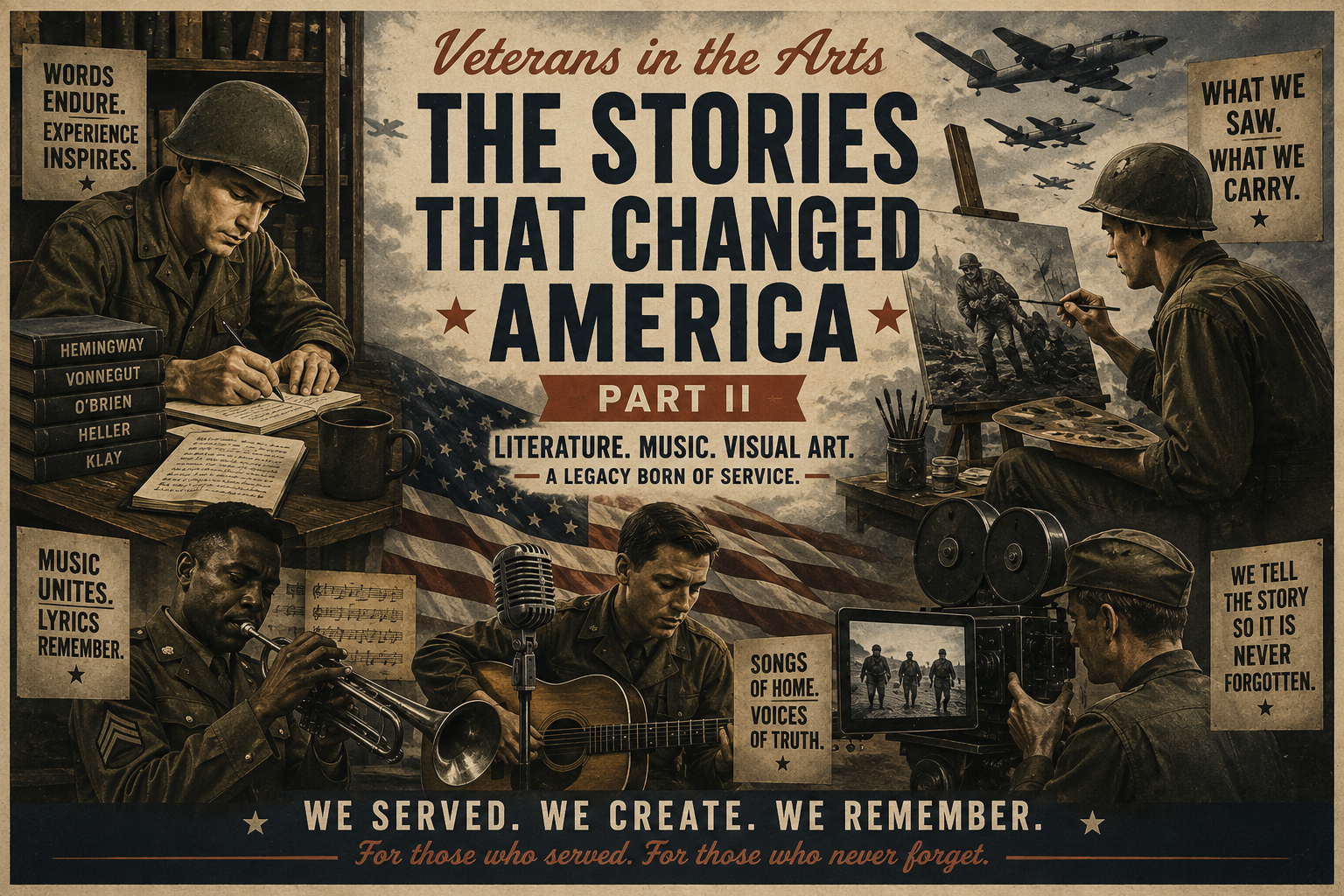
War does not end when the shooting stops.
It follows people home in memories, habits, photographs, songs, nightmares, jokes, paintings and unfinished stories. Sometimes those experiences remain private for decades. Sometimes they become novels, albums, poems, sculptures or works of art that shape how entire generations understand conflict, sacrifice and the human cost of service.
The veteran influence on the arts reaches far beyond the familiar category of “war stories.” Veterans have changed literary style. They have transformed country music, jazz, rock and protest music. They have created some of the most enduring images of war and return. They have also built programs that use art not only as a form of public expression, but as a tool for recovery, communication and renewed purpose.
Some artists wrote directly about combat. Others transformed their military experiences into fantasy, satire, abstract art or music that had no obvious connection to war. That distinction is important.
Veterans do not contribute to the arts simply because they have seen battle. They contribute because military service often forces people to confront leadership, loyalty, fear, death, absurdity, moral uncertainty and the gap between public mythology and lived experience.
Those themes are not limited to war. They are among the oldest and most powerful subjects in art.
Literature: Turning Experience Into Language
The relationship between military service and literature is ancient. Some of humanity’s earliest surviving stories are about warriors attempting to understand courage, loyalty, grief and the difficult journey home.
The Iliad is not only about battle. It is about pride, rage, friendship and loss. The Odyssey is not only about adventure. It is about a veteran trying to return to a life that no longer fits the person he has become.
That basic story has never disappeared. Every generation of veterans has attempted to answer the same questions: What happened? Why did it happen? What did it mean? And how can it be explained to people who were not there?
Modern veteran literature became especially influential during the twentieth century because industrial warfare created experiences that traditional heroic language could no longer contain.
World War I and the End of Romantic War
Before World War I, Western literature frequently described war through the language of honor, glory and adventure. Industrial warfare shattered that tradition. Machine guns, artillery, poison gas, barbed wire and mass mobilization created a battlefield unlike anything earlier generations had experienced.
The individual courage of soldiers remained real. But courage no longer guaranteed survival. A person could die without seeing the enemy, killed by a shell fired from miles away. That reality transformed literature.
Ernest Hemingway and the Power of What Remains Unsaid
Ernest Hemingway served as an ambulance driver for the American Red Cross in Italy and was seriously wounded in 1918. His wartime experiences influenced A Farewell to Arms, but the deeper impact of service can be seen throughout his style.
Hemingway’s prose was restrained. His sentences were often short. His characters rarely explained themselves completely. Emotion was hidden beneath action. Trauma appeared through drinking, silence, risk-taking, failed relationships and the inability to return to ordinary life.
Hemingway’s “iceberg theory” of writing argued that the most important part of a story could remain beneath the surface. That style was ideally suited to veterans who could not—or would not—describe everything they had experienced. The silence became part of the story.
A generation of writers learned from Hemingway that pain did not need to be announced. It could be revealed through what a character avoided saying. That influence reached far beyond military fiction and helped redefine modern American prose.
Wilfred Owen and the Language of the Trenches
British Army officer and poet Wilfred Owen offered another response to the First World War. Owen rejected patriotic language that concealed the physical reality of the trenches. His poetry described exhaustion, mud, gas attacks and broken bodies.
He wanted readers to understand that the language of noble sacrifice could become dangerous when it encouraged young men to imagine war as something clean or glorious. Owen was killed shortly before the armistice, but his work later became central to how generations understood the First World War.
He represented a major turning point in literature: the soldier was no longer expected to protect the public from the truth. The veteran writer could confront the public with it.
J.R.R. Tolkien: War Transformed Into Myth
J.R.R. Tolkien served in the British Army and fought in the Battle of the Somme. He lost close friends during the war and belonged to a generation permanently marked by industrial destruction.
Tolkien resisted simplistic claims that The Lord of the Rings was a direct allegory for either world war. Still, his experience gave his work a depth that readers have long recognized. The fellowship reflects the bond formed among people carrying a shared burden. The destruction of landscapes reflects the violence of industrial power. The return to the Shire reflects the difficult truth that a veteran may come home to a place that appears unchanged even though the person returning has been transformed.
Frodo survives. But survival does not mean complete recovery. That is one of the most powerful veteran themes in modern fiction.
Tolkien’s influence also demonstrated that military experience did not have to produce realistic battlefield writing. It could be transformed into mythology. Veterans could write fantasy, science fiction and allegory while still drawing from the emotional realities of service.
World War II and the Literature of Moral Complexity
The Second World War created a different literary challenge. The fight against fascism could be understood as morally necessary, and the liberation of Europe and defeat of Nazi Germany gave the war a clear public narrative. Yet veterans still returned with memories that victory celebrations could not fully contain.
They remembered fear, incompetence, civilian suffering, arbitrary death and the enormous machinery of military institutions. The literature that followed became less interested in simple heroism and more interested in power, bureaucracy and moral contradiction.
Norman Mailer and the Military Institution
Norman Mailer served in the Army in the Pacific. His novel The Naked and the Dead rejected the idea of the military as a simple collection of heroic individuals.
Mailer examined hierarchy, ambition, fear, resentment, class and the relationship between authority and survival. The military in Mailer’s work was not merely a setting. It was a system that revealed how power operated.
Men carried personal histories, prejudices and ambitions into war. Officers made decisions that affected lives they barely understood. Soldiers were expected to obey even when orders appeared irrational. Mailer helped move war literature away from battlefield adventure and toward institutional analysis.
James Jones and the Life Before Battle
Army veteran James Jones served in the Pacific and wrote From Here to Eternity and The Thin Red Line. Jones understood that military life is shaped long before combat begins.
Training, boredom, punishment, routine, class divisions, leadership failures, loyalty and the pressure of living inside an institution that controls nearly every part of daily life all shape the service member before the first shot is fired.
His work explored how soldiers are formed by the system before they reach the battlefield. That became another major turning point. Military literature no longer needed to focus only on combat. The barracks, parade ground and disciplinary system could be just as important as the front line.
Joseph Heller and the Birth of the Catch-22
Joseph Heller served as a bombardier in the Army Air Forces during World War II. His novel Catch-22 became one of the most influential works of satire in modern literature.
The book’s title entered everyday language as a description of a problem in which the rules make escape impossible. Heller’s characters are trapped inside a bureaucracy that protects itself through circular logic. The more they attempt to act rationally, the more irrational the system becomes.
Missions continue because previous missions established numerical expectations. Officers pursue promotions while subordinates face death. Language becomes a weapon used to conceal reality.
That was the genius of Catch-22. Heller was not simply arguing that war was frightening. He was showing that institutions could become so absurd that madness appeared logical.
His influence reached far beyond military writing. Workplace satire, political comedy, television bureaucracy and corporate absurdity all inherited something from Heller. He gave modern culture a language for systems that cannot be defeated because they define the rules.
Kurt Vonnegut and the Fractured Memory of War
Kurt Vonnegut served in the Army and became a prisoner of war. He survived the bombing of Dresden while sheltered underground in a meat locker. For years, he struggled to write about the experience.
Traditional realism seemed inadequate. How could a conventional narrative explain mass destruction, arbitrary survival and the memory of thousands of civilians killed in a single attack?
Vonnegut’s answer was Slaughterhouse-Five. The novel combined war, science fiction, dark comedy and nonlinear storytelling. Its protagonist becomes “unstuck in time,” moving between different moments of his life without control.
The past is never finished. It keeps returning. That structure reflected something many veterans understood before the broader public had a language for it. Traumatic memory does not always behave like ordinary memory. It interrupts, repeats and reappears.
A person may be physically present in one place while mentally returned to another. Vonnegut also used humor as a survival mechanism. His comedy did not minimize suffering. It made proximity to suffering possible. This dark, absurd and sometimes fatalistic humor remains deeply familiar to veterans.
Vietnam and the Collapse of the Heroic Narrative
The Vietnam War created another major transformation in American literature. Vietnam veterans returned to a country deeply divided over the purpose, conduct and outcome of the war.
Some were celebrated. Some were ignored. Some were blamed. The public often struggled to distinguish between opposition to the war and treatment of the people who fought it.
Veteran writers confronted that confusion directly. Their work frequently explored moral ambiguity, alienation, addiction, memory and the inability of civilians to understand what had happened.
Tim O’Brien and the Truth of a War Story
Tim O’Brien served in the Army in Vietnam. His book The Things They Carried became one of the defining works of the era.
The title referred to physical objects—ammunition, letters, photographs, medical supplies and good-luck charms—but it also referred to invisible burdens: fear, shame, responsibility, grief and survivor guilt.
O’Brien blurred the boundary between fiction and memoir. He changed details, repeated stories and questioned his own memory. That approach was not an attempt to deceive the reader. It was an attempt to communicate emotional truth.
A perfectly factual account may fail to explain what an event felt like. A crafted story may come closer. That idea changed veteran literature.
The writer was no longer expected simply to report events in order. He could examine the instability of memory itself. He could admit uncertainty. He could show how stories evolve because survivors are always trying to understand them.
Other Vietnam Voices
Karl Marlantes, Tobias Wolff, Larry Heinemann and other Vietnam veterans expanded the genre further. Their work explored combat, masculinity, addiction, political disillusionment and the difficult distance between military and civilian life.
Vietnam veteran literature also challenged two durable stereotypes: the veteran as flawless hero and the veteran as permanently broken victim.
Writers showed something more complicated. Veterans could be proud and angry, loyal and disillusioned, strong and wounded. They could criticize the war without condemning the people who fought it. They could love their fellow soldiers while questioning the decisions that placed them in danger.
That complexity remains one of the most important contributions of Vietnam-era art.
The Post-9/11 Generation
The wars in Iraq and Afghanistan produced another important body of veteran literature. This generation returned to a country that often expressed public support for troops while remaining distant from the wars themselves.
The all-volunteer force represented a small percentage of the population. Many civilians did not personally know anyone who served. That distance became one of the central themes of post-9/11 writing.
Veterans were asked to explain wars most Americans had not experienced and increasingly did not follow closely. At the same time, they faced pressure to become symbols: hero, victim, patriot or critic. The strongest writers resisted those categories.
Phil Klay and Many Veteran Voices
Marine veteran Phil Klay’s collection Redeployment won the National Book Award for Fiction. The book does not present one representative veteran. It moves among different military occupations, experiences and moral perspectives.
That choice matters. A rifleman, chaplain, public affairs specialist, mortuary worker and artilleryman do not experience war in the same way. Rank matters. Branch matters. Job matters. Deployment location matters.
Klay challenged the expectation that one veteran story could speak for millions of people. His work also explored the distance between military experience and civilian conversation. Veterans sometimes discover that civilians want simple stories—something inspirational, tragic or politically useful. Klay’s characters resist that simplification.
Elliot Ackerman and the Long Consequences of War
Marine veteran Elliot Ackerman served on multiple deployments and has written fiction and nonfiction about conflict, politics and the consequences of American intervention.
His work often places soldiers, civilians, interpreters and local fighters inside conflicts where loyalty and survival do not always point in the same direction.
Ackerman’s writing reflects a broader change in veteran literature. The veteran writer is not limited to telling the story of American troops. He can examine the full political and human landscape of war, including allies, civilians, refugees, enemy fighters, families and the decisions made far from the battlefield.
This broader perspective makes the work more difficult, but also more honest.
Kevin Powers, Matt Gallagher and a New Literary Generation
Army veteran Kevin Powers used lyrical prose and poetry in The Yellow Birds to explore grief, memory and guilt. Matt Gallagher has written fiction and journalism dealing with Iraq, Ukraine, identity and the continued search for purpose after service.
Other influential voices include Brian Turner, Maurice Decaul, Teresa Fazio, Jerad W. Alexander, Benjamin Busch, Adrian Bonenberger, Katey Schultz, Lauren Kay Johnson and Jerri Bell.
Together, they demonstrate that there is no single post-9/11 veteran voice. Women veterans are writing. Combat veterans are writing. Support personnel are writing. Officers and enlisted veterans are writing. Veterans from different racial, regional and family backgrounds are writing.
That diversity may be the most important literary development of the current era. The field is slowly moving away from the idea that veteran writers must explain the military to civilians.
They are increasingly free to write crime fiction, romance, science fiction, political analysis, literary fiction or stories that have no obvious connection to military service. That is not a rejection of veteran identity. It is the fulfillment of artistic freedom.
Music: Rhythm, Rebellion and the Sound of Returning Home
Military service has influenced American music in ways that reach far beyond patriotic songs and marching bands.
Veterans helped shape jazz, country, rock, folk and popular music. Military bands trained generations of musicians. Deployment exposed performers to new cultures and styles. Music helped troops remember home, survive boredom, process fear and create shared identity.
It also became one of the primary ways Americans argued about war.
Military Bands as American Music Schools
The armed forces have long maintained professional bands. These organizations serve ceremonial and diplomatic purposes, but they also function as elite training grounds.
Military musicians must perform under pressure. They learn multiple styles. They adapt quickly. They rehearse with precision. They understand that an ensemble succeeds only when individuals listen to one another.
That discipline has shaped countless careers. Military bands have also carried American music around the world. Jazz, swing, classical music and popular songs traveled with service bands during wartime and peacetime.
These performances became a form of diplomacy. They introduced foreign audiences to American culture while exposing American musicians to sounds they might never have encountered at home.
Segregation and the Fight for Recognition
Military music was also shaped by segregation. Black service members performed in bands that contributed enormously to morale and culture while facing discrimination inside the same institution they served.
During World War II, Black military musicians helped preserve and spread jazz and swing. The all-Black, all-female 404th Armed Service Forces band became an important example of women fighting for equal recognition while serving their country.
Their story reflects a larger truth: veteran influence on the arts has never been separate from the struggle over who is allowed to participate in American culture. Military service created opportunities, but it also reproduced the inequalities of the society it represented. Veteran artists often challenged both.
Jazz and the Experience of Service
Many major jazz musicians served in the military.
Dave Brubeck entered the Army during World War II and organized an integrated military band known as the Wolfpack. His experiences with segregation influenced his later commitment to civil rights and musical exchange.
Brubeck’s work demonstrated how military service could expose artists to injustice while also creating relationships across racial and regional boundaries.
John Coltrane served in the Navy and performed in military bands before becoming one of the most influential saxophonists in history. His service was not the single source of his artistic development, but it formed part of the disciplined musical foundation from which his career emerged.
Jazz itself has qualities that resonate with military experience: improvisation, listening, adaptation, teamwork and individual excellence within a group mission. A musician must know when to lead and when to support. That balance is familiar to service members.
Country Music and the Veteran Story
Country music has maintained one of the strongest visible connections to military service. Its traditions of storytelling, family, loss, work and homecoming naturally overlap with veteran experience.
But the most influential veteran country artists did more than produce patriotic songs. They expanded the emotional and moral range of the genre.
Johnny Cash
Johnny Cash enlisted in the Air Force in 1950 and served as a radio intercept operator in Germany. During that period, he began developing the musical identity that would later make him one of the most influential performers in American history.
Cash’s military service was only one part of his life, but his later work repeatedly showed sympathy for people trapped inside institutions: prisoners, laborers, addicts, Native communities, poor families, soldiers and the condemned.
Cash could express patriotism, religious faith, criticism of authority and compassion for outsiders within the same body of work. That complexity changed country music.
He refused to fit neatly into one political or cultural category. He could perform for prisoners, support troops, criticize war, celebrate America and challenge the country to examine the people it ignored.
Cash’s influence lies partly in that contradiction. He made country music large enough to contain all of it.
Kris Kristofferson
Kris Kristofferson followed one of the most remarkable career transitions in American music. A Rhodes Scholar and Army helicopter pilot, he left a promising military career to pursue songwriting.
The decision disappointed members of his family and placed him far outside the secure path expected of him. Kristofferson’s songs helped move country music toward greater literary and emotional complexity.
He wrote about loneliness, failure, addiction, regret, desire and moral compromise. Songs such as “Sunday Mornin’ Comin’ Down” gave dignity to people living at the edge of respectability.
Kristofferson’s military background contributed to his public mythology. But his deeper impact came from refusing to live the life others had planned for him. That is also a veteran story: the courage to leave one identity and create another.
Other Veteran Voices in Country Music
Willie Nelson served briefly in the Air Force. George Strait served in the Army. Jamey Johnson served in the Marine Corps. Craig Morgan served in the Army and Army Reserve. Zach Bryan served in the Navy before becoming one of the most commercially successful singer-songwriters of his generation.
These artists do not sound alike. They do not share one political outlook. They do not all write directly about service. That difference matters.
“Veteran musician” should describe experience. It should not dictate content. The most meaningful future for veterans in music is one where they can create anything.
Rock, Rebellion and the Vietnam Era
The relationship between military service and rock music is filled with contradiction. Some veteran musicians became symbols of rebellion. Others became symbols of national service. Many embodied both at once.
Elvis Presley
Elvis Presley entered the Army at the height of his early fame. His service became a major national event. It reinforced the idea that even the country’s most famous entertainer could be subject to military obligation.
When Elvis returned, both his public image and American popular culture had changed. His military service did not define his music, but it became part of the larger story of celebrity, duty and postwar America.
Jimi Hendrix
Jimi Hendrix served in the Army before becoming one of the most revolutionary guitarists in rock history. His military career was brief and difficult, yet military imagery remained present in his life and work.
His performance of “The Star-Spangled Banner” at Woodstock became one of the defining artistic statements of the Vietnam era. Hendrix used distortion, feedback and fragments of melody to transform the anthem.
The performance sounded at once patriotic, violent, mournful and defiant. It suggested bombs, sirens, chaos and national pride. No speech was necessary.
That performance marked a turning point in American music. A patriotic symbol could be transformed without being simply rejected. Hendrix demonstrated that protest and love of country could exist in the same sound.
Music Inside the Vietnam War
The Vietnam War also revealed how music functioned inside military life. Troops listened to rock, soul, country and protest songs even when those songs criticized the war.
That fact challenged the assumption that service members all shared one political view. A soldier could oppose the war and still protect the person beside him. A veteran could love the country and condemn a decision made by its leaders.
Music allowed those contradictions to coexist. It became a private soundtrack to fear, boredom, longing and survival.
Later generations inherited that tradition. Punk, metal, hip-hop and alternative country all became vehicles for veteran anger, humor and post-service identity.
Music as a Bridge Back Home
Modern veteran songwriting programs have become an important part of the creative-arts movement.
Operation Song pairs veterans, active-duty personnel and military family members with professional songwriters. The goal is not merely to produce entertainment. It is to transform experience into structure.
A memory that feels chaotic must become verses, a chorus, a beginning and an end. The process does not erase what happened. It gives the storyteller some control over how the experience is carried.
CreatiVets also uses music and visual art to help wounded veterans tell their stories and reconnect with others.
These programs matter because music can reach people who may never attend a veteran panel or read a policy report. A song creates emotional contact. It allows civilians to feel something before they fully understand it. That is one of art’s greatest powers.
Visual Art: What Cannot Be Said Directly
Visual art has always accompanied military service. Soldiers drew camps, landscapes and fellow service members long before photography existed. Governments commissioned official combat artists. Troops created carvings, tattoos, photographs and handmade objects for personal reasons.
Some work documented history. Some provided psychological distance from it. Some allowed veterans to express experiences that did not fit easily into words.
The Combat Artist Tradition
Official combat art occupies a unique space between journalism, historical record and personal interpretation.
A photograph captures a fraction of a second. A painting can combine observation, memory and emotional emphasis. The artist decides what matters: the machinery, the faces, the waiting, the wounded, the landscape or the empty space after an attack.
Combat art can reveal experiences that military reports cannot. Reports describe units, movement and outcomes. Art can show exhaustion, isolation, fear, tenderness, boredom and confusion.
These emotional details are essential to the historical record.
World War I and World War II Combat Art
The world wars expanded official art and photography programs. Artists documented mobilization, factories, hospitals, ruined cities and daily military life.
They captured the scale of modern war, but they also recorded the individual inside that scale: a soldier shaving, a nurse waiting, a mechanic repairing an aircraft or a group sharing coffee.
These images matter because war is not experienced as a single dramatic event. It is experienced as thousands of ordinary moments interrupted by terror.
Vietnam and the Image War
The Vietnam War became one of the most visually documented conflicts in history. Television footage and newspaper photography brought the war into American homes. Images shaped public opinion.
Veteran artists later challenged, complicated and expanded those images. Some created work that questioned official narratives. Others explored memories that had remained hidden.
Vietnam demonstrated that the image itself could become a battlefield. Who controls the picture? What is shown? What is omitted? What does the public believe it understands after seeing a few seconds of footage?
Those questions remain central today.
From Documentation to Confrontation
Modern veteran artists often reject polished memorial imagery. They use uniforms, identification tags, military paperwork, field equipment and destroyed objects.
Some create paintings and photographs. Others create installations, ceramics or mixed-media works. The material itself becomes part of the meaning.
The Combat Paper Movement
The Combat Paper movement became one of the most powerful examples of transformation through material.
Veterans cut apart military uniforms. The fabric is pulped. The pulp becomes handmade paper. That paper is then used for prints, writing and visual art.
The symbolism is clear. The uniform is broken down, but it is not discarded. It is reformed. Military identity becomes raw material for something new.
This process reflects the challenge of transition itself. A veteran does not erase the past. The goal is to reshape it into a life that can continue.
Ehren Tool and the Object of War
Marine veteran Ehren Tool creates ceramic cups connected to military imagery. He distributes many of them rather than treating them primarily as commercial objects.
His work raises questions about memory, consumption and the way civilians interact with war symbols. A cup is ordinary. It is held, used, washed and placed on a table.
By placing military images on an everyday object, Tool brings war into ordinary civilian space. The viewer cannot keep the subject at a safe museum distance.
Benjamin Busch and the Landscape of Memory
Veteran artist and writer Benjamin Busch has explored landscapes, ruins and physical environments through photography and visual work.
His art reflects the idea that places remember. Buildings, roads and damaged ground can carry traces of what happened even when people are gone.
Veterans often experience this relationship to landscape intensely. A field may look ordinary to one person. To another, it may contain an entire history. Art allows that invisible history to become visible.
George W. Bush and the Politics of Veteran Portraiture
Former President George W. Bush, who served in the Texas Air National Guard, later created portraits of wounded veterans and military personnel.
The paintings became part of a complicated cultural conversation. Bush was not only a veteran artist. He was also a president whose administration launched wars that shaped a generation of service members.
That relationship cannot be separated from the work. Some viewers see the portraits as acts of respect and personal connection. Others see them through the larger political consequences of the wars.
Both responses reveal something important. Veteran art does not exist outside politics, but it cannot always be reduced to a single political argument. Art often becomes most powerful when it forces those contradictions into the same frame.
Art as Treatment, Community and Public Record
Veteran art is not only produced for galleries or public audiences. It is also used in hospitals, community programs and recovery settings.
Creative expression can help veterans communicate experiences that may be difficult to discuss directly. That does not mean art replaces professional treatment. It means art can become one tool within a broader approach to health and reintegration.
Creative Forces
Creative Forces brings together the National Endowment for the Arts, military medicine, the Department of Veterans Affairs and community organizations.
Its work includes music therapy, visual art therapy, dance and movement, writing and other creative practices. The goal is not simply to entertain patients. It is to support communication, rehabilitation and connection.
A veteran who struggles to describe an experience in ordinary conversation may be able to express it through clay, photography or music.
The artwork does not need to become public. It does not need to become commercially successful. Its value may be entirely personal. That is still art.
The National Veterans Creative Arts Festival
The National Veterans Creative Arts Festival brings together veteran work in visual art, writing, music, drama and dance.
The festival reflects a whole-health approach to veteran care. It recognizes that recovery is not limited to symptoms. People need identity, community, purpose, recognition and the opportunity to create something that belongs to them.
The festival also challenges the assumption that veteran art must always be dark. Veterans create comedy, landscapes, love songs, abstract paintings, dance, drama and art about family, faith, nature and ordinary life.
That range is essential.
The Veterans History Project
The Library of Congress Veterans History Project preserves firsthand accounts and creative materials from those who served.
Oral histories, letters, diaries, photographs and artwork allow future generations to hear directly from veterans. This work is especially important because public memory simplifies over time.
Wars become dates, maps, casualty numbers and political slogans. Personal testimony restores the individual. A single voice can complicate an entire historical narrative.
Preservation is therefore not passive. It is a form of cultural responsibility.
The Veteran Community’s Broader Impact on the Arts
The veteran contribution to art is not limited to famous individuals. Veterans have created writing groups, theater companies, film networks, festivals, archives and community programs.
They have also challenged several assumptions about creativity.
Art Is Not Separate From the Practical World
Military life depends on observation, communication, rehearsal, adaptation and shared symbols. These are artistic skills.
A patrol leader reads terrain. A mechanic identifies a problem by sound. A public affairs specialist frames an image. A service member uses humor to keep a group functioning under pressure.
Military service may not call these activities art, but they require many of the same abilities. Veterans often discover that skills developed in service can be redirected toward creative work.
Art Does Not Need Commercial Success to Matter
A painting may help a veteran explain something to a spouse. A song may preserve the memory of a fallen friend. A poem may organize an experience that has remained chaotic for years. A performance may allow a group to discuss grief without turning the event into a formal clinical conversation.
That work has value even if it never appears in a gallery, bookstore or recording contract. The creative act itself may be the point.
Veteran Art Does Not Need to Be Solemn
Some of the most influential veteran-created work is funny. Catch-22, Slaughterhouse-Five and M*A*S*H* remain powerful partly because their humor exposes absurdity.
Military humor often grows from powerlessness. Service members may not control the mission, the weather, the bureaucracy or decisions made above them. But they can control how they describe the situation.
Humor becomes a form of resistance. It allows people to retain identity inside systems designed around obedience.
That influence has spread far beyond military culture. Modern satire owes a great deal to veteran writers who learned to survive absurdity by naming it.
Current Veterans Working in Literature, Music and Art
Today’s veteran creators are more visible and more connected than previous generations.
In literature, Phil Klay, Elliot Ackerman, Kevin Powers, Matt Gallagher and others continue to shape discussions about war, citizenship and national power. Their work extends beyond immediate combat memoir into political analysis, international fiction, poetry, speculative conflict and stories about life years after deployment.
In music, Navy veteran Zach Bryan has become one of the most prominent singer-songwriters in the country. Marine veteran Jamey Johnson remains a respected figure in country music. Army veteran Craig Morgan continues to connect performance with military and public-service identity.
In visual art, veterans are producing paintings, photography, ceramics, sculpture, digital work and installations. Many are supported by networks such as Creative Forces, CreatiVets, local VA competitions and independent veteran-artist organizations.
The challenge is moving from access to sustainability. A workshop may help someone begin. A professional career requires time, equipment, funding, galleries, publishers, representation and industry relationships.
Veteran artists also face pressure to repeat stories of trauma because those are the projects institutions often expect. The next major step will be allowing veterans to create work about anything.
Literature
Veteran writers are moving beyond the expectation that they must explain war, creating fiction, poetry, analysis and genre work on their own terms.
Music
Veteran performers continue to shape country, rock, jazz and songwriting while creative programs use music to build connection and purpose.
Visual Art
Veterans are transforming uniforms, landscapes, photographs and ordinary objects into public history and personal expression.
The Goal
True inclusion means military service can be central, peripheral or entirely absent from a veteran artist’s finished work.
A Marine should be able to write a romance novel without being asked when the combat memoir is coming. An Army veteran should be able to paint abstract art without explaining how every color relates to deployment. A Navy veteran should be able to write a pop song that has nothing to do with military service.
True inclusion means military experience can be central, peripheral or absent.
What the Future Holds
A Growing Digital Archive
The wars in Iraq and Afghanistan produced enormous amounts of digital material: emails, photographs, helmet-camera footage, blogs, social-media posts, voice messages and personal videos.
Future artists will use that material to create new forms of documentary, memoir and interactive media. This creates opportunity, but it also creates ethical questions.
Who owns the footage? Who has the right to publish it? How should the dead be represented? How can private moments be preserved without becoming entertainment?
Veteran involvement will be essential in answering those questions.
More Women and Minority Veteran Voices
For much of American cultural history, the default fictional veteran was a white male combat soldier. That image never represented the entire military, and it is increasingly inadequate.
Women veterans, Black veterans, Native veterans, Latino veterans, Asian American veterans, LGBTQ veterans, disabled veterans and veterans from noncombat occupations are expanding the meaning of service.
This is not about replacing one official veteran story with another. It is about recognizing that no single story can represent millions of people.
The future of veteran art will be more diverse because the veteran community itself is more diverse.
Independent Publishing and Production
Digital publishing, podcasts, online galleries and affordable recording equipment have lowered many barriers.
Veterans no longer need immediate approval from a major publisher, record label or gallery to reach an audience. They can release books independently, record music at home, produce narrative podcasts, sell visual art directly and create online exhibitions.
That freedom is significant. But digital platforms also reward speed, outrage and easily categorized identities. Veteran creators may be pressured to simplify complex experiences into content that confirms what audiences already believe.
The strongest work will resist that pressure.
Virtual Reality and Immersive Storytelling
Virtual and augmented reality will create new ways to present military history and veteran memory. Users may explore reconstructed environments, hear location-based oral histories or interact with archival objects.
These technologies may also be used in education and therapy. But immersive storytelling carries risks.
A battlefield is not an amusement ride. Combat simulation can create the illusion of understanding without the consequences, confusion or moral weight of actual war.
Veterans should not merely be technical advisers on these projects. They should help define the ethical boundaries.
Artificial Intelligence and Creative Ownership
Artificial intelligence will affect every artistic industry. AI tools may help restore historical audio, organize archives, translate interviews, generate storyboards or make creative work more accessible to veterans with disabilities.
They may also copy artistic styles, fabricate military images or reproduce a veteran’s voice without meaningful consent.
For veterans, authenticity is not an abstract concern. False service claims, altered records and stolen identities already cause harm.
Creative industries will need firm standards governing consent, attribution and the use of personal military histories. Technology should expand veteran creativity. It should not erase ownership.
More Than a War Story
Veterans have never influenced the arts in only one way.
Some became artists because they needed to describe what they witnessed. Some were artists before they served. Some rarely addressed military experience directly but carried its discipline and emotional consequences into everything they created.
Others reacted against the institution, mocked it, defended it or spent a lifetime trying to understand their relationship with it.
Together, they created some of the most important cultural works of the modern era.
Hemingway changed the sound of American prose. Tolkien helped build the foundation of modern fantasy. Heller transformed military bureaucracy into universal satire. Vonnegut used science fiction to represent traumatic memory. Tim O’Brien challenged the boundary between factual accuracy and emotional truth.
Johnny Cash and Kris Kristofferson expanded the emotional and moral range of country music. Dave Brubeck and John Coltrane carried military discipline into jazz. Jimi Hendrix transformed a national anthem into one of the most complex statements of the Vietnam era.
Combat artists, photographers, painters, ceramicists and community programs created images where ordinary speech failed.
Their collective contribution is not one opinion about war. It is the insistence that military service is too complicated to be reduced to slogans.
The future of veterans in the arts will not depend on producing more predictable stories about heroes or victims. It will depend on freedom—the freedom to tell stories of pride and regret, courage and absurdity, loyalty and betrayal, war and peace, and subjects that have nothing to do with military service at all.
Veterans have already changed how America reads, listens, sees and remembers.
The next generation is preparing to do it again.
Sources and Further Reading
- Library of Congress: Veterans History Project
- National Endowment for the Arts: Creative Forces
- National Endowment for the Arts: Creative Forces Research
- Department of Veterans Affairs: National Veterans Creative Arts Festival
- CreatiVets: Music and Visual Arts Programs for Veterans
- Library of Congress: Veterans History Project Events and Operation Song Programming
- U.S. Army Center of Military History: Military Art and Historical Collections
- Library of Congress: Veteran Stories Through Combat Paper Art
- Smithsonian Magazine: The Military’s All-Black, All-Female 404th Band
- Penguin Random House: Elliot Ackerman Biography and Work