
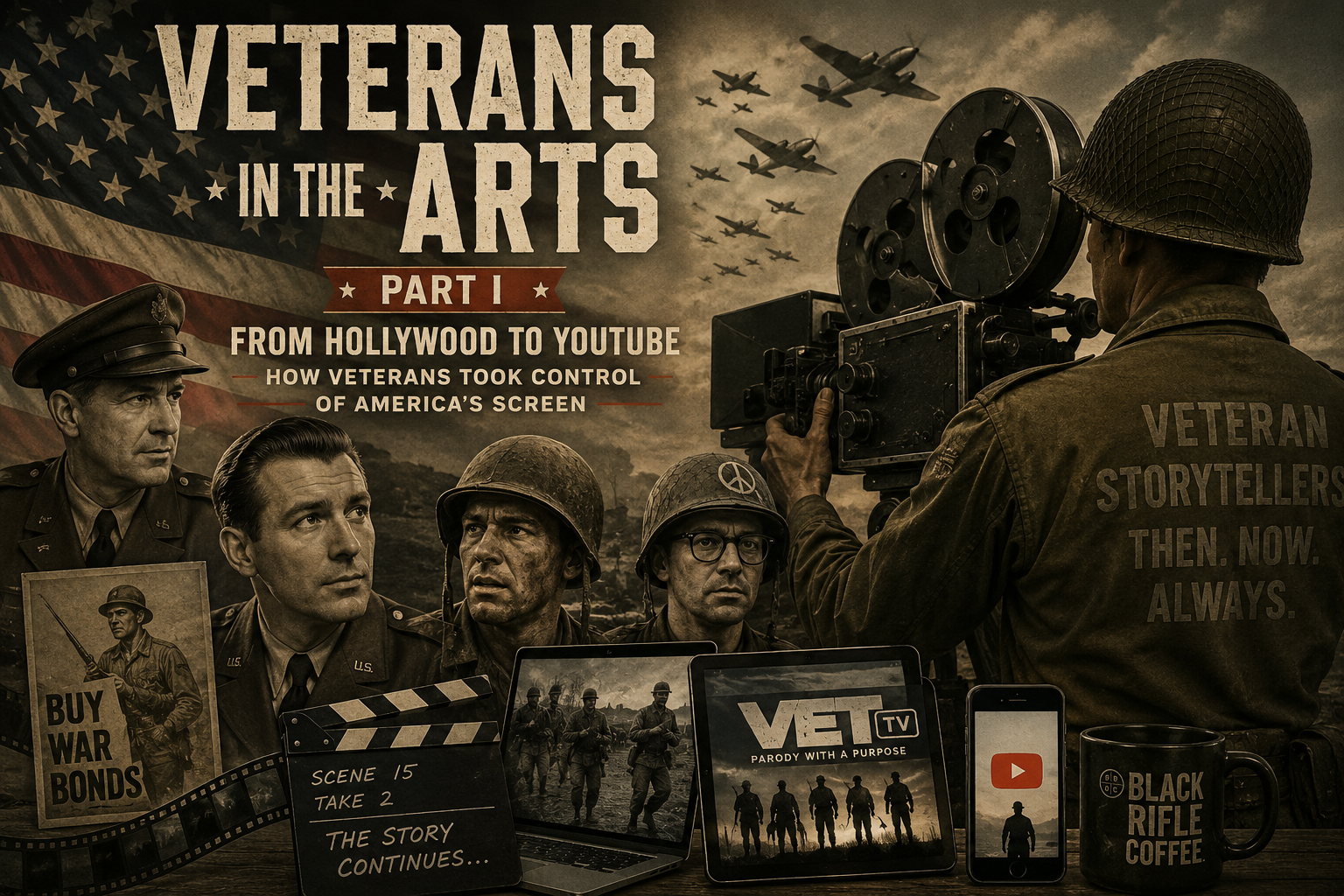
When most Americans think about veterans in entertainment, they picture war movies.
Saving Private Ryan.
Apocalypse Now.
Black Hawk Down.
Perhaps a military adviser making sure a uniform is worn correctly or a former special operator consulting on tactics for the latest action film.
Those contributions are important, but they only scratch the surface of the veteran influence on American entertainment.
For more than eighty years, veterans have fundamentally changed how films are made, how television tells stories and, more recently, how independent creators build entire entertainment companies without asking Hollywood for permission.
Some returned from war to become Academy Award-winning actors.
Others reinvented the war movie itself.
Some rejected the studio system altogether, building successful films through crowdfunding and online communities.
Today's veterans are creating streaming platforms, YouTube channels, podcasts and independent studios that reach millions of viewers while telling stories in their own voice.
The journey from Jimmy Stewart to YouTube may seem unlikely.
In reality, it is one continuous story.
It is the story of veterans taking ownership of their own narratives.
Film: From Uniformed Stars To Combat Realism
The veteran influence on film has operated both in front of and behind the camera.
For much of Hollywood history, military service was common among actors, directors, writers and technical crews. During World War II, major studios contributed to the war effort, performers enlisted or were drafted, and filmmakers produced training films, documentaries and propaganda.
When those veterans returned, they brought direct experience into an industry that would shape the public memory of war.
The World War II Generation of Actors
Jimmy Stewart was already a major Hollywood star when he entered the Army Air Forces. He became a bomber pilot, flew combat missions and rose to senior rank in the Air Force Reserve.
His postwar performances often contained a greater emotional intensity than his earlier work. In films such as It’s a Wonderful Life, Stewart could move rapidly between warmth, exhaustion, anger and despair. Although the film is not about military service, its portrait of a man overwhelmed by responsibility and nearly destroyed by forces he cannot control resonated deeply with postwar audiences.
Stewart’s career illustrates an important point: military influence does not always appear through military roles. It can change an actor’s emotional range, physical presence and understanding of pressure.
Other major performers with military backgrounds included Clark Gable, Henry Fonda, Lee Marvin, Charles Bronson, James Earl Jones, Gene Hackman, Steve McQueen and Paul Newman.
Their service histories differed, but together they helped establish a postwar screen presence that valued restraint, toughness and credibility. Many belonged to a generation that did not publicly discuss trauma in contemporary terms. What they carried often appeared indirectly—in pauses, posture, anger, humor and silence.
Lee Marvin’s combat experience as a Marine in the Pacific contributed to the authenticity he brought to violent and morally compromised characters. Charles Bronson, who served in the Army Air Forces, became one of cinema’s defining figures of stoic masculinity. Gene Hackman’s Marine Corps experience preceded a career built around complex authority figures, detectives, soldiers and men whose confidence concealed instability.
Veteran Directors and the Transformation of the War Film
Directors with military experience also changed how war was shown on screen.
John Ford served in the Navy and worked with the Office of Strategic Services, producing wartime documentary material. His film of the Battle of Midway captured real combat and was itself made under fire. Ford’s later films contributed to the visual mythology of the American military and the American West, even when they also questioned the legends they helped create.
William Wyler served in the Army Air Forces and directed wartime documentaries, including The Memphis Belle. He suffered permanent hearing damage during the war. After returning, he directed The Best Years of Our Lives, one of the most important films ever made about veterans returning home.
Released in 1946, the film addressed disability, unemployment, strained marriages, alcohol use and the difficulty of becoming a civilian again. Harold Russell, a real disabled veteran who had lost both hands in a training accident, delivered a performance that prevented the character from becoming a sentimental symbol.
The film was a turning point because it treated the return home as a subject worthy of the same seriousness as the battlefield.
Samuel Fuller, an Army infantry veteran who saw combat in North Africa and Europe, brought a hard, unsentimental style to films such as The Steel Helmet and The Big Red One. His movies often rejected polished heroism. Combat was confusing, dirty, abrupt and sometimes absurd.
Fuller understood that battle is often experienced in fragments. His visual style—close faces, sudden violence and sharp transitions—helped shape later action filmmaking.
Vietnam Veterans Taking Control of the Narrative
The Vietnam War created a prolonged struggle over who had the authority to represent the conflict.
Many early Vietnam films used the war as a backdrop for broader cultural anxiety. Later, filmmakers with direct experience began challenging those representations.
Oliver Stone served in the Army and was wounded in Vietnam. His film Platoon was marketed and received as a corrective to more stylized or politically distant portrayals of the war. The movie placed viewers at the ground level with exhausted infantrymen divided not only by the enemy but by moral conflict within their own unit.
Stone’s influence extended beyond battlefield realism. In films such as Born on the Fourth of July, he examined disability, patriotism, protest and the transformation of a wounded veteran’s political identity.
The larger turning point was not simply that veterans made war films. It was that they contested national memory.
Vietnam veterans argued through film that service did not require silence, that patriotism could include criticism and that the veteran experience could not be reduced to either heroic worship or social pathology.
The Post-9/11 Screen Veteran
Post-9/11 veterans entered entertainment during an era of highly technical filmmaking and constant military media coverage.
Some became military advisers, stunt performers, screenwriters or independent filmmakers. Others moved into mainstream acting without making their service the central feature of their public identity.
Adam Driver is one of the most prominent examples. Driver enlisted in the Marine Corps after the September 11 attacks and later received a medical discharge following an injury. He studied acting at Juilliard and became an internationally recognized performer through Girls, the Star Wars films, Marriage Story, BlacKkKlansman, Paterson and other projects.
Driver has spoken about the unexpected similarities between military units and theater ensembles: both require discipline, trust, preparation and commitment to a group objective.
He also founded Arts in the Armed Forces, an organization that brought high-quality theatrical performances to military audiences. The project challenged the assumption that service members only want military-themed entertainment. Its underlying philosophy was that troops deserved access to challenging art precisely because they were complete human beings, not a market category.
Driver’s career represents an important evolution. He is not known primarily for portraying soldiers. His military background informs his work ethic and perspective without restricting his artistic range.
That may be one of the most promising developments for veterans in entertainment: the opportunity to participate without being confined to military characters.
Television: Who Gets To Define The Veteran?
Television has had an unusually powerful role in shaping civilian perceptions of veterans because its characters enter viewers’ homes over long periods.
For decades, television veterans often fit a small number of categories: the stable authority figure, the damaged drifter, the action hero, the homeless veteran or the dangerous man unable to leave the war behind.
Some of those portrayals reflected real struggles. The problem was repetition. When the same limited images appeared again and again, they began to function as a substitute for the full diversity of veteran life.
The Veteran as National Authority
Early television frequently treated military experience as evidence of character. Veteran performers and hosts carried an assumed credibility rooted in wartime service.
Actors including James Arness, Eddie Albert, Bea Arthur and Leonard Nimoy served before becoming television fixtures. Their military backgrounds were not always central to their roles, yet they belonged to a period when service was common enough that it did not require elaborate explanation.
James Arness, an Army veteran wounded at Anzio during World War II, became one of television’s most recognizable figures through Gunsmoke. His physical presence and restrained performance helped define the television lawman for a generation.
Bea Arthur served in the Marine Corps Women’s Reserve before becoming known for Maude and The Golden Girls. Her career is a reminder that women veterans have long shaped entertainment, even when their service was omitted from simplified popular histories.
Vietnam and the Troubled-Veteran Template
Vietnam-era television helped popularize the veteran as an outsider carrying unresolved war experiences.
Characters in action programs, crime dramas and made-for-television movies were often haunted, volatile or estranged. These portrayals opened space to discuss post-traumatic stress before the public fully understood it, but they also created a durable stereotype: the veteran as a human time bomb.
The image remains difficult to escape.
Modern programs have improved when veterans are allowed to be funny, ambitious, selfish, loving, competent, ordinary or contradictory—rather than existing solely to represent trauma.
Military Television Becomes More Complex
Series such as MASH used an earlier war to comment on a contemporary one. Set during Korea but broadcast during and after Vietnam, the program combined comedy, grief, institutional satire and moral exhaustion.
Its turning point was tonal.
The show demonstrated that a military story could be funny without treating war as harmless. Humor became a survival mechanism. The characters joked because the alternative was emotional collapse.
Later programs, including China Beach, brought nurses and women’s wartime experiences closer to the center of the narrative. Band of Brothers, The Pacific and later military miniseries used extensive historical research and veteran testimony to combine individual storytelling with broader operational history.
Post-9/11 series have addressed special operations, military families, intelligence work, disability and reintegration with varying degrees of realism. Yet the most significant development may be happening off-screen as veterans become writers, consultants, directors and producers.
When veterans are only advisers on uniforms and tactics, they improve technical accuracy. When they are involved in story development, they can influence which stories are told in the first place.
That is a much greater form of representation.
Adam Driver’s forthcoming Netflix series Rabbit, Rabbit will place the Marine veteran in a hostage drama alongside Regina Hall, Odessa Young and Will Poulter. Netflix announced the project in 2026 as part of its upcoming dramatic slate. The role is another example of Driver moving through mainstream entertainment without being limited to military narratives.
The future of veterans in television will likely depend less on achieving perfect portrayals and more on creating room for many portrayals. No single series can represent millions of people. A healthy culture needs enough veteran characters and veteran creators that one fictional figure is no longer expected to carry the weight of an entire community.
Independent Veteran Film And Television: Taking Control Of The Camera
For generations, veterans seeking work in film and television generally had to enter an industry controlled by civilian studios, producers and network executives. Even when military advisers were present, veterans rarely controlled the final script, tone or creative direction.
The expansion of affordable digital cameras, crowdfunding, online distribution and subscription streaming changed that arrangement.
Veterans no longer had to wait for Hollywood to approve their stories. They could finance productions directly, recruit performers from within the military community and reach an audience already familiar with their language and experiences.
Few projects demonstrated that change more clearly than the 2016 zombie comedy Range 15.
Range 15 and the Veteran-Made Cult Film
Range 15 grew from a collaboration between Ranger Up and Article 15 Clothing, two veteran-run lifestyle companies that had already developed large online audiences through military humor, apparel and social-media videos.
Ranger Up founder and Army veteran Nick Palmisciano joined forces with Mat Best, Jarred Taylor, Ross Patterson, Jack Mandaville, Vincent “Rocco” Vargas and other figures from the emerging veteran-media world. Rather than asking a major studio to create a sanitized military comedy, the group used crowdfunding and its existing audience to build the project independently.
The crowdfunding campaign initially sought $325,000, in addition to money committed by the participating companies. The completed production ultimately had a reported budget of approximately $1.5 million and reached hundreds of theaters during its 2016 release.
The plot was deliberately outrageous. A group of badly behaved veterans awakens after a night of drinking to discover that a zombie apocalypse has begun. The survivors then stumble through a violent, profane and intentionally offensive mission to save what remains of the country.
The film included Medal of Honor recipients Leroy Petry and Clinton Romesha, Navy veteran and Lone Survivor author Marcus Luttrell, Special Forces veteran Tim Kennedy, Marine veteran and military-film adviser Dale Dye, and veteran entrepreneurs Evan Hafer, Mat Best, Jarred Taylor and Nick Palmisciano. Established performers including William Shatner, Danny Trejo, Keith David and Sean Astin also appeared.
The result was not designed for every veteran, and it made little effort to translate its humor for audiences unfamiliar with military culture. That exclusivity was part of the point.
Military comedy created by traditional studios often explains its jokes to civilian viewers. Range 15 reversed that relationship. Veterans were the assumed audience, while civilians were invited to keep up.
Its humor came from barracks conversations, tactical stereotypes, interservice rivalry, drinking culture, bad decisions and the kind of deliberate offensiveness often used within military groups to release tension. The filmmakers were not attempting to create a dignified public-relations portrait of former service members. They portrayed veterans as crude, reckless, loyal, capable and deeply imperfect.
That was a significant artistic choice.
Veterans had long objected to being depicted only as flawless heroes, damaged victims or unstable threats. Range 15 presented another possibility: veterans as comic antiheroes who could be ridiculous without surrendering their competence or loyalty.
The film won the GI Choice Film Award at the 2016 GI Film Festival and developed a cult following within the military community. Its journey was later documented in Not a War Story, a behind-the-scenes film examining how the veteran team created and distributed the production outside the conventional studio system.
The cultural importance of Range 15 was larger than its critical reception or box-office performance. It demonstrated that the military community had become large and connected enough to support its own entertainment.
Veterans were no longer merely providing stories for Hollywood. They could become the writers, actors, producers, marketers, financiers and initial audience.
VetTV and “Parody with a Purpose”
The development of Veteran Entertainment Television—better known as VetTV—took that idea further by creating an entire streaming service around veteran-produced entertainment.
Founded by Marine veteran Donny O’Malley, VetTV emerged as an online network producing original military comedies, series, films and sketches. The platform describes its mission as creating humor “for veterans, by veterans” and calls its approach “Parody with a Purpose.” It has developed more than 40 military-oriented shows and hundreds of hours of programming.
VetTV’s productions frequently explore subjects that mainstream military programs avoid: incompetent leadership, administrative punishment, boredom, barracks life, reckless junior enlisted behavior, awkward medical examinations, toxic commands, deployment relationships and the enormous gap between recruiting advertisements and daily military reality.
The network’s comedy is intentionally unfiltered. It is often profane, sexually explicit and politically incorrect. That style does not represent every veteran, but it reflects a form of humor recognizable across much of the military community.
Service members frequently use humor to discuss subjects that would otherwise be difficult to approach directly. Fear, death, institutional frustration, loneliness and anger can become jokes long before they become formal conversations.
VetTV built its identity around that reality. Its programming gives veterans permission to laugh at experiences the civilian world may view only through reverence or tragedy.
That does not mean the comedy is without purpose. By exaggerating military dysfunction, VetTV can expose failures of leadership, bureaucracy and culture. A sketch about an absurd command decision may be entertaining, but it can also communicate how powerless junior personnel sometimes feel inside a rigid hierarchy.
This is part of a much older artistic tradition.
Joseph Heller used absurdity to attack military bureaucracy in Catch-22. MASH used comedy to expose the emotional contradictions of war. VetTV applies similar tools to the language and experiences of the post-9/11 force, although with the freedom and lack of restraint made possible by subscription streaming.
The platform also allows veteran performers, writers and production workers to gain industry experience without first persuading civilian executives that military audiences exist.
That infrastructure may prove to be VetTV’s most lasting contribution. A sustainable veteran entertainment industry requires more than recognizable actors. It needs camera operators, editors, costume designers, writers, directors, sound technicians, production managers and business professionals.
VetTV helps create a place where those skills can develop.
From Technical Accuracy to Creative Authority
Independent veteran film and television represent a major shift from consultation to ownership.
For decades, Hollywood often called veterans when it needed someone to correct a uniform, demonstrate how to hold a weapon or explain military terminology. Those contributions improved realism, but they did not necessarily give veterans authority over character development or meaning.
Veteran-led production changes the question.
Instead of asking, “Does this uniform look correct?” the creators can ask, “Is this a story the veteran community recognizes?”
Technical accuracy remains important, but emotional accuracy matters more. A perfectly arranged ribbon rack cannot rescue a character who speaks and behaves like a civilian stereotype of a service member.
Independent creators are able to portray the details that rarely appear in conventional war dramas: waiting for transportation, cleaning already-clean spaces, navigating contradictory orders, inventing ways to avoid unnecessary work, forming intense friendships and laughing at situations that outsiders might consider inappropriate.
These details help restore the full humanity of military life.
The expansion of veteran filmmaking also means military stories are no longer limited to combat. Independent productions can explore veterans in business, politics, family life, law enforcement, comedy, horror and science fiction. They can address service directly or treat it as one element of a larger character.
Crowdfunding and digital distribution remain difficult and financially uncertain. Independent filmmakers must still find audiences, maintain production quality and compete with enormous amounts of online content. Veteran-led projects can also become trapped by their own success if audiences expect creators to repeatedly produce the same familiar jokes or stereotypes.
Nevertheless, Range 15, VetTV and similar projects proved that veterans do not need to depend entirely on established studios to enter entertainment.
They can build their own studios, platforms and audiences.
From The Barracks To Youtube: The Rise Of Veteran Sketch Comedy
Before veteran creators began producing feature films and subscription television, many built their audiences through short internet videos.
YouTube arrived at an ideal moment for the post-9/11 veteran generation. Millions of veterans were returning from Iraq and Afghanistan while social-media platforms were lowering the cost of video distribution. A sketch that once would have required a television network could now be filmed with friends and delivered directly to military viewers.
The early production quality was sometimes rough. The humor was not.
Veteran creators understood their audience because they had lived beside it. They knew the personalities found in every unit, the language troops used when leaders were absent and the difference between the official version of military life and what happened after duty hours.
The result was the emergence of a distinct veteran internet comedy scene.
Ranger Up and the Birth of a Digital Veteran Voice
Ranger Up began as a veteran-owned apparel company founded by Army veteran Nick Palmisciano, but its influence extended far beyond shirts and merchandise.
The company used essays, cartoons, sketches and videos to build a recognizable veteran voice online. Its content combined military pride with relentless criticism of weak leadership, public misconceptions and the veteran community’s own bad habits.
Ranger Up’s videos frequently relied on shared experience rather than elaborate explanation. The jokes assumed viewers understood military acronyms, unit stereotypes, physical training, deployment culture and the strange logic of government bureaucracy.
That approach helped create a digital gathering place for veterans who felt disconnected from conventional veterans’ organizations or polished military public affairs.
The importance of Ranger Up was not that every veteran agreed with its tone or politics. It was that the company demonstrated how a veteran brand could become a media organization.
Its audience was not simply purchasing clothing. It was participating in a shared culture.
Ranger Up later used that audience and production experience to help create Range 15, moving from short online comedy into independent feature filmmaking.
Mat Best and the Military Sketch as a Music Video
Former Army Ranger Mat Best became one of the most recognizable figures in veteran internet comedy.
Best served with the 2nd Ranger Battalion, 75th Ranger Regiment, before entering the worlds of online entertainment and veteran entrepreneurship. His early YouTube work combined sketch comedy, firearms culture, exaggerated masculinity, military stereotypes and music-video parody.
Videos such as “How to Be an Operator” mocked the growing mythology surrounding special operations. Instead of attacking that culture from the outside, Best exaggerated it from within. Beards, tactical equipment, weapons, coffee and hyperaggressive confidence became props in a performance that was both a celebration and a parody.
That dual quality helped the videos connect with veterans.
The audience could admire the competence associated with elite military units while also recognizing the absurdity of people who attempted to build their entire personalities around tactical imagery.
Best’s musical sketches expanded that style. Songs and videos such as “Bitch I Operate” converted military inside jokes into highly produced comedy. The song even appeared on a Billboard chart, illustrating how veteran internet content could cross into mainstream entertainment.
The production values gradually increased, but the essential formula remained direct: veterans creating entertainment in their own language for an audience that understood the references.
Best’s career eventually expanded into acting, writing, business and the co-founding of Black Rifle Coffee Company. Yet his YouTube work was foundational because it showed that a veteran could build a major media identity without first receiving permission from Hollywood.
Jarred Taylor and the Creation of a Veteran Comedy Ensemble
Air Force veteran Jarred Taylor—widely known as JT—became another major figure in the development of veteran digital entertainment.
Taylor served for approximately 11 years, including work as a Tactical Air Control Party specialist. He met Mat Best while still serving, and the two began creating comedy content together while Best was between overseas contracting assignments.
Taylor brought a different style of performance to the emerging group. His exaggerated confidence, musical ability, willingness to become the target of a joke and instinct for improvisation helped turn individual videos into ensemble comedy.
That ensemble approach became critical.
Military humor rarely belongs to one person standing alone. It develops through groups interrupting, insulting and escalating one another’s stories. Best, Taylor, Palmisciano, Ross Patterson, Vincent Vargas, Jack Mandaville and their collaborators brought that rhythm into online video.
The performers developed recognizable personas, running jokes and a shared fictional world. Audiences followed them across company channels, personal pages, podcasts, music videos and eventually feature films.
Taylor’s work with Article 15 Clothing, Range 15, Black Rifle Coffee Company and the Drinkin’ Bros podcast demonstrated how internet comedy could become the center of a larger veteran-media ecosystem. His official channel continues to identify comedy production as a major part of his work.
Black Rifle Coffee Company as a Media Operation
Black Rifle Coffee Company was founded as a coffee business, but its growth was inseparable from digital media.
Army Special Forces veteran Evan Hafer founded the company, while Mat Best and Jarred Taylor became prominent co-founders and creative figures. BRCC’s official history identifies Best as a co-founder and chief creative officer and Taylor as a co-founder.
Rather than relying primarily on conventional coffee advertisements, the company produced sketches, action parodies, music videos, podcasts, documentaries and personality-driven content.
The coffee was often present, but the videos sold something larger: membership in a veteran-centered cultural community.
Black Rifle’s productions blended military humor, firearms, outdoor culture, entrepreneurship and tributes to service members. Some videos were intentionally ridiculous. Others dealt seriously with sacrifice, military families and fallen troops.
That range was important. Veteran digital media could move from comedy to remembrance without treating the two as incompatible.
Military communities have always laughed beside grief. The people making jokes in the barracks may be the same people standing silently at a memorial formation the next morning.
A 2021 music video featuring Best, Taylor and their collaborators honored fallen warriors, while a 2026 Black Rifle production titled “Folded Flag” was connected to a $150,000 contribution supporting the Major Brent Taylor Foundation and Gold Star families.
BRCC also developed podcast and long-form interview content featuring veterans, military figures, entrepreneurs and public personalities. Its podcast channel describes its programming as a combination of company stories and conversations from the veteran and military communities.
This made Black Rifle more than an advertiser that occasionally produced funny videos. It became a media company attached to a consumer brand.
That model has influenced numerous veteran-owned businesses. Companies learned that they could build audiences by creating entertainment before asking viewers to buy anything.
A New Kind of Veteran Representation
The veteran YouTube movement created a version of military representation that traditional entertainment had largely missed.
Mainstream films often focused on combat, trauma or heroic sacrifice. Internet sketches focused on the person who took physical training too seriously, the officer who could not read the room, the veteran who turned every conversation into a deployment story and the specialist who somehow avoided every unpleasant assignment.
These characters were exaggerated, but they were recognizable.
They allowed veterans to laugh at themselves rather than merely criticize civilian misunderstandings. Every branch, rank and specialty became a potential target.
The comedy also challenged the stereotype that veterans were emotionally fragile figures who had to be approached with constant solemnity. Veteran performers could be crude, vain, foolish, theatrical and completely ordinary.
At the same time, online veteran comedy created complications.
The humor was often designed for a military audience accustomed to insults, dark subjects and few boundaries. When videos reached larger civilian audiences, jokes could lose the context that made them understandable within the original community.
The scene also overlapped with political commentary, firearms culture and commercial branding. Viewers who enjoyed the comedy did not necessarily agree with every political message or company associated with it.
No creator or brand can represent the entire veteran community.
Ranger Up, Mat Best, Jarred Taylor and Black Rifle Coffee helped create one influential version of the post-9/11 veteran voice—irreverent, entrepreneurial, highly online and suspicious of polished institutional messaging. Other veterans built different voices through poetry, drama, documentary film, visual art and quieter forms of comedy.
The importance of the YouTube movement is therefore not that it spoke for all veterans.
It proved that veterans could speak directly to one another at scale.
From Online Sketches to a Veteran Entertainment Industry
The path from early YouTube videos to Range 15, VetTV, podcasts and professional media companies reveals how a creative industry can grow from a community.
A short sketch attracts an audience. That audience supports merchandise and sponsors. The revenue finances better equipment and larger productions. Performers develop experience, collaborators form networks, and independent creators gain enough support to produce films or streaming series.
That progression changed what appeared possible for veterans entering the arts.
The person writing comedy in a barracks room could become a screenwriter. The service member filming jokes with friends could become a director or producer. A small veteran clothing company could develop an audience capable of financing a nationally distributed film.
This digital movement also helped veterans build public identities that were not based entirely on trauma or government assistance.
They became creators, entertainers and business owners.
The next generation will inherit a much larger toolkit. Veterans now have access to inexpensive cinema-quality cameras, remote production software, streaming services, podcasts, direct subscriptions and social platforms capable of reaching millions.
The challenge will be maintaining authenticity while expanding beyond the original audience.
Veteran comedy must be free to evolve. Its creators should not be forced to repeat the same jokes about tactical beards, energy drinks, junior enlisted irresponsibility or interservice rivalry forever.
The movement’s future may include veteran-created animation, narrative podcasts, dramatic internet series, feature films and comedies that have no obvious connection to military life.
The greatest achievement of the early veteran YouTube creators was not establishing a single style.
It was opening the door.
The Future of Veteran Entertainment
The path from Jimmy Stewart to YouTube tells a remarkable story.
The Greatest Generation transformed Hollywood.
Vietnam veterans challenged America's understanding of war.
Post-9/11 veterans entered mainstream entertainment while simultaneously building an entirely new ecosystem of independent film, streaming platforms, podcasts and digital media.
Today's veterans no longer wait for permission to tell their stories.
They write their own scripts.
Raise their own funding.
Build their own audiences.
Launch their own studios.
The next generation of veteran creators will likely produce feature films, streaming series, documentaries, animation, podcasts and digital entertainment that extends far beyond military themes.
That may be the movement's greatest achievement.
Veterans are no longer confined to telling war stories.
They are simply telling great stories.
And increasingly, the rest of America is listening.