
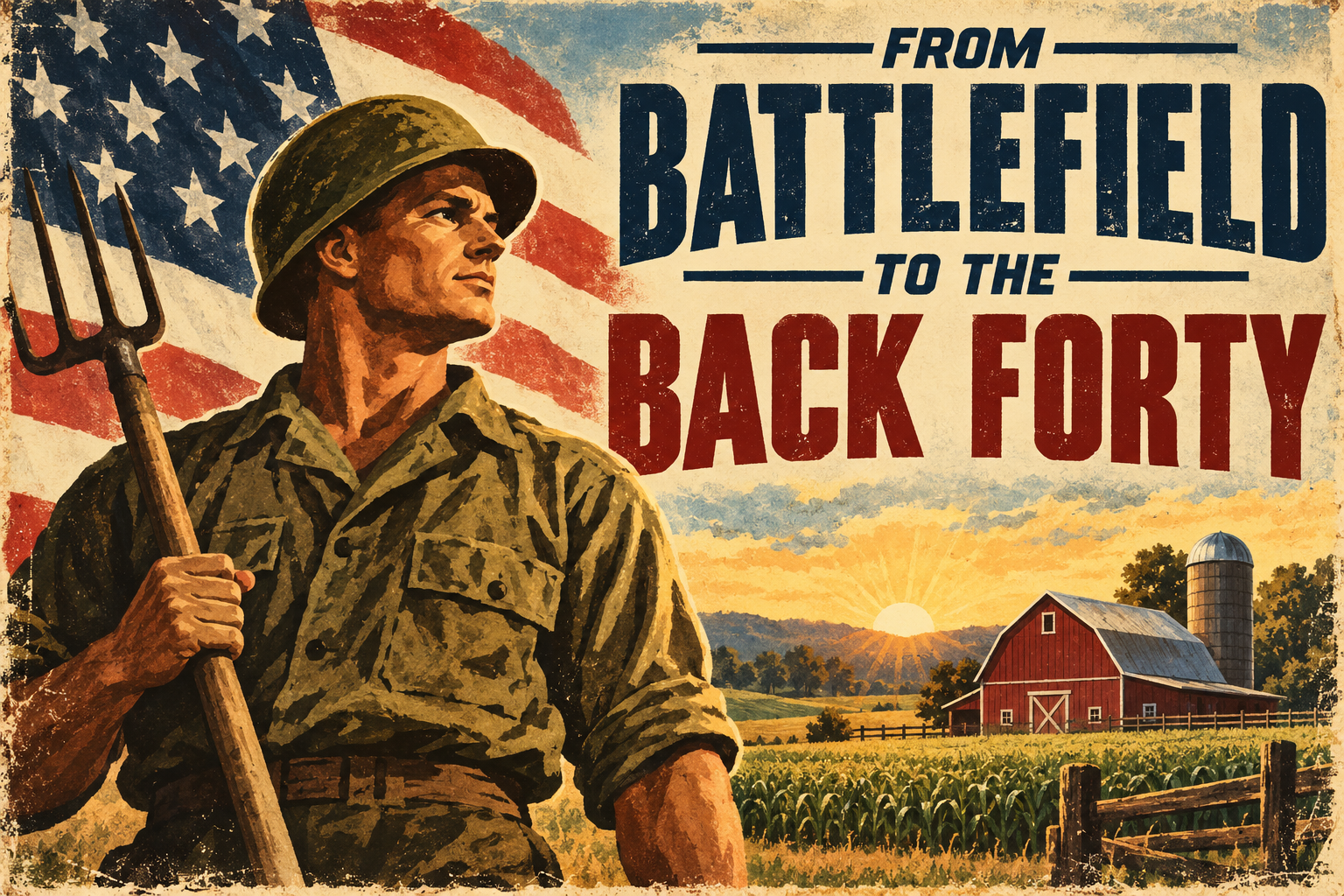
For generations, leaving military service often meant returning to the land.
Following World War II, millions of American veterans returned home looking for something remarkably similar to what today's veterans seek: a stable livelihood, independence, a place to raise a family and a new mission after military service.
For some, that mission was agriculture.
Today, farming is once again emerging as an attractive second career for veterans. It can offer independence, tangible work, entrepreneurship, connection to the land and the satisfaction of producing something essential. Agriculture also needs new people. America's farms are businesses, and entering the industry requires considerably more than buying a tractor and planting a field.
Fortunately, veterans interested in agriculture don't have to figure it out alone.
The federal government, universities, nonprofits, veteran organizations and agricultural groups operate programs that can help veterans learn farming, develop business plans, obtain financing, acquire equipment, improve land, manage risk and, in some circumstances, find a path onto farmland itself.
The key is knowing where to look—and understanding what these programs actually provide.
Why Farming Appeals to Veterans
There are some obvious parallels between military service and agriculture.
Both involve early mornings, long days, unpredictable conditions and work that frequently must be completed regardless of whether you are tired, cold, hot, wet or simply having a bad day.
More importantly, both provide something many veterans miss after leaving the military: a mission.
A farmer wakes up knowing exactly why the work matters. Animals need feeding. Crops need tending. Equipment needs maintaining. Customers need products. Families and communities need food.
There is also autonomy.
After years of operating inside one of the world's largest bureaucracies, the idea of owning a piece of land and building something yourself can be extremely attractive.
Veterans may also bring useful skills into agriculture: logistics, equipment maintenance, planning, leadership, problem solving, risk management, operating under pressure and the ability to learn complicated systems.
But military experience should not be confused with agricultural experience.
Farming can punish overconfidence quickly.
And that makes education the first investment a prospective farmer should make.
Before Buying the Farm: Do Your Reconnaissance
The worst possible introduction to farming may be purchasing an expensive property, financing equipment and then attempting to figure out what to grow afterward.
A prospective farmer should approach agriculture the same way a military planner approaches an operation.
Start with intelligence.
Before purchasing land, determine what your farm will produce, who will buy it and whether the numbers work.
That means researching questions such as: What agricultural products are profitable in your area?
Growing soybeans on 20 acres is an entirely different economic proposition from operating a 20-acre vegetable farm.
Likewise, cattle, poultry, hay, grain, orchards, vineyards, maple syrup, mushrooms, flowers, Christmas trees, honey and greenhouse production all have radically different infrastructure, labor and capital requirements.
Then investigate your market.
Who will buy what you produce?
Possible markets include wholesalers, grocery stores, restaurants, farmers markets, farm stands, Community Supported Agriculture programs, online customers, processors and direct-to-consumer meat sales.
A beautiful farm producing something nobody nearby wants to purchase is still a failing business.
Veterans should also investigate zoning, water availability, soil quality, drainage, property taxes, agricultural exemptions, environmental restrictions, building codes, slaughter and processing availability, transportation, insurance and local regulations before committing to property.
Even the location of the nearest equipment dealer matters.
When a tractor breaks during hay season, discovering that the nearest dealer is 90 miles away becomes surprisingly important.
Farming Is a Business Before It Is a Lifestyle
This distinction may save prospective farmers enormous amounts of money.
There is a romantic image of farming: sunrise over a field, an old barn, cattle grazing behind the house and a tractor moving across the horizon.
There is another side.
Fuel. Insurance. Feed. Seed. Fertilizer. Veterinary bills. Equipment repairs. Property taxes. Labor. Loan payments. Fencing. Electricity. Transportation. Processing. Marketing.
And weather that does not particularly care about your business plan.
A veteran considering farming should build realistic financial projections before making major purchases.
Calculate startup costs, annual operating expenses, expected production, conservative selling prices, debt service and household living expenses.
Then ask an uncomfortable question: How long can the operation survive if revenue is significantly lower than expected?
Agriculture regularly encounters droughts, floods, disease, pests, commodity-price swings and equipment failures.
Planning for the bad year—not merely the good year—is essential.
The Farmer Veteran Coalition specifically encourages veterans considering financing to determine whether they have sufficient training, a detailed business plan, a realistic budget, a clear understanding of how borrowed money will be used and personal finances stable enough to tolerate the risk.
That is excellent advice.
Don't Quit Your Day Job Too Quickly
One of the smartest ways to enter agriculture may be gradually.
A veteran doesn't necessarily need 500 acres and a $200,000 tractor.
Depending on the enterprise, agriculture can begin with rented land, leased equipment, a greenhouse, a small livestock herd, bees, poultry, mushrooms, vegetables or another specialty product.
Some veterans may maintain full-time employment while developing the farm.
Others may work for an established farmer first.
That approach has a major advantage: Someone else pays for your mistakes.
Learning why a crop failed while working for another operation is education.
Learning the same lesson after borrowing $300,000 is considerably more expensive.
Your First Stop: USDA
One of the most important resources for any prospective veteran farmer is the U.S. Department of Agriculture.
USDA maintains a dedicated Military Veteran Farmers resource center through Farmers.gov.
Veterans can potentially access programs involving farm loans, conservation assistance, disaster recovery and risk management. USDA also recognizes certain "veteran farmer or rancher" classifications that can provide special provisions within some programs.
There is an important detail here.
Not everyone who served automatically receives every veteran-farmer preference indefinitely.
For FSA and NRCS purposes, USDA states that qualifying veteran producers generally must have operated a farm or ranch for fewer than 10 years or first obtained veteran status within the most recent 10-year period, along with the applicable discharge and program requirements.
The best move is simple: Visit your local USDA Service Center before spending serious money.
Explain that you are a veteran interested in becoming a beginning farmer.
Ask to speak with both the Farm Service Agency and Natural Resources Conservation Service.
Those conversations can uncover programs you didn't know existed.
The Biggest Misconception: “USDA Will Give Me a Grant to Start a Farm”
This needs clarification.
There generally isn't a giant federal check waiting for a veteran who decides to purchase a farm.
The Farmer Veteran Coalition explicitly warns prospective farmers that there are not general USDA grants simply available to start a new farm. Instead, the funding landscape includes loans, conservation cost-sharing, specialized grants, nonprofit programs and other assistance.
That distinction matters.
There are grants connected to agriculture.
There are also cost-share programs that may pay substantial portions of qualifying improvements.
But purchasing 100 acres, a farmhouse, tractor and cattle entirely with grant money is not a realistic business strategy.
Instead, think of agricultural financing as a toolbox.
Different programs solve different problems.
USDA Farm Service Agency Loans
The Farm Service Agency may be one of the most valuable tools available to a beginning veteran farmer.
FSA provides direct and guaranteed farm ownership and operating loans. Funds can potentially be used for land, livestock, equipment, feed, seed, supplies, buildings and farm improvements. FSA programs are particularly important for farmers who cannot obtain adequate conventional commercial financing.
Beginning farmers receive additional consideration within the system.
USDA generally defines a beginning farmer for these programs as someone who has operated a farm for no more than 10 years and meets additional ownership and program requirements.
Farm Ownership Loans
These can help finance agricultural real estate and associated capital needs.
For someone whose biggest obstacle is obtaining land, this should be one of the first programs investigated.
Farm Operating Loans
These address the costs of actually running an agricultural operation.
Depending on the loan and eligibility, that can include livestock, equipment, feed, seed, supplies and other operating expenses.
Microloans
This program can be especially interesting for veterans beginning on a smaller scale.
FSA Operating Microloans can provide up to $50,000 and can potentially finance livestock, equipment, feed, seed, supplies, minor improvements, marketing and certain operating costs.
Ownership Microloans can also provide up to $50,000 toward farmland and qualifying farm buildings or infrastructure.
For someone starting a market garden, beekeeping operation, small livestock operation or specialty farm, that can be far more appropriate than immediately taking on massive debt.
Getting Access to Land: USDA's Transition Incentives Program
Land is one of the largest barriers confronting beginning farmers.
USDA's Transition Incentives Program, or TIP, attempts to address part of that problem.
TIP encourages owners of expiring Conservation Reserve Program land to transition that acreage to beginning or veteran farmers and ranchers for sustainable grazing or crop production.
The landowner may receive up to two additional annual rental payments for qualifying transitions.
In other words, USDA creates an incentive for an established landholder to give a new producer an opportunity.
The FY2026 TIP enrollment period has already closed because of application volume, illustrating why veterans interested in these programs should begin talking to USDA well before they need the land.
Watch future enrollment periods.
Don't Automatically Buy Land
Ownership is not the only path into farming.
Leasing can dramatically reduce startup costs.
A beginning farmer might lease pasture, crop acreage, barns or an existing agricultural operation.
Creative arrangements include cash leases, crop-share leases, livestock-share agreements and lease-to-own arrangements.
This allows the farmer to preserve capital for things that actually generate revenue.
Imagine having $100,000 available.
Putting the entire amount into a land down payment leaves nothing for livestock, fencing, seed, irrigation, equipment or operating expenses.
Leasing land and deploying capital toward production may sometimes create a stronger business.
Land ownership can come later.
NRCS: One of Agriculture's Most Overlooked Resources
A new farmer should become familiar with USDA's Natural Resources Conservation Service.
NRCS provides technical and financial assistance for conservation improvements through programs such as the Environmental Quality Incentives Program—EQIP.
EQIP can support qualifying conservation practices involving soil, water, grazing, livestock systems and other resource concerns.
This becomes particularly valuable because historically underserved producers—including qualifying beginning and veteran farmers—may receive higher payment rates and may request advance payments for approved practices.
NRCS states that the EQIP advance option can provide at least 50 percent of the contracted payment upfront for qualifying practices, helping producers purchase materials or services before completing the work.
That can make a substantial difference when building farm infrastructure.
Think: fencing, water systems, grazing infrastructure, erosion control, soil-health improvements, high tunnels, habitat improvements, and other qualifying conservation projects.
The exact practices and payment amounts vary by state and program year, so farmers should work directly with their local NRCS office rather than assuming a particular project will be covered.
The Farmer Veteran Coalition
If USDA should be one of your first government stops, the Farmer Veteran Coalition should be one of your first nonprofit stops.
The organization focuses specifically on helping veterans and currently serving military personnel enter agriculture.
Its network now includes more than 50,000 members, according to FVC.
One particularly valuable program is the Farmer Veteran Fellowship Fund.
The Fellowship provides assistance generally ranging from $1,000 to $5,000 to veterans in the beginning years of farming and ranching.
Applicants need to understand that this isn't simply free spending money.
FVC describes the program as assistance intended to help advance a farm business through critical equipment or infrastructure. Applications examine farming experience, education, military service, financial and business planning and short- and long-term goals.
That application process itself reinforces an important lesson:
A veteran with a detailed business plan is going to be much more competitive for agricultural assistance than someone with nothing more than "I've always wanted a farm."
Homegrown By Heroes
Farmer Veteran Coalition also administers Homegrown By Heroes.
This national certification allows qualifying veteran farmers, ranchers and fishermen to identify their products as veteran owned and produced.
More than 2,000 producers have reportedly obtained Homegrown By Heroes certification.
That may sound like a small thing.
It isn't.
Agriculture increasingly depends upon branding.
Consumers buying beef, honey, produce, coffee, flowers or other direct-market products often want to know who produced them.
Veteran ownership can become part of the farm's identity.
A veteran-owned farm selling directly to consumers isn't simply selling tomatoes or steaks.
It is selling a story, a relationship and a connection between the consumer and the producer.
Homegrown By Heroes gives that story recognizable branding.
AgVets: Training Veterans for Agriculture
USDA's National Institute of Food and Agriculture operates the Enhancing Agricultural Opportunities for Military Veterans Program, commonly called AgVets.
This program is slightly different from what many veterans may initially assume.
AgVets funding is generally awarded to eligible nonprofit organizations rather than directly to an individual veteran looking to buy a tractor.
Those organizations then create agricultural training opportunities for veterans.
Projects can combine classroom instruction, hands-on agricultural training, workforce preparation and employment skills.
The FY2026 competition had approximately $2.853 million in estimated program funding, with organizational awards ranging from $300,000 to $750,000.
The important takeaway for an individual veteran is therefore: Look for AgVets-funded training programs—not merely an AgVets check.
Armed to Farm
Another program worth investigating is Armed to Farm, operated by the National Center for Appropriate Technology.
The program provides agricultural training and technical assistance to military veterans, particularly those interested in sustainable and organic agriculture.
Training can expose veterans to agricultural production, business planning, marketing and farm-management concepts without requiring them to gamble their savings just to learn the basics.
The National AgrAbility Project identifies Armed to Farm among its principal training resources for veterans entering agriculture.
For someone still asking, "What kind of farming would actually work for me?" programs like this can be enormously valuable.
Use the GI Bill Before Using Your Savings
Veterans should also investigate whether their existing VA education benefits can finance agricultural education.
The GI Bill isn't limited to four-year universities.
VA education benefits can support approved education and job-training programs, and GI Bill benefits can also apply to approved on-the-job training and apprenticeships.
That opens numerous possibilities.
A veteran might pursue agriculture, agribusiness, animal science, horticulture, agricultural mechanics, forestry, precision agriculture, welding, diesel technology or another field that directly supports an agricultural career.
The important word is approved.
Before enrolling, verify the specific program through VA's GI Bill Comparison Tool or the school's certifying official. Program approval is handled through VA and State Approving Agencies.
Do that before paying tuition.
Farming Doesn't Necessarily Mean Owning a Farm
This deserves emphasis.
A veteran interested in agriculture doesn't have to become a landowner immediately—or ever.
Modern agriculture requires equipment technicians, diesel mechanics, agronomists, crop advisers, farm managers, precision-agriculture technicians, drone operators, livestock managers, irrigation specialists, food processors, agricultural sales representatives, foresters, truck drivers, welders, heavy-equipment operators, and agricultural technology specialists.
The Farmer Veteran Coalition specifically notes that agriculture companies need people in areas such as farm management, precision agriculture and technical occupations that can provide an agricultural lifestyle without assuming all of the financial risk of owning a farm.
For some veterans, that may be the smartest entry point.
Work in agriculture. Learn the industry. Build contacts. Save capital. Then decide whether ownership makes sense.
Boots to Business—for Farmers
Veterans also need business education.
The Small Business Administration's Boots to Business program teaches entrepreneurship fundamentals to service members and military spouses through the Transition Assistance Program, while Boots to Business Reboot extends entrepreneurship training into veteran communities.
Even better, USDA and SBA have partnered on versions specifically aimed at farmers and ranchers.
A September 2026 Boots to Business Reboot for Farmers and Ranchers covered market research, agricultural economics, legal business structures, business planning, financing and USDA/SBA resources.
That is exactly the kind of education a prospective farmer should obtain before signing a major loan.
Your Local Cooperative Extension Office May Be One of Your Best Resources
One of the most useful—and frequently overlooked—resources in American agriculture is the Cooperative Extension system.
Land-grant universities across the country provide agricultural education through Extension offices.
Depending upon the state and county, Extension programs can offer education on soil testing, livestock, pasture management, vegetable production, pest management, farm business planning, food safety, forestry, fruit production, beekeeping, marketing, farm taxes, and dozens of other subjects.
These programs can be inexpensive or free.
More importantly, Extension specialists understand local agriculture.
A national website can explain how to grow apples.
Your county Extension agent may know which apple varieties survive your winters, which pests are causing problems locally, what soil amendments are typically needed and where nearby growers sell their crop.
That knowledge is incredibly valuable.
Veteran-Specific University Programs
Some universities have gone further.
Cornell University's Small Farms Program, for example, operates Farm Ops, which provides training, mentoring and resources for veterans interested in agriculture.
National AgrAbility maintains a broader list of veteran-focused agricultural training opportunities, including Farm Ops, Armed to Farm, veteran apprenticeships and other regional programs.
Veterans should search not only nationally but within their own state.
Agriculture varies enormously by region.
The best cattle program in Texas may be irrelevant to someone planning an orchard in New York.
Local knowledge matters.
Beginning Farmer and Rancher Development Programs
USDA's Beginning Farmer and Rancher Development Program, or BFRDP, funds organizations that educate beginning farmers.
Like AgVets, these grants generally go to organizations, universities, Extension systems and partnerships rather than directly to someone wanting to purchase a farm.
But those grants create the courses, workshops and resources new farmers can use.
USDA also supports the Farm Answers clearinghouse, which makes beginning-farmer educational material and training resources available nationally.
This illustrates an important strategy.
Don't search only for: "Veteran farming grants."
Also search for: beginning farmer programs.
A veteran may qualify for assistance under multiple categories simultaneously.
Veterans With Disabilities: AgrAbility
Agriculture can be physically demanding, but a disability does not automatically eliminate farming as a career.
The National AgrAbility Project exists specifically to help farmers, ranchers and agricultural workers with disabilities remain productive.
AgrAbility provides education, technical assistance, consultations, networking and information about adaptive agricultural technology.
Its veteran resources include training opportunities, financial-assistance information, resource guides and agricultural career programs.
Adaptive equipment can make an enormous difference.
AgrAbility's resources address technology such as lifts, equipment adaptations, mobility solutions and other tools designed to allow people with physical limitations to continue working in agriculture.
AgrAbility itself generally does not simply purchase adaptive equipment for individual farmers. Instead, it can help identify solutions and connect producers with potential funding sources, including state vocational rehabilitation programs.
For a disabled veteran considering agriculture, AgrAbility should be contacted early in the planning process.
Don't Forget VA Vocational Programs
Veterans with service-connected disabilities should also investigate whether VA employment and vocational services can support their particular career plan.
Depending upon individual eligibility and circumstances, VA vocational rehabilitation programs may potentially assist with education, training and employment preparation.
AgrAbility specifically recommends that disabled veteran farmers investigate VA vocational rehabilitation resources as well as state vocational rehabilitation agencies when adaptive equipment or occupational assistance is required.
Do not assume eligibility or that VA will purchase a particular piece of equipment.
Talk to a counselor and develop the plan first.
Equipment: Buy, Lease, Rent or Borrow?
One of the easiest ways to destroy a young farm financially is buying equipment because it looks like something a farmer is supposed to own.
A tractor is a tool.
It isn't the objective.
Before purchasing machinery, calculate how many hours per year you will actually use it.
Sometimes purchasing makes sense.
Sometimes leasing does.
Sometimes renting equipment for three days annually is dramatically cheaper.
And sometimes hiring a neighboring farmer to perform a job costs less than owning the equipment necessary to perform it yourself.
Veterans should also investigate equipment-sharing arrangements, local cooperatives, machinery rings and custom agricultural operators.
Spend money on equipment that produces revenue—not equipment that produces impressive photographs.
Think About Infrastructure Before Equipment
For many small operations, infrastructure may provide a greater return than horsepower.
A livestock farmer may benefit more from excellent fencing and a reliable water system than from a larger tractor.
A vegetable farmer might gain more from irrigation, wash-and-pack facilities and a high tunnel.
A direct-market meat operation may desperately need freezer capacity.
A produce farm might need cold storage.
A greenhouse operation needs reliable power and heating.
This is another reason NRCS, Extension and experienced farmers should be involved before major purchases.
Build the system first.
Then buy the equipment the system actually requires.
Crop Insurance and Risk Management
New farmers tend to focus on production.
Experienced farmers think about survival.
USDA's Risk Management Agency administers federal crop-insurance programs, and qualifying veteran farmers may receive special provisions under USDA rules. Farmers.gov directs veterans to RMA resources and private crop-insurance agents for coverage information.
Insurance will not eliminate agricultural risk.
Nothing will.
But catastrophic weather or crop losses can turn one difficult year into bankruptcy.
A farmer should understand available insurance and disaster programs before the disaster occurs.
Farming Is Bigger Than Crops and Cattle
Veterans should also broaden their definition of agriculture.
A profitable agricultural business might involve beekeeping, mushrooms, flowers, greenhouses, nursery plants, Christmas trees, maple syrup, berries, orchards, agritourism, farm stays, hunting leases, timber, specialty livestock, poultry, eggs, farm-to-table products, food processing, or value-added products.
A small farm selling premium products directly to consumers can sometimes generate more revenue per acre than conventional commodity agriculture.
But higher-value agriculture usually requires something else: marketing.
You are no longer merely a farmer.
You are a salesperson, accountant, mechanic, logistics manager, purchasing officer, social-media manager, customer-service representative and CEO.
Military veterans may recognize that situation.
"Additional duties as assigned."
Questions Every Veteran Should Answer Before Starting a Farm
Mission
What exactly am I producing, who is buying it, and how much will they pay?
Capital
What are my startup and annual operating costs, and how much working capital will I need?
Land & Equipment
Do I need to own land and machinery, or can I lease, rent, share or hire custom work?
Risk
What happens during a bad production year, and what insurance or disaster assistance is available?
Before committing significant money, veterans should also answer: How much can the land realistically produce? How will the household be supported while the farm grows? What USDA and state programs apply? What markets and processing infrastructure are nearby? What licenses or permits are required? What skills are missing, and who can teach them?
If several answers are "I don't know," that isn't necessarily a reason to abandon the idea.
It means you aren't ready to buy the farm yet.
A Veteran's Roadmap Into Agriculture
First, decide what part of agriculture interests you. Don't worry about buying land yet. Determine whether you are interested in livestock, crops, vegetables, orchards, forestry, beekeeping, agricultural technology or another specialty.
Second, get hands-on experience. Work or volunteer on a farm. Attend workshops. Find a mentor. Take an agriculture course. Spend enough time doing the work to determine whether you enjoy farming—not merely the idea of farming.
Third, visit your local USDA Service Center. Tell FSA and NRCS that you are a veteran considering becoming a beginning farmer. Ask what programs you qualify for.
Fourth, contact the Farmer Veteran Coalition. Join the veteran agricultural network and investigate Fellowship opportunities, training and Homegrown By Heroes.
Fifth, contact Cooperative Extension. Find your county or state Extension service and identify courses relevant to your intended operation.
Sixth, check your GI Bill. Before paying for agricultural education, determine whether VA will cover an approved program.
Seventh, build a business plan. Determine startup costs, markets, projected revenue and cash requirements. Take Boots to Business or another entrepreneurship course.
Eighth, investigate land without automatically buying it. Look at leases, retiring farmers, TIP opportunities and partnerships.
Ninth, investigate NRCS before installing infrastructure. Do not build $30,000 worth of qualifying conservation infrastructure and then discover that assistance might have been available had you applied beforehand.
Finally, start smaller than your ego wants you to.
Prove the business model.
Then expand.
The Veteran Advantage Isn't Free Money
There is an important reality behind all of these programs.
Veteran status can open doors.
It can provide priority in certain programs, access to specialized training, networking, financing options and nonprofit assistance.
But none of it replaces competence.
The government cannot make an unprofitable farm profitable simply because its owner served in the military.
The greatest advantage veterans may have isn't a grant.
It is the mindset many already possess.
Learn the mission. Study the terrain. Understand the logistics. Identify the risks. Build contingencies. Train before execution. Adapt when the plan fails. And keep moving.
Those habits translate remarkably well to agriculture.
A Second Mission
There is something deeply American about veterans moving into agriculture.
One profession protects the country.
The other feeds it.
Both are easy to romanticize from a distance and brutally demanding when actually performed.
Both depend upon people willing to work while most of the country sleeps.
And both remain essential regardless of whether society remembers to appreciate them.
For veterans searching for purpose after military service, agriculture won't be the answer for everyone.
For the right person, however, it offers something increasingly difficult to find.
A tangible mission.
Build the soil.
Raise the animals.
Grow the crop.
Feed your neighbors.
Build a business your children might inherit.
And leave a piece of ground better than you found it.
For veterans interested in making that transition, the resources exist.
The first step isn't buying a farm.
The first step is learning how to become a farmer.
Veteran Farming Resource Guide & Further Reading
- USDA Farmers.gov — Military Veteran Farmers
- USDA Farm Service Agency — Beginning Farmer and Rancher Loans
- FSA — Operating Microloans
- FSA — Ownership Microloans
- USDA — Transition Incentives Program
- NRCS — EQIP Advance Payment Option
- Farmer Veteran Coalition
- Farmer Veteran Fellowship Fund
- Homegrown By Heroes
- USDA NIFA — AgVets Program
- National AgrAbility Project — Veteran Resources
- VA — Education and Training Benefits
- VA — GI Bill School and Program Approval
- SBA — Boots to Business
- USDA NIFA — Beginning Farmer and Rancher Development Program
Program availability, eligibility rules, application windows, payment rates and funding change by fiscal year and location. Veterans should verify current requirements directly with USDA, VA, SBA, their state agriculture department and the relevant program before making financial commitments.