
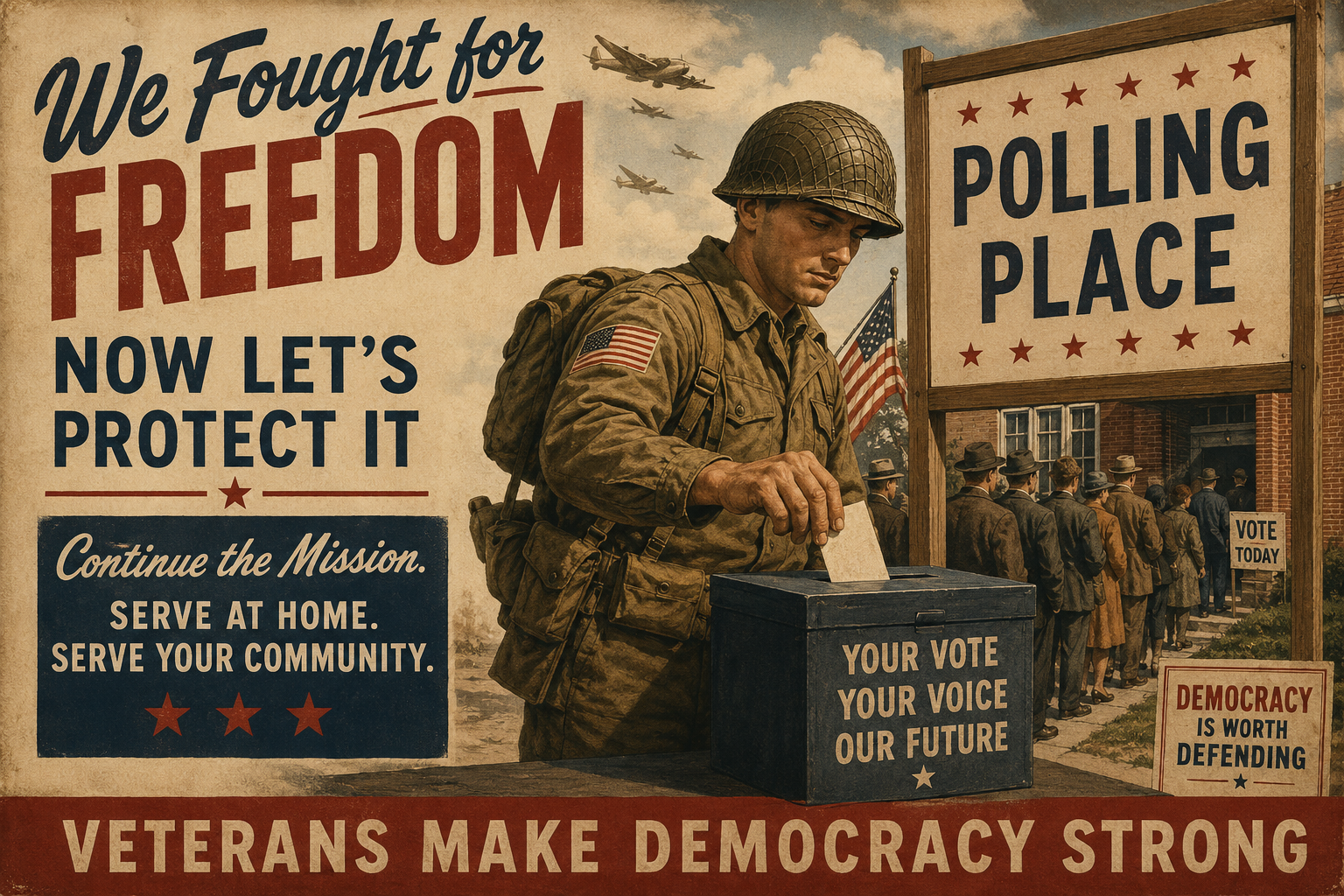
Veterans have spent generations defending America’s democratic system from threats overseas. In 2026, there is another mission waiting much closer to home: helping local communities run safe, orderly, trusted elections.
The midterm cycle will touch every level of government. The general election is scheduled for Tuesday, November 3, 2026. Every voting seat in the U.S. House will be on the ballot, along with U.S. Senate races, gubernatorial races, state legislatures, county offices, judicial races, school boards, ballot questions, and local contests that often shape daily life more directly than anything happening in Washington.
While the political fight gets most of the attention, the election itself depends on thousands of ordinary citizens willing to do the unglamorous work: checking in voters, setting up polling places, assisting neighbors, securing ballots, testing equipment, answering questions, and following the rules exactly as written. That is where veterans can make an immediate impact.
Why Veterans Fit the Mission
Election work requires traits that are already built into military service: calm under pressure, attention to detail, respect for procedure, accountability, and the ability to serve people from every background without making the mission personal. Poll workers are not there to win an argument. They are there to execute the rules fairly.
That matters because elections are high-pressure public operations. Lines form. Equipment can fail. Voters may be confused, frustrated, elderly, disabled, first-time participants, or dealing with language barriers. Election workers have to stay professional, follow state law, and keep the process moving.
Veterans understand controlled chaos. They understand chain of command. They understand that personal opinions take a back seat when the job is to serve the mission. Those instincts are valuable in local election offices that must recruit and train reliable workers every cycle.
Vet the Vote: A National Call to Serve
One of the clearest paths into election service is Vet the Vote, a nonpartisan initiative of We the Veterans and Military Families. Its mission is simple: recruit veterans and military family members to serve as poll workers and help strengthen confidence in local elections.
The organization’s message is direct: America runs on elections, and elections run on poll workers. Vet the Vote reports that more than 165,000 veterans and military family members have stepped up since the initiative launched in 2022, and its 2026 goal is to recruit 250,000 veterans and military family members for the midterms and beyond.
Bulletproof Veteran Podcast listeners may remember the interview with Ellen Gustafson and Ben Keiser of Vet the Vote. The core takeaway from that conversation still holds: veterans are trusted in their communities, and that trust can be used to strengthen the election process without turning the mission into a partisan fight.
Vet the Vote is not about telling veterans how to vote. It is about asking veterans to help every eligible citizen vote. That distinction is the whole point.
What Poll Workers Actually Do
A poll worker’s duties vary by state and county, but the job often includes setting up the polling location, checking voter registration, issuing ballots, helping voters understand the process, assisting voters with disabilities, monitoring equipment, maintaining order, securing materials, and closing out the site after polls close.
Most jurisdictions provide training before Election Day. Some roles are paid, while others are volunteer-based. Some require long hours on Election Day, while others involve early voting, absentee ballot processing, voter registration support, or pre-election preparation.
Veterans with logistics, communications, IT, cyber, administration, operations, security, transportation, or leadership backgrounds may find that local election offices need exactly the skills they already possess.
Federal Election Day
The 2026 general election is scheduled for Tuesday, November 3, 2026.
Poll Worker Push
The U.S. Election Assistance Commission will recognize National Poll Worker Recruitment Day on August 11, 2026.
Vet the Vote Goal
Vet the Vote is working to recruit 250,000 veterans and military family members for the 2026 midterms and beyond.
Deadline Warning
Registration, absentee, early voting, candidate filing, and poll worker deadlines vary by state and county.
Beyond Election Day
Serving as a poll worker is only one lane. Veterans can also get involved with county boards of elections, state election offices, ballot security teams, voter education efforts, nonpartisan civic organizations, and local government commissions that support election administration.
At the local level, veterans can contact town clerks, city election offices, county election commissioners, or boards of elections to ask about poll worker openings, election inspector positions, machine technician roles, ballot processing jobs, warehouse support, translation assistance, voter outreach, and training needs.
At the state level, secretaries of state and state election boards often publish election calendars, poll worker information, voter registration rules, candidate filing deadlines, absentee ballot rules, early voting dates, and employment opportunities. Veterans who want to get involved should start there, because the rules are different in every state.
At the federal level, the U.S. Election Assistance Commission provides poll worker recruitment resources and national guidance, while the Federal Voting Assistance Program helps service members, eligible family members, and overseas citizens understand voting rules and deadlines.
Veterans Can Also Run, Volunteer, and Lead
Election involvement does not have to stop with administration. Veterans can run for office, work on campaigns, advise candidates on veteran policy, manage volunteers, help with logistics, support voter registration efforts, or lead nonpartisan civic education in their communities.
Local elections are often the best entry point. School board, town council, county legislature, mayor, sheriff, clerk, judge, state representative, and county executive races all affect the ground-level issues citizens feel every day: taxes, roads, schools, public safety, zoning, housing, parks, emergency services, and veteran support programs.
Veterans who are tired of yelling at the news may find more value by showing up at the meeting, learning the process, and becoming the person who solves the problem. That is the spirit behind efforts like Operation 9-12 and the broader veteran civic-service movement: stop waiting for someone else to restore trust. Get local. Get useful. Get involved.
2026 Midterm Deadlines Veterans Should Track
The most important national date is November 3, 2026. But for anyone who wants to vote, volunteer, serve as a poll worker, request an absentee ballot, register voters, or run for office, the real deadlines begin much earlier.
Primary election dates vary by state throughout 2026. Candidate filing deadlines often close months before a primary. Poll worker applications and training may begin in the summer. Absentee ballot request deadlines, early voting windows, mail ballot return rules, and voter registration deadlines vary across the country. Some states allow same-day registration; others do not. Some states conduct mostly mail elections; others rely heavily on neighborhood polling places.
Veterans should check three places now: their state election office, their county board of elections or county clerk, and a trusted voter deadline tool such as Vote.gov or Vote.org. Do not wait until October to figure out what your state required in August.
How to Get Started
First, decide your lane. If you want a nonpartisan role, start with Vet the Vote or your local election office. If you want to help administer elections, apply to be a poll worker or election inspector. If you want to improve civic trust, volunteer with a nonpartisan voter education group. If you want to change policy, consider a local board, commission, or campaign.
Second, get trained. Election work is governed by law and procedure, not personal preference. Veterans should bring the same seriousness they brought to weapons safety, operations orders, classified material, or convoy briefs. Read the instructions. Attend the training. Follow the checklist.
Third, keep it professional. The strength veterans bring to election service is trust. That trust disappears if the role becomes partisan theater. Whether a voter agrees with you or not is irrelevant. The mission is to help eligible voters participate under the rules of your state.
Finally, recruit another veteran. Election offices need reliable people. Veterans know reliable people. A single veteran serving as a poll worker is helpful. A squad of veterans serving across a county can become a force multiplier for civic confidence.
The Bottom Line
Democracy is not protected by slogans. It is protected by people who show up, learn the rules, do the work, and place the mission above themselves.
For veterans, the 2026 midterms offer a clear opportunity to continue serving without picking up a weapon or putting on a uniform. The assignment is simple: help your community vote, help your neighbors trust the process, and remind the country that citizenship is not a spectator sport.
The next mission may be waiting at your local polling place.
Veteran Election Involvement Resources
- Vet the Vote: Sign up to serve as a veteran or military family poll worker
- We the Veterans and Military Families: Vet the Vote campaign information
- U.S. Election Assistance Commission: Poll worker resources
- Help America Vote: National poll worker information
- Vote.gov: Register to vote and find state election rules
- Vote.org: Voter registration deadlines by state
- Federal Voting Assistance Program: Military, family, and overseas voting help
- USA.gov: Find your state election office
- Bulletproof Veteran Podcast: Episode 83 with Ellen Gustafson and Ben Keiser of Vet the Vote
Sources and Further Reading
- VA News: Veterans and military families answer call to staff polls
- Vet the Vote: Poll worker recruitment campaign
- U.S. Election Assistance Commission: National Poll Worker Recruitment Day and poll worker resources
- Federal Voting Assistance Program: 2026 Primary Elections Calendar
- Vote.gov: State voter registration rules and deadlines
- Vote.org: Voter registration deadlines by state
- Bulletproof Veteran Podcast RSS feed: Vet the Vote interview listing