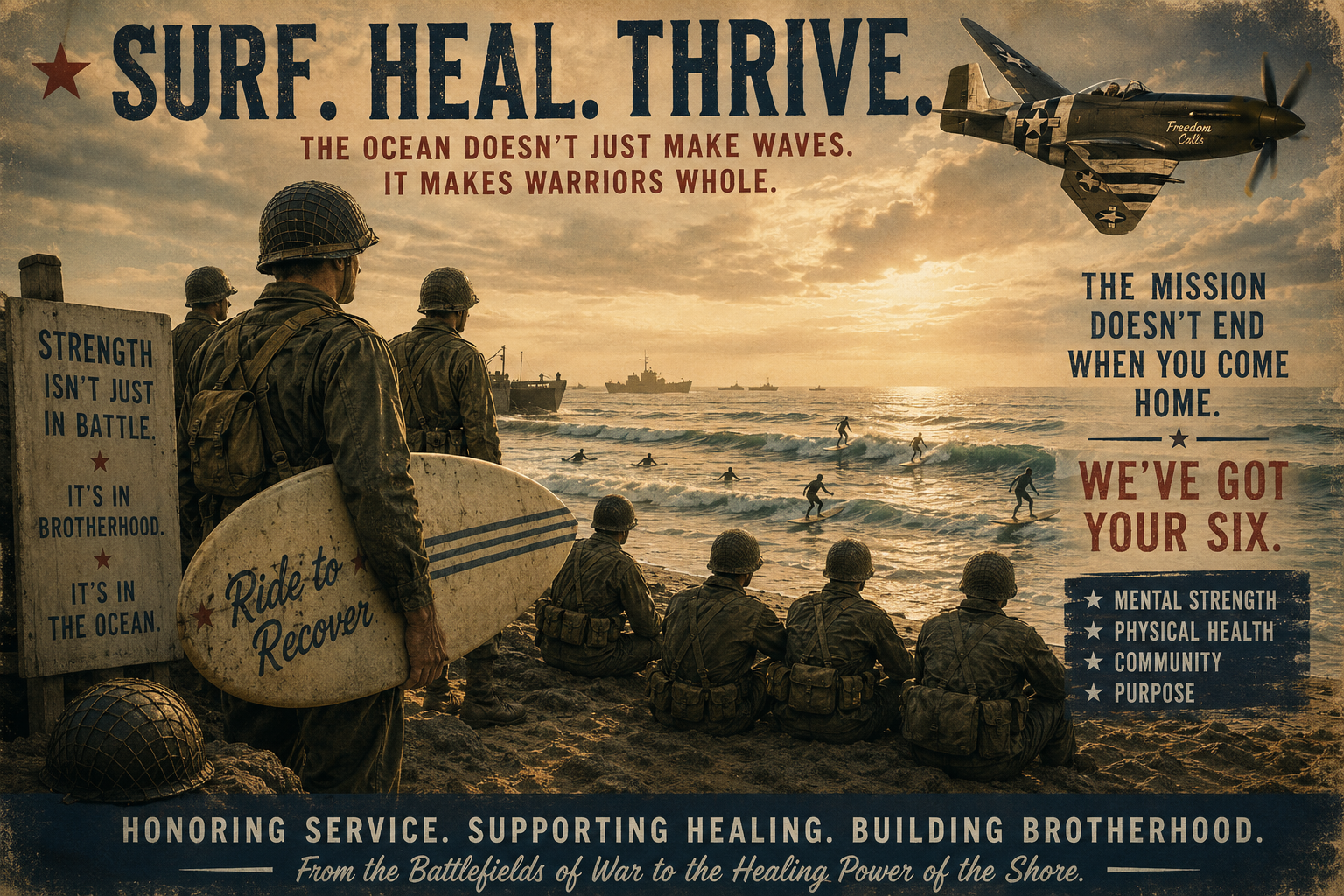
For many veterans, the ocean provides something difficult to reproduce inside a clinic.
It demands attention without demanding conversation. It creates physical exertion without feeling like a conventional workout. It presents risk, uncertainty, frustration, and failure—but also immediate opportunities to adapt, recover, and try again.
A veteran paddling into the surf cannot remain entirely focused on yesterday’s memories or tomorrow’s problems. The water requires attention to breathing, balance, timing, currents, waves, other surfers, and the constantly changing environment. That forced presence is one reason surfing is increasingly being used as a complementary intervention for post-traumatic stress, depression, anxiety, chronic pain, traumatic brain injury, physical disability, addiction recovery, and the loss of identity or community that can follow military service.
Surf therapy does not require every participant to stand on a board. Programs may incorporate traditional surfing, adaptive surfing, tandem surfing, bodyboarding, bodysurfing, swimming, breathwork, mindfulness exercises, group discussion, beach activities, and peer support.
The purpose is not simply to teach veterans how to catch waves.
The larger mission is to help them reconnect with their bodies, trust other people, regain confidence, experience healthy challenge, and become part of a community again.
What Is Surf Therapy?
Surf therapy generally combines structured water instruction with activities designed to improve psychological, physical, and social well-being. Depending on the organization, a program may be led by surf instructors, adaptive-sports specialists, veterans, volunteers, licensed mental-health professionals, or some combination of those groups.
Waves of Recovery, a surf-therapy nonprofit, describes the approach as combining surfing instruction with individual or group activities that promote psychological, physical, and psychosocial health. Its programming includes mindfulness, mental-health education, embodied learning, and community support in addition to surf coaching.
Some programs operate like short retreats. Others provide weekly sessions extending over several weeks or months. Adaptive programs may modify boards, use additional instructors, provide beach wheelchairs, or place participants in seated, prone, kneeling, or tandem positions.
Although the words surfing and surf therapy are sometimes used interchangeably, they are not necessarily the same.
Recreational surfing can provide significant benefits by itself. Formal surf therapy usually adds structure, intentional therapeutic goals, trained staff, a defined curriculum, peer support, or mental-health components. A 2026 review of 44 publications emphasized that surf interventions exist along a continuum—from ordinary recreational surfing to programs with a strong clinical or therapeutic focus.
Surf therapy should generally be viewed as a complementary tool rather than a universal replacement for evidence-based mental-health care, medication, physical rehabilitation, or crisis services. The research is promising, but the field remains younger and less developed than many conventional treatments.
Still, the evidence is increasingly difficult to dismiss.
What the Research Says About Veterans and Surf Therapy
One of the strongest studies involving military personnel was a randomized controlled trial comparing surf therapy with hike therapy among 96 active-duty service members diagnosed with major depressive disorder.
Participants attended six weeks of structured surfing or hiking. Both groups experienced significant reductions in depression, but the surf-therapy group showed especially strong short-term improvements. Researchers also reported reductions in anxiety and post-traumatic stress symptoms, along with improvements in positive affect and social functioning. A substantial number of participants continued to demonstrate improvement after the programs ended.
The study is important because it did not compare surfing with doing nothing. It compared surfing with another credible, nature-based physical activity. Both helped, suggesting that movement, outdoor exposure, challenge, group participation, and time away from ordinary stressors may all contribute to recovery.
Another military-focused study examined individual surf sessions among service members with post-traumatic stress disorder, major depressive disorder, or both. Researchers found that depression and anxiety symptoms decreased during the sessions while positive mood increased.
The authors also noted that the improvement in positive affect was particularly important because emotional numbness, loss of pleasure, and persistent sadness can be difficult symptoms to treat among people experiencing PTSD and depression.
A 2025 study evaluating Operation Surf’s weeklong program followed 41 veterans with PTSD. Researchers measured post-traumatic stress, depression, anxiety, sleep, social functioning, pain interference, and quality of life. The study reported statistically significant improvements in several psychological measures following the program, including decreases in PTSD-related distress and depression.
San Diego State University summarized the findings by reporting that participants experienced improvements in anxiety, depression, sleep, and overall psychological functioning when surfing was combined with therapeutic and community-based support.
Researchers are also beginning to examine whether the benefits last. A 2024 study on the long-term effects of surf therapy noted that earlier military programs had demonstrated short-term reductions in PTSD, depression, and generalized anxiety, but that retained benefits beyond several months had historically received less attention. The study represents part of a broader effort to determine who benefits, how long those improvements last, and what ongoing support is needed after an intensive program ends.
Promising Evidence—With Important Limitations
It is important not to oversell the research.
A 2024 systematic review of controlled surf-therapy studies concluded that the intervention shows promise for people with mental-health conditions, but it also found that the available research remains limited. Studies frequently involve small groups, different program designs, short follow-up periods, and participants who have voluntarily chosen to try surfing.
That creates several unanswered questions:
Surfing Itself
How much improvement comes from riding waves rather than exercise, outdoor exposure, or expectation?
Community
How much of the benefit comes from belonging to a supportive group and sharing a mission?
Who Benefits
Are the effects equally strong for beginners, experienced surfers, and veterans with different diagnoses?
Long-Term Impact
Do improvements last after organized programming ends, and what follow-up support is needed?
The systematic review concluded that larger, better-controlled studies are needed before surf therapy can be treated as an established stand-alone mental-health treatment.
That caution does not mean the therapy is ineffective. It means researchers are still separating the different ingredients that make it work.
Those ingredients appear to include physical activity, concentration, exposure to nature, mastery of a difficult skill, sensory regulation, social connection, identity rebuilding, and the unique psychological effect of being near or in water.
Why the Ocean May Affect the Mind
The broader study of oceans, lakes, rivers, and other aquatic environments is often called blue-space research.
Researchers have proposed several pathways through which blue spaces may improve health:
Restoration
Natural water environments may reduce stress, mental fatigue, and psychological overload.
Movement
Beaches, lakes, and rivers encourage walking, swimming, paddling, surfing, and recreation.
Connection
Blue spaces create opportunities for shared activity, social contact, and community identity.
Sensory Regulation
Wave rhythm, horizon views, wind, saltwater, and repetitive movement may help anchor attention.
A major systematic review of blue-space interventions concluded that aquatic environments appear to provide direct mental-health and psychosocial benefits. Many of the programs reviewed were associated with improved well-being, stronger social connection, and reduced psychological distress, although the evidence for specific physical-health outcomes was less consistent.
A separate review examined the mechanisms that might explain the connection between blue spaces and health. It found support for several pathways, particularly increased physical activity, opportunities for restoration, improved environmental conditions, and greater social interaction.
The ocean may be particularly powerful because it engages several senses at once.
A person at the beach sees constant movement, hears repetitive wave patterns, smells saltwater, feels wind and temperature changes, and physically encounters sand and water. The environment is stimulating, but its patterns can also be predictable enough to feel regulating.
For veterans living with hypervigilance, intrusive thoughts, or chronic stress, that sensory environment may temporarily redirect attention away from internal threat signals and toward immediate, manageable information.
The next wave is approaching. Where is the board pointed? Is the current pulling left or right? When should the surfer paddle? Should the wave be taken or allowed to pass?
The mind has a job, but the job is happening in the present.
Surfing as Moving Mindfulness
Mindfulness is often explained as paying attention to the present moment without becoming trapped in judgment or distraction. Surfing can create a similar state without asking the participant to sit still in a quiet room.
The ocean punishes inattention quickly. A surfer who is mentally somewhere else may miss the wave, mistime the takeoff, collide with another surfer, lose the board, or get rolled in the whitewater.
That does not make surfing automatically therapeutic, but it does create an environment in which presence is practical rather than abstract.
The surfer must monitor breathing, posture, fatigue, water movement, other people, and changing conditions. That combination can interrupt rumination—the repetitive cycling of distressing thoughts that often accompanies depression, anxiety, grief, and post-traumatic stress.
Surfing may also produce what psychologists describe as a flow state: deep absorption in an activity where the level of challenge is closely matched to the person’s skill.
During flow, self-consciousness may decrease, time may seem altered, and attention becomes tightly focused on the task. For a veteran who spends significant time replaying the past or anticipating danger, even a brief period of total engagement can be meaningful.
Relearning the Difference Between Danger and Challenge
Veterans experiencing PTSD may struggle with a nervous system that continues reacting as if danger is present even when the immediate environment is safe.
Surfing introduces genuine but manageable uncertainty.
The ocean moves. Waves arrive unpredictably. Balance is lost. The surfer falls. Water closes overhead. The participant must orient, surface, find the board, regulate breathing, and prepare for the next wave.
In a properly supervised setting, this becomes controlled exposure to challenge.
The veteran experiences elevated heart rate, uncertainty, adrenaline, physical exertion, and temporary loss of control—but also learns that those sensations do not always mean catastrophe. The body can become activated and then recover.
That process may help some participants rebuild confidence in their own physiological responses.
Instead of interpreting every racing heartbeat or surge of adrenaline as evidence that something is wrong, the veteran experiences those sensations in a setting associated with accomplishment, recreation, and community.
Failure Is Expected in the Surf
Military culture often rewards competence, preparation, control, and execution. Civilian life can be especially difficult when veterans believe they should already know how to navigate employment, family relationships, disability, mental health, or a new identity.
Surfing makes failure unavoidable.
Everyone falls. Experienced surfers miss waves. Beginners wipe out repeatedly. Conditions change. A person who surfed well yesterday may struggle today.
Yet falling is not treated as moral failure. It is simply part of learning.
The immediate consequence of most beginner mistakes is a splash, a reset, and another attempt. That environment can help participants practice frustration tolerance, humility, adaptability, and self-compassion.
A veteran may enter the water believing, I cannot do this.
Then an instructor helps position the board. Other veterans cheer. The wave lifts the participant. For several seconds, the board moves toward shore.
That small success can challenge a much larger belief: I am no longer capable.
The Physical Benefits of Surfing
Surfing combines extended aerobic work with short bursts of higher-intensity activity.
Paddling develops cardiovascular endurance and recruits the shoulders, upper back, chest, arms, and trunk. Sitting or lying on an unstable board requires continuous postural adjustment. Standing and turning require lower-body strength, coordination, mobility, rotational control, and dynamic balance.
A review of surfing performance found that paddling requires upper-body strength, muscular endurance, aerobic and anaerobic capacity, and the ability to recover between high-intensity efforts. Wave riding requires lower-body strength, single-leg control, dynamic balance, and rotational power.
Physiological research has found that surfing can place participants at an average heart-rate intensity equivalent to approximately 75 to 85 percent of values recorded during maximal laboratory paddling tests. Surfers also demonstrated upper-body aerobic capacity comparable with athletes in other endurance-based sports.
For veterans, these physical demands may support:
Conditioning
Cardiovascular endurance, work capacity, weight management, and recovery between efforts.
Strength
Shoulders, upper back, chest, arms, trunk, hips, legs, and rotational control.
Movement
Balance, coordination, mobility, reaction time, and joint-position awareness.
Purposeful Exercise
The work is tied to catching waves, making it more engaging than repetitive indoor exercise for some veterans.
The sport also uses intermittent effort. A surfer may paddle steadily, sprint to catch a wave, hold position against current, recover while sitting on the board, and then repeat the process.
That variable pattern can feel more engaging than a treadmill or stationary bike because the work has an immediate purpose.
Balance, Proprioception, and Neuromuscular Control
A surfboard is an unstable platform moving over another unstable surface.
The brain receives constant information from the feet, ankles, knees, hips, spine, eyes, inner ear, and skin. It must integrate those signals and make rapid corrections.
This process exercises proprioception, the body’s awareness of where it is in space.
A 2025 study comparing surfers and nonsurfers found favorable differences in measures related to postural stability, flexibility, and self-esteem among people who surfed. The study was observational and cannot prove surfing caused all the differences, but it supports the idea that regular participation may be associated with stronger balance and body control.
For veterans recovering from limb loss, orthopedic injuries, neurological impairment, or long periods of inactivity, adaptive surfing can provide a motivating environment for practicing weight shifting, trunk control, bilateral coordination, protective reactions, transfers, and seated, kneeling, or standing balance.
Adaptive programs can modify the activity around the participant rather than requiring the participant to fit one definition of surfing.
Why Bodyboarding Can Be an Excellent Entry Point
Not every veteran needs—or wants—to stand on a surfboard.
Bodyboarding allows the participant to ride waves while lying prone, kneeling, or using a drop-knee position. Swim fins are often used to provide propulsion and control.
Because the rider stays closer to the water and does not need to complete a standing pop-up, bodyboarding can reduce some barriers for beginners and people with mobility limitations.
It can still provide significant physical work through fin kicking, swimming, upper-body paddling, core stabilization, breath control, wave timing, grip strength, and repeated movement through surf.
Bodyboarding can provide the speed, excitement, sensory stimulation, challenge, and community of wave riding without requiring the same standing balance or lower-body mobility as conventional surfing.
For some veterans, it becomes a bridge to stand-up surfing. For others, it becomes the preferred sport.
Neither outcome is more legitimate than the other.
The therapeutic value is not determined by whether a participant stands up. It comes from movement, engagement, accomplishment, connection, and repeated positive experiences in the water.
Bodysurfing: The Simplest Form of Wave Riding
Bodysurfing involves riding a wave with the body rather than a board. Many bodysurfers use swim fins and some use a small handplane to reduce drag and lift the upper body.
It requires strong swimming ability, awareness of breaking waves, breath control, timing, and comfort in moving water.
Bodysurfing can offer a particularly direct connection to the ocean. There is little equipment between the participant and the wave. The person learns to feel when the wave lifts, accelerates, steepens, and releases.
Physically, bodysurfing can develop swimming endurance, leg strength from fin use, core control, shoulder strength, breath awareness, coordination, and water confidence.
Mentally, it can create an intense sense of presence. Once a person commits to a wave, attention narrows rapidly to body position, breathing, speed, and the route back to the surface.
However, bodysurfing should not be treated as automatically safer because it uses less equipment. Shore break, shallow water, submerged hazards, strong currents, spinal injuries, and breath-hold risks must be taken seriously. Beginners should learn in appropriate conditions with experienced supervision.
The Ocean as a Low-Impact Environment
Water supports body weight and can reduce the load placed on painful joints during certain movements. That can make water-based activity appealing to veterans with arthritis, chronic back pain, orthopedic injuries, or mobility restrictions.
The resistance of water also allows participants to work muscles without relying exclusively on heavy external loads.
However, surfing itself is not always low impact. Paddling can aggravate shoulder or neck conditions. Repeated pop-ups may stress the wrists, knees, hips, and lower back. Wipeouts can cause acute injuries. Cold water may be dangerous for individuals with certain cardiovascular or respiratory conditions.
Programs should therefore screen participants, provide adaptive options, select appropriate wave conditions, and encourage veterans to discuss medical concerns with their healthcare providers.
Rebuilding Trust Through Shared Risk
One of the most important elements of veteran surf therapy may have little to do with the wave.
It is the person standing beside the board.
Military service teaches reliance on other people. Following separation, many veterans lose the built-in structure that once created daily contact, shared purpose, accountability, and belonging.
Surf programs can recreate parts of that environment without attempting to recreate military service itself.
Participants rely on instructors to choose safe conditions. They trust volunteers to stabilize boards, guide them through waves, watch for hazards, and help them return to shore. In adaptive programs, several people may work together to help one veteran catch a wave.
That cooperation can be powerful for someone who has become isolated or distrustful.
Trust is not discussed only as a concept. It is practiced physically.
A participant allows another person to hold the board. An instructor says, “Paddle.” A volunteer says, “I’ve got you.” A group watches the veteran ride toward shore and celebrates the attempt whether the participant remains on the board or falls immediately.
The message is simple: You are not doing this alone.
The Surf Community as a Replacement Team
Veterans often say they do not necessarily miss every aspect of military life. They miss the people, the shared mission, and the sense that their presence mattered.
Surf communities can offer a new form of belonging built around repeated gatherings, local knowledge, mentorship, humor, physical challenge, and responsibility.
A beginner needs instruction. An experienced participant eventually helps someone else. A veteran who first arrived as a program recipient may return as a volunteer, mentor, fundraiser, photographer, safety assistant, board builder, or surf coach.
That transition from receiving help to providing it can be especially meaningful.
It restores purpose.
Research involving military surf programs has repeatedly identified social support as a major part of the benefit. The physical activity draws participants together, but the relationships may help sustain progress after the formal program ends.
In a survey of 569 Australian surfers, more than 75 percent agreed that surfing positively affected their physical health, mental health, ability to manage stress, and social relationships. The study was based on self-report and does not prove causation, but it demonstrates how strongly surfers associate the activity with overall well-being and community connection.
Surf Parks Are Moving Surfing Inland
Historically, access to surfing required access to a coastline, favorable weather, sufficient swell, appropriate tides, and safe local conditions.
Surf parks are changing that.
A modern surf park uses mechanical systems to generate rideable waves in a purpose-built pool or lagoon. Depending on the technology, waves may be created by paddles, pneumatic chambers, submerged foils, displacement modules, or other mechanisms that push water through a carefully designed basin.
The bottom contours of the lagoon help determine how the energy becomes a breaking wave.
Operators can often adjust:
Wave Shape
Height, speed, steepness, barrel intensity, and length of ride.
Direction
Left-breaking or right-breaking waves can be generated for different sessions.
Difficulty
Beginner whitewater, gentle open-face waves, and advanced performance settings.
Frequency
Operators can control the interval between waves and create predictable lesson progressions.
This predictability can be particularly valuable for adaptive recreation and therapeutic programs.
In the ocean, an instructor may wait through long flat periods, manage changing tides, respond to shifting currents, and select waves from an unpredictable lineup. In a surf park, instructors can know approximately where a wave will break, how large it will be, and when it will arrive.
That can create a controlled progression for beginners and veterans with disabilities.
A participant might begin in shallow whitewater, progress to a gentle unbroken wave, and eventually attempt steeper or faster settings.
Surf parks cannot reproduce every benefit of the natural ocean. They do not provide the same coastal ecosystem, horizon, tides, wildlife, or fully natural unpredictability. Sessions can also be expensive.
They can, however, make wave riding available to people living hundreds of miles from the coast and can help develop inland surf communities.
Surf Parks and Wave Facilities in the United States
The number and operational status of surf parks can change quickly. Veterans should confirm current hours, pricing, accessibility, lesson availability, and opening status directly with each facility.
Waco Surf — Waco, Texas
Waco Surf operates a large artificial wave facility in Central Texas. It offers sessions for different skill levels, including beginner waves, intermediate settings, and more advanced wave configurations. Its inland location has made it one of the best-known examples of a surf destination that does not require access to the ocean.
Palm Springs Surf Club — Palm Springs, California
Palm Springs Surf Club operates a wave pool in the California desert. The facility combines programmable surfing with resort-style amenities and instruction. It demonstrates how surf technology can place consistent waves in an environment far removed from a traditional coastal break.
Atlantic Park Surf — Virginia Beach, Virginia
Atlantic Park Surf uses Wavegarden technology to create multiple wave types for different ability levels. The lagoon is part of a larger entertainment and community development in Virginia Beach. Although Virginia Beach already has ocean access, the lagoon provides more predictable conditions and year-round programming opportunities.
Skudin Surf at American Dream — East Rutherford, New Jersey
The American Dream complex contains an indoor pool where Skudin Surf offers wave sessions and instruction. Because the facility is indoors, participants can surf regardless of cold Northeast winters or ocean conditions. The waves are different from those produced by larger lagoon systems, but the facility provides a practical entry point for veterans in the New York and New Jersey region.
Kelly Slater Wave Company Surf Ranch — Lemoore, California
The Surf Ranch uses a hydrofoil-style wave-generation system to create long, high-performance waves. It is best known as an elite surfing and competition venue rather than an inexpensive beginner recreation facility. Its technology demonstrates the level of precision artificial-wave systems can now achieve.
DSRT Surf — Palm Desert, California
DSRT Surf is a Wavegarden project planned for the Palm Desert area. Development and opening timelines should be verified before travel.
The Point Surf Park — Fellsmere, Florida
The Point Surf Park has been under development in Indian River County near Sebastian Inlet. Plans call for an Endless Surf lagoon and a larger recreation destination. Its developers have projected a 2026 opening, but construction projects can change, so veterans should confirm whether the facility is operational before planning a visit.
Across the industry, approximately three dozen wave pools were operating worldwide by 2026, with additional U.S. facilities under construction or development.
Warrior Surf Foundation
Warrior Surf Foundation is based in the Charleston, South Carolina, area and serves veterans through surf instruction, wellness programming, and community support.
Its programs are designed to address physical and psychological well-being through surfing, yoga, peer connection, and goal setting. Participants do not need prior surfing experience.
The organization’s model recognizes that a single exciting day at the beach may provide temporary relief, but sustained change often requires repetition and relationships. Structured programming gives veterans the opportunity to return to the water, build skills, establish routines, and form connections over time.
Warrior Surf Foundation also offers opportunities for community members to volunteer, support events, raise funds, and assist the organization’s veteran programs.
Endless Summer Surfathon
Warrior Surf Foundation’s Endless Summer Surfathon is scheduled to run from August 1 through August 29, 2026.
The event is designed so supporters can participate from wherever they have safe access to water. Participants can surf, paddle, swim, or take part in other approved water-based activities while raising awareness and funds for Warrior Surf Foundation’s programming.
The organization lists the Surfathon as taking place “anywhere in the water,” making it accessible to supporters beyond South Carolina. Warrior Surf Foundation also lists its annual Surfboard Auction and Raffle for August 29, 2026.
Veterans and supporters should visit Warrior Surf Foundation’s official event page for current registration instructions, fundraising requirements, safety guidance, and event updates.
One More Wave
One More Wave is a veteran-focused nonprofit built around a direct mission: provide wounded and disabled veterans with customized surfing equipment and connect them with a community that can help them continue surfing.
The organization recognizes that attending one surf event does not necessarily create lasting access.
A veteran may need a board adapted for an amputation, spinal injury, mobility limitation, balance impairment, or another disability. Commercial adaptive equipment can be difficult to locate and expensive to purchase. One More Wave works to reduce that barrier through customized boards, equipment, and community support.
Its goal is to make surf therapy available beyond a single clinic by equipping the veteran to continue participating with local surfers and volunteers.
One More Wave also maintains an identifiable community through its distinctive boards, apparel, events, and nationwide network. Veterans can apply for support, learn about events, donate, volunteer, or help connect recipients with local surf communities through the organization’s official website.
Operation Surf
Operation Surf is one of the best-known surf programs serving injured military personnel and veterans.
Its mission is to use the healing power of the ocean to restore hope, renew purpose, and revitalize community. The organization uses curriculum-based programs, peer support, wellness tools, and surf instruction to help participants pursue longer-term physical and psychological well-being.
Operation Surf offers immersive programs in which veterans receive individualized surf instruction, encouragement, and community support. The program is designed to create more than a recreational vacation. Participants work through progressive challenges and reflect on how lessons from the water apply to life outside the ocean.
The organization emphasizes several recurring themes:
Resilience
Overcoming fear, tolerating frustration, and trying again after a wipeout.
Support
Accepting help, trusting instructors, and connecting with peers.
Purpose
Rebuilding confidence and finding meaningful goals after service.
Continuation
Carrying wellness practices and community connections beyond the event.
Operation Surf reports serving thousands of veterans and family members through its programming. Veterans can review application information, upcoming locations, volunteer opportunities, and eligibility requirements through the organization’s official website.
AmpSurf
AmpSurf is an adaptive-surfing nonprofit founded to serve people with disabilities, veterans, first responders, and others who can benefit from adaptive water recreation.
The organization operates U.S. chapters in California, New England, New York, and the Pacific Northwest.
AmpSurf clinics generally provide adaptive instruction and necessary equipment. Depending on the event, that may include surfboards, wetsuits, rash guards, adaptive boards, beach wheelchairs, trained water assistants, dry-land instruction, and individualized in-water support.
Clinics commonly begin with beach instruction before participants enter the water with volunteers and surf instructors.
AmpSurf has also participated in the VA’s National Veterans Summer Sports Clinic, where veterans with a range of disabilities take part in surfing and other adaptive sports.
Veterans should check the AmpSurf chapter nearest them because event schedules, registration procedures, and participant eligibility vary by region.
Jimmy Miller Memorial Foundation
The Jimmy Miller Memorial Foundation provides ocean therapy programming in Southern California.
Its surf-therapy model has served veterans, active-duty military personnel, youth, and other groups experiencing trauma or mental-health challenges. Programs combine surfing, supportive relationships, structured activities, and the psychological benefits of the ocean.
The organization has emphasized belonging, presence, and relief from symptoms associated with PTSD and depression. Its veteran work has contributed to the broader development of surf therapy as a recognized complementary intervention.
Veterans in Southern California can review current military and veteran programming through the foundation’s official website.
Waves of Recovery
Waves of Recovery is a California nonprofit using surfing, mindfulness, community activities, and mental-health education to support people affected by addiction, trauma, and mental-health challenges.
Its programs are not limited exclusively to veterans, but the model may be relevant to former service members seeking recovery support in a nontraditional setting.
Participants receive beginner or intermediate surf coaching while taking part in embodied-learning exercises designed to strengthen the connection between mind, body, and environment.
For veterans uncomfortable with a conventional office-based setting, programs like this may provide a less stigmatized doorway into conversations about trauma, addiction, emotional health, and recovery.
Team Red, White & Blue and Waves of Valor
Team Red, White & Blue is a national veteran organization that builds community through physical and social activity.
In 2024, Team RWB partnered with the VA Greater Los Angeles Healthcare System to hold the Waves of Valor Surf Camp, providing veterans with a therapeutic surfing experience and an opportunity to connect through adaptive recreation.
Team RWB does not focus exclusively on surfing, but local chapters may participate in surf events, beach workouts, paddling, swimming, and other outdoor activities.
Veterans who do not live near a dedicated surf-therapy organization may find that a Team RWB chapter can help connect them with local opportunities.
VA Adaptive Sports and Local Vet Centers
The Department of Veterans Affairs supports adaptive sports and recreation through national programs, local healthcare systems, rehabilitation departments, recreational therapy, and partnerships with nonprofit organizations.
The National Veterans Summer Sports Clinic has included surfing alongside activities such as sailing, kayaking, cycling, and other adaptive sports.
Local VA medical centers and Vet Centers may also know about regional surf events that are not widely advertised nationally.
Veterans interested in participating should consider contacting:
VA Care Teams
A recreational therapist, adaptive-sports coordinator, physical therapist, occupational therapist, or Whole Health coordinator.
Specialty Programs
Spinal-cord injury, polytrauma, prosthetics, rehabilitation, or mental-health programs.
Community Support
A local Vet Center, Team RWB chapter, county veterans-service office, or state veterans agency.
Useful Search Terms
Adaptive surfing, ocean therapy, aquatic therapy, recreational therapy, and veterans summer sports clinics.
How Veterans Can Find a Program
A veteran searching for surf therapy should begin by identifying what kind of support is needed.
Someone with no major physical limitation may want a beginner-friendly veteran group with boards, wetsuits, and instruction.
A veteran with an amputation, spinal injury, visual impairment, balance disorder, or neurological condition may need an adaptive program with specialized equipment and a higher instructor-to-participant ratio.
A veteran seeking support for PTSD, depression, addiction, or anxiety may prefer a program that includes licensed mental-health professionals, structured group work, or a formal therapeutic curriculum.
Before registering, ask the organization:
Cost and Access
Is there a fee? Are travel, lodging, equipment, transportation, and beach access provided?
Training and Safety
Are instructors trained in water rescue, adaptive surfing, trauma-informed care, or mental health?
Program Structure
Is it a one-day event, retreat, or multiweek program? Is follow-up support available?
Eligibility
Is swimming experience required? Can caregivers attend? Is medical clearance necessary?
Volunteering and Staying Involved
Veterans do not need to be participants to become part of surf therapy.
Organizations often need surf instructors, water-safety volunteers, board handlers, beach assistants, photographers, fundraisers, event planners, drivers, peer mentors, medical volunteers, mental-health professionals, equipment builders, social-media support, and administrative help.
A veteran who is not comfortable in deep water may still help organize equipment, welcome participants, assist families, prepare meals, manage registration, or support fundraising.
The community is built on shore as well as in the water.
Preparing for a First Session
Veterans should tell program staff about medical conditions, physical limitations, medications, panic symptoms, seizure history, heart or lung conditions, hearing limitations, prosthetic needs, skin sensitivity, and prior experiences with water.
A participant should bring or ask about sun protection, water, towels, secure footwear, prescription medication, inhalers or emergency medication, prosthetic protection, hearing-device storage, warm clothing for after the session, food appropriate for medical needs, identification, and required forms.
Veterans who are nervous should say so.
Fear of deep water, drowning, being held underwater, crowded spaces, physical contact, or loss of control may be related to past experiences. A responsible program should not shame or pressure the participant.
The first victory may simply be putting on a wetsuit.
The next may be walking into knee-deep water.
Progress does not need to look dramatic to be real.
Ocean Safety Cannot Be Ignored
The therapeutic value of the ocean does not eliminate its dangers.
Veterans should learn about rip currents, shore break, changing tides, water temperature, hypothermia, heat illness, sun exposure, marine life, water contamination, board collisions, shallow-bottom injuries, breath-holding hazards, lightning, and storms.
Participants should use qualified instructors, follow local warnings, wear appropriate equipment, and avoid entering unfamiliar conditions alone.
Alcohol, sedating medication, and recreational drugs can significantly increase water risk. Veterans taking medication that affects blood pressure, alertness, balance, temperature regulation, or heart rhythm should discuss strenuous water activity with a healthcare professional.
Surf therapy is supposed to create manageable challenge—not uncontrolled danger.
Healing Does Not Always Look Like Therapy
For some veterans, the word therapy creates resistance.
Surf programs can reduce that barrier because the initial invitation is often simple:
The conversation may come later.
The ocean creates a shared task that allows trust to develop without forcing immediate disclosure. Veterans can speak when they are ready, and silence does not automatically separate them from the group.
This is sometimes described as “stealth therapy,” but the term should not suggest deception. The participant still deserves to know whether a program includes clinical treatment, what information is collected, and who has access to it.
What the phrase captures is that healing can happen while people are focused on something other than being treated.
A veteran may begin by learning to surf and eventually realize that the deeper work involved learning to trust, breathe, fail, recover, accept help, and feel joy again.
The Wave Is Only Part of the Treatment
Surf therapy is not magic.
It will not erase trauma, repair every injury, cure depression, or eliminate the need for professional care.
The ocean can also be frustrating, cold, physically demanding, inaccessible, and dangerous. Some veterans will not enjoy it. Others may benefit more from hiking, cycling, equine therapy, team sports, art, fishing, sailing, martial arts, or conventional clinical care.
But for the veterans who connect with it, surf therapy offers a rare combination:
And every wave provides another chance.
The veteran paddles, commits, falls, surfaces, finds the board, and tries again.
That may be the most important lesson the ocean offers.
Not that a person will never be knocked down—but that being knocked down does not mean the session is over.
Veteran Surf-Therapy Resources
Veterans can find applications, program schedules, volunteer information, donation opportunities, and event registration through the official websites of Warrior Surf Foundation, One More Wave, Operation Surf, AmpSurf, Jimmy Miller Memorial Foundation, Waves of Recovery, Team Red, White & Blue, VA National Veterans Sports Programs and Special Events, and local VA recreational-therapy and adaptive-sports departments.
Because dates, locations, eligibility rules, and available funding can change, veterans should verify all program information directly before making travel arrangements.
The Warrior Surf Foundation Endless Summer Surfathon is scheduled for August 1–29, 2026, with participation possible from approved water locations beyond the organization’s home region.
For a veteran wondering whether surf therapy might help, the first step does not need to be a weeklong trip or a major commitment.
It can be an email. A phone call. A conversation with a recreational therapist. A beginner clinic. Or one morning at the beach with a group of people willing to say:
Sources and Further Reading
- Randomized controlled trial comparing surf therapy and hike therapy among active-duty service members
- Psychological effects of surf therapy sessions among service members with PTSD and major depressive disorder
- Evaluation of Operation Surf programming for veterans with PTSD
- San Diego State University: Surfing eases symptoms of PTSD
- Research on the longer-term effects of surf therapy
- Systematic review of controlled surf-therapy studies
- Systematic review of blue-space interventions and health outcomes
- Review of pathways connecting blue spaces and human health
- Review of the physical and physiological demands of surfing
- Physiological demands and aerobic characteristics of surfing
- Study of postural stability, flexibility, and self-esteem among surfers
- Survey of surfers regarding physical health, mental health, stress, and social relationships
- Warrior Surf Foundation
- Warrior Surf Foundation events and Endless Summer Surfathon
- One More Wave mission and veteran adaptive surfing support
- Operation Surf
- AmpSurf adaptive surfing programs
- Jimmy Miller Memorial Foundation
- Waves of Recovery surf-therapy programming
- VA Greater Los Angeles: Waves of Valor Surf Camp
- VA: Adaptive surfing at the National Veterans Summer Sports Clinic
- Palm Springs Surf Club
- Wavegarden projects, including U.S. surf-park developments
- Endless Surf: The Point Surf Park development in Florida
- WavePoolMag surf-park and wave-pool directory