
At 2:17 on a cold February morning, a pickup truck disappears from the driveway of a suburban home. No police officer witnesses the theft. No patrol car gives chase. No helicopter takes to the sky. Yet before the owner has finished dialing 911, investigators may already possess something detectives throughout most of American history could only dream about: a machine-generated trail showing where the truck traveled, which intersections it crossed, what direction it was moving, and where it was last observed.
The witnesses never slept. They never blinked. They never forgot. They were cameras.
Across the United States, thousands of communities now rely on automated license plate readers, commonly called ALPRs, to investigate crimes, locate missing people, recover stolen vehicles, and identify suspects. Few companies have become more closely associated with that expansion than Flock Safety, whose solar-powered cameras increasingly appear at neighborhood entrances, schools, shopping centers, apartment complexes, business districts, and public intersections.
Supporters describe the system as one of the most useful investigative advances since DNA databases. Critics describe it as a decentralized surveillance network capable of reconstructing the movements of millions of innocent people. Both claims contain important truths. The debate is therefore not simply about whether the technology works. It is about who controls it, what limits govern its use, how much data should be collected about people who are not suspected of crimes, and whether a constitutional republic can adopt increasingly powerful surveillance systems without allowing convenience to erode liberty.
Surveillance Is Older Than the Republic
Long before digital databases, colonial Americans experienced what they considered invasive government monitoring through British customs enforcement. Royal officials used general warrants and Writs of Assistance to search homes, warehouses, ships, and businesses without naming a particular place or item. To many colonists, the central offense was not merely that searches occurred. It was that government officials could search broadly first and justify their actions later.
In 1761, Boston lawyer James Otis Jr. delivered a famous argument against the writs. John Adams later described the speech as one of the sparks that helped ignite the American Revolution. The Fourth Amendment grew from that history. Its protection against unreasonable searches and seizures reflected a basic principle: government should ordinarily investigate a person because there is a reason to suspect that individual, not investigate everyone in the hope that a suspect eventually emerges.
For most of American history, practical limitations reinforced that principle. Following someone required human officers, vehicles, time, and money. Monitoring correspondence required physical access. Watching an intersection required someone to be present. Mass observation was possible only in narrow locations and for limited periods. Technology steadily removed those limits.
Every Generation Invents a New Way to Watch
Wiretaps allowed investigators to monitor conversations from afar. Photography documented public gatherings. Fingerprint databases linked suspects across jurisdictions. Later came computerized criminal histories, satellite imagery, GPS tracking, cellphone location records, internet metadata, networked doorbell cameras, facial recognition, and artificial intelligence.
History also shows that surveillance powers do not remain confined to their original purpose. The FBI’s COINTELPRO program monitored civil-rights leaders, antiwar organizers, journalists, and political organizations. After September 11, Congress expanded investigative authority through the USA PATRIOT Act. Later disclosures regarding National Security Agency metadata collection reignited the national debate over whether large-scale information gathering had outrun meaningful oversight.
None of that means every modern camera program is equivalent to COINTELPRO or the NSA. It means Americans have repeatedly learned that a system built for serious threats can migrate toward ordinary use, and that legal restrictions often arrive only after the technology has become deeply embedded.
From Neighborhood Watch to Nationwide Network
Flock Safety began in Atlanta in 2017. Its early pitch was aimed largely at neighborhoods and property owners seeking a practical response to theft and property crime. Rather than requiring expensive wiring or traditional closed-circuit camera infrastructure, Flock offered compact, solar-powered cameras connected through cellular service. The cameras were designed to photograph vehicles and read license plates as they passed.
The model expanded quickly. Homeowners associations, apartment complexes, retail centers, schools, businesses, and local governments became customers. Police agencies increasingly treated the cameras not merely as private security devices but as nodes in a broader investigative network. A camera at one neighborhood entrance might help solve a burglary elsewhere. A stolen vehicle seen in one county could be identified in another. A suspect car could be traced across multiple participating jurisdictions.
Flock’s product line also grew beyond its best-known license plate readers. The company has promoted video cameras, gunshot detection, real-time investigative software, and integrations intended to bring different streams of public-safety information together. The central business proposition is simple: create a searchable record of vehicle movement and deliver it to authorized users quickly enough to change the outcome of investigations.
A Camera That Does Not Simply See—It Remembers
A traditional security camera records a scene. Someone may later need to retrieve the footage and manually review it. An ALPR camera automates the most labor-intensive portion of that process. It identifies a plate, associates the observation with a time and location, and makes the record searchable.
Depending on the equipment and configuration, a system may also categorize a vehicle by make, body type, color, direction of travel, and visible features such as roof racks, decals, damage, or missing plates. Investigators can search for an exact plate, a partial plate, or a vehicle description supplied by a witness.
What a Typical ALPR Captures
Plate number, vehicle type, color, time, date, location, direction, and visible identifying features.
What It Creates
A searchable record of where a vehicle was observed, often available across participating jurisdictions.
What It Is Not
An ALPR hit is generally an investigative lead, not proof that the driver committed a crime.
The Central Question
Whether the value of rapid searches justifies collecting routine movement data on people not suspected of wrongdoing.
Flock says its system generally stores a still image rather than continuous video, does not use facial recognition, and ordinarily retains records for a limited period under customer policy. Those distinctions matter. Yet critics argue that the constitutional issue is not limited to what one camera captures. It is what thousands of networked cameras can reveal when their observations are aggregated and searched together.
The New Investigative Tool
For much of American policing, investigations relied upon three pillars: eyewitnesses, physical evidence, and officer observation. Each has limitations. Witnesses forget. Fingerprints are not always left behind. DNA may require significant time to process. Officers cannot be everywhere.
Automated license plate readers introduce what investigators often describe as a fourth pillar: vehicle movement. Criminals generally travel to commit crimes. The challenge has always been reconstructing those movements after the fact.
Instead of asking, “Did anyone see the suspect’s car?” investigators can ask, “Which cameras observed this vehicle?” That difference can fundamentally change an investigation.
The Speed of Modern Investigations
Imagine a homicide committed at 8:15 p.m. Witnesses report a gray Toyota Camry, a partial plate beginning with “KX7,” and one broken taillight. Twenty years ago, detectives might have spent days or weeks canvassing businesses and reviewing surveillance footage.
Today, investigators may be able to search a regional ALPR database for gray Camrys matching those characteristics within a defined geographic area and timeframe. Rather than reviewing hundreds of hours of video, software narrows the field in seconds. Investigators can compare sightings across jurisdictions, identify possible travel routes, and combine those observations with witness statements, forensic evidence, interviews, and records obtained through legal process.
An ALPR hit is not proof that someone committed a crime. A vehicle’s presence near an incident requires context and corroboration. The system is most defensible when officers treat it as a lead rather than a verdict.
Recovering Missing Children When Minutes Matter
Perhaps no category of case better illustrates the potential value of ALPR technology than child abductions. When an AMBER Alert is issued, every minute matters. Historically, officers relied heavily on patrol units spotting the suspect vehicle while coordinating across nearby jurisdictions.
Modern ALPR networks dramatically expand that search. Instead of hoping an officer happens to encounter the vehicle, cameras compare passing plates and vehicle descriptions against active alerts. Flock has reported that agencies using its systems have credited the technology with helping locate thousands of missing people and contributing to significant numbers of cleared cases. Those figures are company-reported estimates and should not be confused with an independent nationwide audit, but they help explain why the technology has attracted strong support from police departments and victims’ families.
Colorado agencies have reported multiple child-abduction investigations in which license plate readers helped identify suspect vehicles after alerts were issued. The Elizabethtown Police Department in Kentucky has similarly credited the system with helping recover a kidnapped infant in less than an hour. Individual cases do not prove that every deployment is effective, but they illustrate the stakes: in a genuine emergency, a timely vehicle sighting can be the difference between an active search and a successful rescue.
Organized Crime Does Not Respect County Lines
Modern criminal organizations rarely operate within one municipality. Auto-theft rings may steal vehicles in one county, transport them through another, dismantle them in a third, and sell parts across state lines. Retail-theft crews may target multiple stores in several jurisdictions during a single day. Drug-trafficking organizations routinely move along interstate highways.
Historically, jurisdictional boundaries made these patterns difficult to see. One detective might not know that another department had encountered the same vehicle. Shared ALPR networks can connect geographically dispersed events. A vehicle observed near a burglary in one county may later appear near a robbery elsewhere. Neither sighting proves guilt, but together they may justify closer investigation.
A Force Multiplier During Staffing Shortages
Many police agencies report recruitment problems, retirements, and growing workloads. Technology has become a force multiplier. Just as fingerprint databases reduced manual record searches, ALPR systems reduce the time investigators spend reviewing video or canvassing neighborhoods.
Officers often describe the cameras as additional eyes distributed throughout a community. Unlike human patrols, those eyes remain fixed in place, operating through weather, holidays, staffing shortages, and shift changes. That capability has obvious appeal—but it also means surveillance can become permanent precisely because it is cheaper and easier than traditional observation.
Solving Crime Is Not the Same as Preventing Crime
Supporters frequently describe ALPR networks as crime-prevention tools. Researchers draw an important distinction between preventing crimes and helping solve them after they occur. Investigative value can be measured through arrests, recovered property, or case clearances. Prevention requires demonstrating that crimes never happened because the system deterred offenders, which is much harder to prove.
Research on public camera systems generally shows modest overall crime reductions, with stronger effects for vehicle crime, theft, and parking facilities than for violent crime or public disorder. Cameras appear most effective when they are targeted, actively monitored, well maintained, and combined with broader policing and environmental strategies.
The implication is important. Surveillance cameras can make investigations substantially more efficient. Whether they consistently prevent serious violent crime remains a more complicated question.
What London and the United Kingdom Teach Us
London is frequently described as one of the world’s most watched cities. The United Kingdom combines extensive CCTV coverage with a mature Automatic Number Plate Recognition system used by police. Supporters point to Britain as evidence that dense camera networks can aid public safety. Critics point out that London still experiences serious crime despite decades of surveillance.
The research is neither wholly positive nor wholly negative. British and international reviews generally find that cameras work best against vehicle crime and property crime, especially in controlled environments such as parking facilities. They are less reliable as stand-alone tools against spontaneous violence. They can help reconstruct terrorist attacks, identify suspects, and establish timelines, but they do not eliminate the social and economic conditions that produce crime.
London demonstrates that cameras can become powerful investigative infrastructure. It does not demonstrate that surveillance alone creates safety. Public safety remains dependent on policing, prosecution, community trust, environmental design, social services, economic opportunity, and the willingness of witnesses to cooperate.
The Fourth Amendment Meets the Camera
The debate over Flock cameras rarely begins with the Constitution. It begins with a recovered child, a solved homicide, or a stolen vehicle found before it can be dismantled. Only later does someone ask a different question: if the government can know where every criminal goes, does it also know where every innocent citizen goes?
Americans generally have no reasonable expectation of privacy in what they knowingly expose to public view. A police officer may observe a vehicle on a public road. License plates are specifically designed for public identification. From that perspective, an ALPR merely automates something officers have always been allowed to do.
Critics respond that a camera does more than observe. It remembers. One officer at one intersection for one hour is not the same as a regional network recording every passing vehicle, every day, and making those observations searchable later.
When Observation Becomes Surveillance
Imagine a police officer sees your truck drive through an intersection. Almost no one disputes the officer’s right to observe it. Now imagine the officer follows you for weeks, documenting every church, doctor, political meeting, gun range, attorney, treatment center, veterans’ group, hospital, labor meeting, romantic partner, and family routine.
Eventually, the question changes from “Can the officer see me?” to “Why is the government building a record of my life?” That distinction lies at the center of modern location-privacy law.
United States v. Jones
In 2012, the Supreme Court considered a GPS device secretly attached to Antoine Jones’s vehicle and used to monitor his movements for nearly a month. The Court held that physically attaching the tracker constituted a Fourth Amendment search. Several concurring justices went further, suggesting that prolonged monitoring itself could violate reasonable expectations of privacy even without physical trespass.
Justice Sonia Sotomayor questioned whether Americans should accept government assembly of a comprehensive record of a person’s public movements. Her reasoning became closely associated with the “mosaic theory” of privacy: one trip reveals little, but thousands of trips can reveal an entire life.
Carpenter v. United States
In 2018, the Supreme Court held that the government generally needs a warrant to obtain extensive historical cellphone location records. Chief Justice John Roberts explained that such information provides an intimate window into a person’s life. The Court declined to treat the data as unprotected simply because a service provider possessed it.
Carpenter did not decide the constitutionality of ALPR databases. Yet it is central to the debate. If months of cellphone location history deserve heightened protection, critics ask why months of searchable vehicle sightings should be treated as constitutionally insignificant.
Katz, Kyllo, and Riley
In Katz v. United States, the Court declared that the Fourth Amendment protects people rather than merely physical places. In Kyllo v. United States, it restricted warrantless use of advanced thermal imaging to gather information about a home. In Riley v. California, it required warrants for most cellphone searches incident to arrest because modern phones contain extraordinary quantities of personal information.
Taken together, these decisions suggest that constitutional analysis must account for what technology makes possible, not merely compare a new system to an isolated act an officer could have performed manually.
The Mosaic Problem
Imagine reading one sentence from a stranger’s diary. It tells you very little. Read every page, and the information changes—not because any one sentence became more revealing, but because accumulation creates context.
Vehicle histories can expose religious attendance, medical appointments, political activity, labor organizing, firearm purchases, domestic-violence shelters, addiction treatment, psychotherapy, meetings with journalists, visits to attorneys, romantic relationships, and family routines. Most of those activities are lawful; many are constitutionally protected.
The constitutional concern is therefore not one photograph. It is the aggregation of millions of lawful observations into a searchable system capable of revealing patterns no officer could realistically compile by hand.
Is Flock Different?
Flock and its supporters emphasize that the cameras record point-in-time observations of vehicles traveling on public roads, do not ordinarily use facial recognition, and do not follow every vehicle continuously. They also emphasize limited retention periods, customer-controlled access, and audit logs.
Those distinctions are significant. A fixed camera is not identical to a GPS tracker attached to one vehicle, and thirty days of data is not the same as years of permanent storage. Yet critics argue that network scale can recreate a form of persistent tracking even when no single camera follows a vehicle continuously.
The Supreme Court has not yet drawn a clear constitutional line for nationwide ALPR networks. Lower courts have reached differing conclusions depending on retention, coverage, access, and the scope of a particular search. The law remains unsettled.
Searches Without Warrants or Outside Authority
Most routine ALPR searches occur without a judge reviewing the request in advance. An officer enters a plate or description, chooses a timeframe, and states an investigative purpose. That speed is one reason the systems are useful. It is also why internal controls matter.
Audit logs can record which user searched which plate and why. But an audit log does not prevent misuse by itself. Someone must regularly review it. Supervisors must investigate suspicious searches. Agencies must impose consequences. Independent authorities must have enough information to determine whether safeguards are real rather than merely written on paper.
When Private Companies Become the Eyes of Government
Historically, investigative surveillance was conducted by government agencies subject to elected officials, public-records laws, inspectors general, legislative oversight, and judicial review. Modern surveillance increasingly relies on private vendors that build the cameras, maintain the software, develop the algorithms, store the data, and connect participating agencies.
Governments have always purchased equipment and services from private companies. Police cars, radios, body armor, dispatch software, and forensic tools are routinely supplied by contractors. Surveillance is different because it concerns the government’s power to observe and reconstruct the lives of its citizens.
When private infrastructure becomes central to public investigations, difficult questions follow. Who owns the data? Who can copy it? What happens if the company is sold? Can the vendor use the records to train new systems? What happens when local policies conflict with broader network access? What remedies exist if the platform fails or access is abused?
A New Kind of Deputy
Some scholars describe this development as privatized policing. Modern companies may operate nationwide technological infrastructure that government agencies rely on every day. The distinction between public authority and private capability becomes blurred.
The trend extends beyond Flock. Networked doorbell cameras have been integrated into police investigations. Data brokers sell location and identity information assembled from commercial sources. Private satellite companies provide imagery once reserved for governments. Artificial-intelligence vendors analyze video, faces, objects, and behavior.
The question is no longer whether private industry will participate in policing. It already does. The question is how much transparency and constitutional oversight should accompany that participation.
Documented Abuse: When the System Is Used for the Wrong Reason
One of the most common arguments made by supporters of surveillance is simple: if you are not doing anything wrong, you have nothing to worry about. History provides an important answer. The greatest threats to civil liberties rarely arise because a government intentionally targets everyone. They arise because systems built for extraordinary circumstances become ordinary and because people sometimes misuse the tools entrusted to them.
Over the past several decades, law-enforcement databases have been improperly searched for former spouses, romantic partners, neighbors, journalists, celebrities, political figures, coworkers, and family members. Misuse has occurred in criminal-history systems, motor-vehicle databases, cellphone tools, and license plate reader platforms.
The lesson is uncomfortable but consistent: technology does not eliminate human temptation. It increases the amount of information a single improper search can reveal.
Recent Examples Show Why Oversight Matters
Flock promotes audit logs intended to record searches and deter misuse. Those safeguards can be valuable, but only when agencies review them and enforce consequences.
In Baytown, Texas, an officer came under internal and criminal investigation for alleged misuse of the Flock system. In another Texas matter, a Pasadena officer resigned during an investigation into allegations that the platform had been used to harass another officer. Georgia officers have also faced charges or termination after audits allegedly identified ALPR searches unrelated to legitimate duties.
These incidents should not be interpreted as proof that misuse is universal. They illustrate a narrower and more defensible point: any database containing sensitive information requires constant oversight because misuse is always possible. Audit systems are strongest when they identify suspicious behavior quickly, produce independent review, and lead to meaningful discipline.
Mistaken Identity Can Carry Serious Consequences
Technology is often described as objective. Reality is more complicated. Automated readers can be highly accurate, but problems arise through dirty plates, poor lighting, similar combinations, human entry errors, outdated hot lists, clerical mistakes, and cloned plates.
Criminals sometimes manufacture counterfeit plates that match legitimate vehicles. When the cloned vehicle is associated with a crime, an innocent owner’s registration may become an investigative lead. Even where officers eventually correct the mistake, motorists can experience high-risk traffic stops, detention, questioning, vehicle searches, lost work, fear, and reputational damage.
For that reason, agencies should train officers that an ALPR alert is not probable cause by itself in every circumstance and should require confirmation of the plate, vehicle description, hot-list status, and surrounding facts before escalating an encounter.
Transparency Has Become a Battleground
Many of the most intense disputes surrounding Flock involve governance rather than camera hardware. Communities ask who owns the data, how long it remains available, which agencies can search it, whether federal authorities can gain access, whether immigration enforcement may use it, and what happens when company or government policy changes.
Connectivity is both the system’s strength and its danger. Cross-jurisdiction sharing allows investigators to pursue offenders who move between cities. It can also expand a local program far beyond what residents understood when cameras were approved.
The Immigration Debate
Civil-liberties groups have raised concerns that locally funded ALPR systems may indirectly support federal immigration enforcement or other investigations local voters did not intend to facilitate. Flock has announced restrictions and contractual controls governing certain federal access, while municipalities have adopted additional sharing limits.
The controversy illustrates a recurring problem in surveillance governance: the agency that purchases a tool today cannot guarantee how future officials, future contractors, or future laws will use it. A policy based only on present intentions may provide little protection against mission creep.
Communities Are Beginning to Push Back
Opposition does not come only from national privacy organizations. Local governments have declined deployments, paused renewals, terminated agreements, or demanded stronger policies after residents questioned surveillance scope, data sharing, camera placement, cost, and local control.
Public disputes in communities including Verona, Wisconsin; Syracuse, New York; and Los Angeles have illustrated how quickly an ordinary procurement contract can become a larger argument about democratic consent. In some locations, officials objected not only to the cameras themselves but to the difficulty of obtaining clear answers about removal, access, and interagency sharing.
These decisions do not establish that every rejected system was unlawful or ineffective. They show that communities are increasingly unwilling to treat surveillance infrastructure as routine equipment that can be approved without public debate.
Mission Creep and Sensitive Investigations
A system purchased to recover stolen vehicles may later be used for narcotics investigations, probation enforcement, debt-related repossession, immigration inquiries, protest monitoring, or searches connected to medical and reproductive care. Some uses may be lawful; others may violate policy or constitutional protections. The critical point is that technological capability tends to expand faster than public rules.
First Amendment activity deserves particular concern. A camera network capable of identifying vehicles near a political rally, union meeting, church, mosque, newspaper office, gun-rights event, abortion clinic, or veterans’ protest can reveal association even without facial recognition. The chilling effect may begin before anyone is prosecuted. People may avoid lawful activity because they believe their attendance is being cataloged.
The Company’s Response
Flock rejects the characterization that its platform is inherently a mass-surveillance system. The company emphasizes point-in-time vehicle observations on public roads, limited retention, customer control, audit logs, and the absence of facial recognition in its standard license plate product. It also argues that isolated misuse should not define technology used by thousands of agencies for legitimate public-safety purposes.
That response deserves consideration. A tool can be valuable even though individuals sometimes misuse it. The existence of abuse does not prove that every deployment should be abolished. But the existence of legitimate uses does not prove that broad access should remain unregulated.
Where This Is Heading
Fixed license plate readers are only one layer of a rapidly developing surveillance environment. The next generation combines ALPRs with real-time crime centers, drones, gunshot detection, facial recognition, public and private video feeds, predictive analytics, and artificial intelligence capable of identifying patterns across enormous datasets.
Drones can provide mobile observation far beyond a fixed intersection. Some departments use “drone as first responder” programs, sending unmanned aircraft toward emergency calls before officers arrive. Supporters say drones improve situational awareness, reduce response times, locate missing people, and keep officers out of danger. Critics worry that emergency deployment can become routine neighborhood patrol from the air.
Artificial intelligence magnifies both value and risk. It can search video for a specific vehicle, connect events that appear unrelated, identify travel patterns, prioritize leads, and alert officers in real time. It can also generate false associations, reproduce biased assumptions, and create investigative suspicion from opaque calculations that defendants and courts may struggle to examine.
The future is not one camera watching one street. It is a network of sensors capable of combining location, identity, behavior, social connections, and prediction. The constitutional challenge will be deciding when the aggregation becomes a search, when a warrant is required, how long data may be retained, and whether private vendors can be trusted to operate infrastructure that functions like a national public-safety nervous system.
What Responsible Guardrails Could Look Like
The debate does not have to end with a choice between abolishing every camera and permitting unlimited surveillance. Communities can preserve legitimate investigative value while imposing rules designed to prevent routine monitoring of innocent people.
Short Retention
Delete routine records quickly unless they are connected to a documented investigation or legal preservation order.
Purpose Limits
Restrict searches to enumerated crimes, missing-person cases, stolen vehicles, warrants, and genuine emergencies.
Independent Audits
Require regular review by an inspector general, civilian board, court-appointed auditor, or another body outside the police chain of command.
Public Reporting
Publish camera counts, search totals, sharing partners, disciplinary findings, errors, and demonstrated outcomes.
Warrant Rules
Require judicial approval for long-term historical tracking, broad pattern searches, or sensitive First Amendment activity.
Contract Controls
Prohibit vendor reuse, sale, secondary analytics, or transfer of public data beyond the approved purpose.
Additional safeguards can include written supervisory approval for sensitive searches, automatic alerts for searches involving elected officials or protected institutions, clear procedures for correcting false records, restrictions on immigration and civil enforcement, disclosure in criminal cases, and automatic contract expiration unless elected officials renew the program after a public review.
Know Your Rights and Protect Them Lawfully
Citizens do not need to damage equipment or interfere with police operations to challenge surveillance. Vandalizing, covering, disabling, or tampering with cameras can create criminal liability and weaken legitimate public debate. The strongest tools are public records, public meetings, legislation, litigation, journalism, and elections.
Find Out Whether Your Community Uses ALPRs
Search city-council agendas, police budgets, procurement records, grant applications, contracts, and meeting minutes for “Flock Safety,” “ALPR,” “automatic license plate reader,” “real-time crime center,” “camera network,” or “vehicle recognition.” Ask the police department or municipal clerk for the number and general placement of cameras, the vendor contract, retention policy, access list, sharing agreements, audit procedures, and privacy impact assessment.
Use State Public-Records Laws
Every state has an open-records or freedom-of-information process. A focused request may seek:
- The current vendor contract and all amendments.
- Policies governing searches, retention, sharing, and auditing.
- A list of agencies with direct or indirect access.
- Monthly search totals and stated investigative purposes.
- Records of misuse, discipline, complaints, and false alerts.
- Reports describing arrests, recoveries, case clearances, and costs.
- Grant documents used to purchase or renew the system.
- Communications regarding federal access, immigration enforcement, protests, and sensitive facilities.
Agencies may lawfully withhold certain active investigative details, but they should still be able to explain the structure, cost, governance, and effectiveness of a publicly funded surveillance program.
Attend the Meetings Where Contracts Are Approved
Surveillance programs are often adopted through routine procurement votes with little public attention. Citizens should review agendas for city councils, county legislatures, police commissions, school boards, and public-safety committees. Ask elected officials to delay approval until the public receives the contract, policy, cost, data-sharing rules, retention period, measurable goals, and sunset date.
Ask Better Questions
Instead of asking only whether cameras “work,” ask what success means. How many alerts produced arrests? How many arrests produced convictions? How many searches involved violent crime rather than minor offenses? How many records involved innocent vehicles? Did auto theft decline after installation, and how did comparable areas without cameras perform? What alternative use could have been made of the same funds?
Advocate for Surveillance-Technology Ordinances
Some communities require public notice, a privacy impact report, and legislative approval before an agency acquires surveillance technology. These ordinances can require annual reports, complaint procedures, use policies, independent audits, and renewal votes. That keeps the decision in public view rather than allowing permanent surveillance to grow through administrative contracts.
Challenge Abuse Through Law
People who believe they were improperly tracked, stopped, or investigated should preserve records and consult a qualified attorney or civil-liberties organization. Potential issues may involve the Fourth Amendment, state constitutional privacy protections, public-records laws, due process, equal protection, First Amendment retaliation, or violations of agency policy. The availability of a claim depends on the facts and jurisdiction.
This article provides general information and is not legal advice.
Resources for Citizens
- Electronic Frontier Foundation: ALPR research, surveillance maps, public-records guidance, and digital-privacy advocacy.
- American Civil Liberties Union: Fourth Amendment analysis, local surveillance campaigns, litigation, and model policy resources.
- Brennan Center for Justice: research on law-enforcement technology, data brokers, artificial intelligence, and constitutional safeguards.
- Institute for Justice and local civil-rights clinics: information about constitutional litigation and government accountability.
- State open-government coalitions: assistance with public-records requests and open-meeting laws.
- Municipal clerks and state attorneys general: official guidance on records, procurement, and local-government procedures.
- Flock Safety: company policies, product descriptions, privacy statements, transparency materials, and case studies.
- Local police departments: agency-specific policies, annual reports, audit summaries, and complaint procedures.
Liberty Requires More Than Good Intentions
The greatest lesson from American history is that constitutional safeguards are not written for times when everyone behaves responsibly. They exist because power—whether exercised by governments, corporations, or individuals—can be abused.
No serious observer argues that every officer misuses surveillance technology. No serious observer argues that every Flock deployment is unconstitutional. The enduring question is how a free society should regulate tools capable of documenting the movements of millions of law-abiding citizens while preserving their proven value in locating victims and solving violent crime.
The Choice Before Us
The strongest argument for Flock cameras is not theoretical. It is the child found alive, the stolen vehicle recovered, the murder suspect identified, and the violent offender arrested before another person is harmed.
The strongest argument against unchecked surveillance is equally concrete. It is the innocent driver stopped because of an error, the officer searching a former partner, the protester whose movements are cataloged, the patient whose visit to a clinic becomes part of a government timeline, and the community that discovers too late that a local camera network was connected far beyond its borders.
The cameras are tools. The danger lies in pretending that tools capable of immense power require only good intentions. Liberty depends on rules written before abuse, not apologies issued afterward.
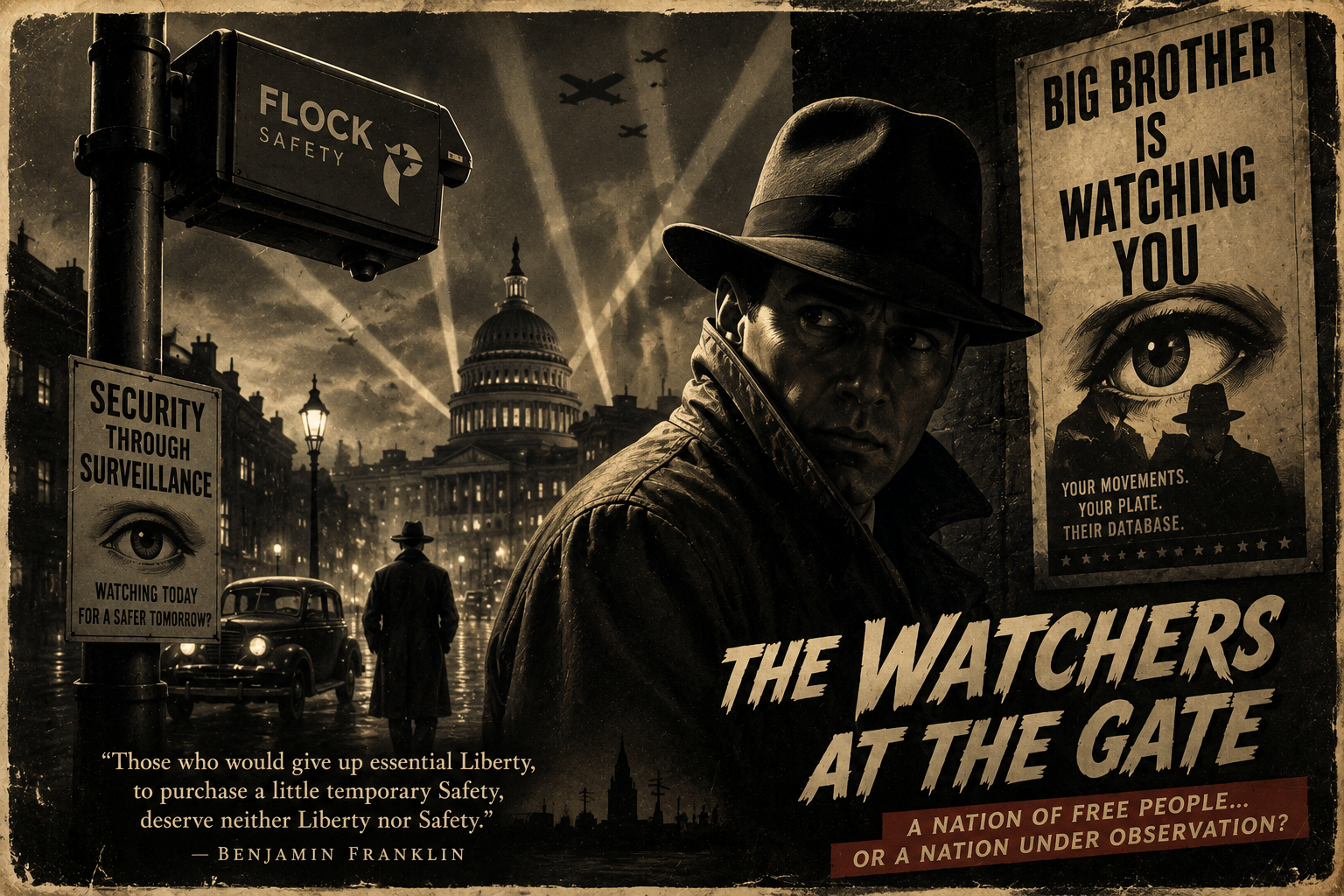
Benjamin Franklin’s warning is often quoted without its full historical context, but the principle it evokes remains alive: temporary fear can produce permanent power. A free society may decide that some surveillance is necessary. It may decide that certain public-safety benefits justify carefully limited observation. But that decision should be made openly, governed by law, tested with evidence, audited independently, and reversible by the people.
The question is not whether Americans must choose between safety and liberty. The question is whether they will demand enough discipline from government to preserve both.
Sources and Further Reading
- Flock Safety: company information, products, policies, and case studies
- Flock Safety: privacy and data practices
- Flock Safety: company response to mass-surveillance concerns
- Electronic Frontier Foundation: Automated License Plate Readers
- American Civil Liberties Union: Automatic License Plate Readers
- U.S. Supreme Court: United States v. Jones
- U.S. Supreme Court: Carpenter v. United States
- U.S. Supreme Court: Riley v. California
- U.S. Supreme Court: Kyllo v. United States
- U.S. Supreme Court: Katz v. United States
- UK College of Policing: CCTV crime-reduction evidence review
- UK Government: National ANPR standards
- Brennan Center for Justice: privacy and technology research
- U.S. Department of Justice: privacy, civil liberties, and ALPR systems
- National Criminal Justice Reference Service: CCTV systematic review and meta-analysis
- ACLU: scrutiny of Flock representations and local governance
- The Guardian: local opposition and contract disputes involving Flock cameras