
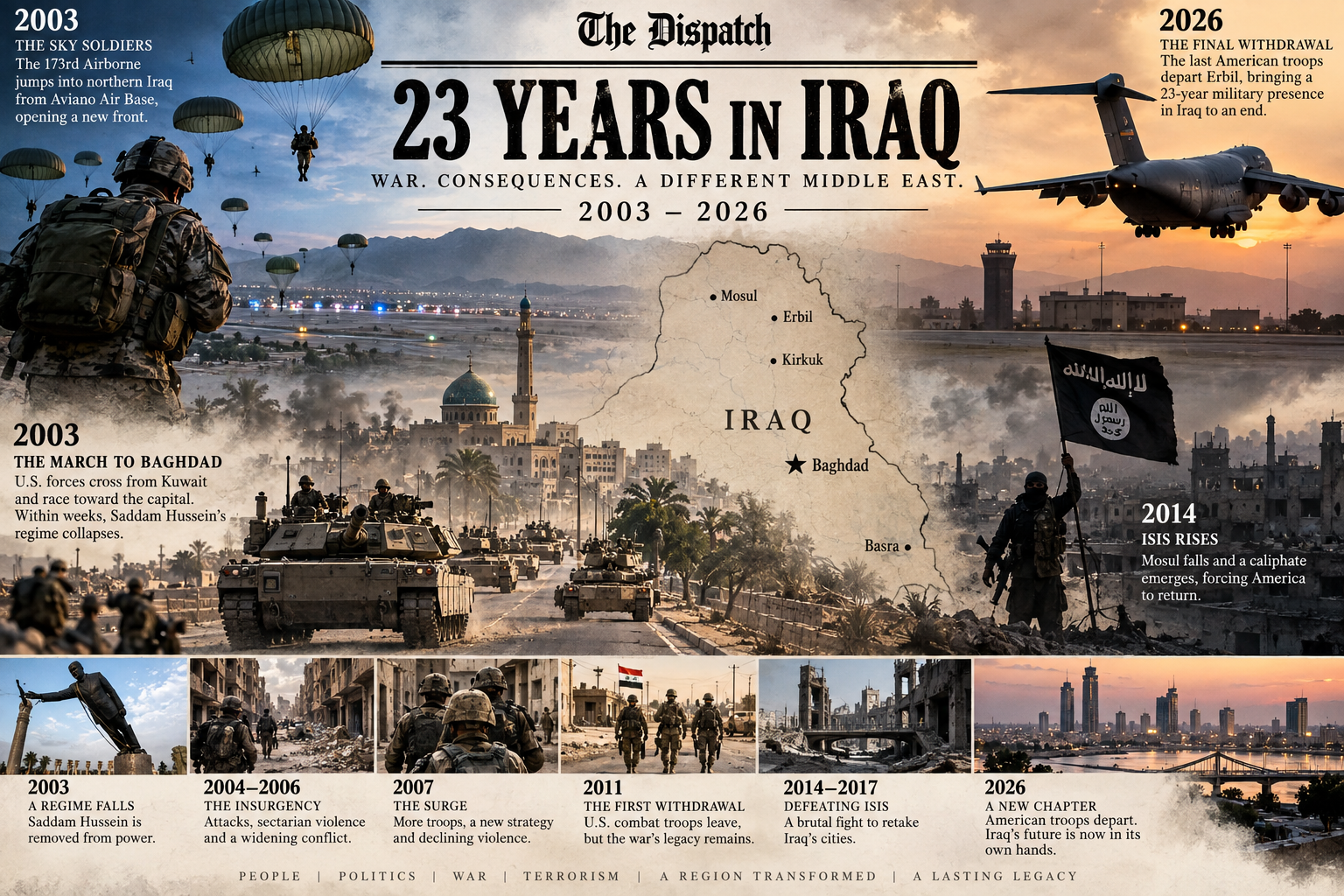
On September 30, 2026, the last American military forces departed Iraq.
U.S. Central Command announced that American forces and equipment had completed their departure from Erbil Air Base, formally ending the Operation Inherent Resolve military mission inside Iraq. The remaining counter-ISIS mission has shifted outside the country, while Washington and Baghdad say their relationship will transition toward more conventional bilateral security cooperation, including intelligence and training.
It is an extraordinary bookend to a story that began more than 23 years earlier.
In March 2003, American soldiers and Marines crossed the Kuwaiti border and raced north toward Baghdad. Hundreds of miles away, paratroopers stationed in Italy prepared for one of the largest American combat parachute operations in decades.
What followed would become something far larger than the invasion planners originally envisioned.
The United States would overthrow Saddam Hussein in weeks, fight an insurgency for years, become trapped in a sectarian civil war, conduct a troop surge, withdraw, return to fight the Islamic State, confront Iranian-backed militias, and finally leave again.
The March to Baghdad
Operation Iraqi Freedom began in March 2003 with a deceptively simple military objective: remove Saddam Hussein's regime.
The campaign was conducted in the shadow of September 11, 2001. The Bush administration argued that Iraq's suspected weapons-of-mass-destruction programs represented an unacceptable danger in the post-9/11 world.
Congress authorized military force in October 2002.
When diplomacy and weapons inspections failed to resolve the confrontation, the invasion began.
American and coalition forces attacked from Kuwait, with the U.S. Army's 3rd Infantry Division driving toward Baghdad while Marines advanced through southeastern Iraq.
The conventional campaign moved with astonishing speed.
American armored formations bypassed many Iraqi positions rather than becoming bogged down fighting for every town. Apache helicopters, artillery, precision airpower and armored units hammered Republican Guard formations attempting to defend Baghdad.
Within approximately three weeks, American forces had reached the capital.
On April 9, Baghdad fell to American forces. Images of Iraqis and American troops pulling down Saddam Hussein's statue in Firdos Square became one of the defining images of the war.
But while the world watched American armor enter Baghdad from the south, another extraordinary military operation was unfolding hundreds of miles to the north.
The Sky Soldiers Come to Iraq
The original invasion plan envisioned the U.S. 4th Infantry Division attacking Iraq from Turkey.
That never happened.
Turkey refused to permit American ground forces to launch the planned offensive through its territory, forcing U.S. commanders to improvise.
One of the answers was the 173rd Airborne Brigade.
Based in Vicenza, Italy, the brigade became the conventional American force capable of rapidly establishing a significant U.S. presence in northern Iraq.
On March 26, 2003, approximately 1,000 paratroopers boarded C-17 Globemaster III aircraft and launched from Aviano Air Base in Italy.
Their destination was Bashur Airfield in northern Iraq.
Then the jump lights came on.
The Sky Soldiers stepped into the darkness.
Operation Northern Delay became the first strategic brigade-sized airborne insertion using C-17s flying in formation and one of the largest American combat parachute operations since Panama.
Their mission was larger than simply capturing an airfield.
With the planned mechanized northern invasion blocked, the 173rd—working alongside U.S. Special Operations Forces and Kurdish Peshmerga—created a credible northern front.
Once Bashur was secured, American aircraft began delivering additional soldiers, vehicles and eventually armor.
The 173rd subsequently operated around Kirkuk and northern Iraq, helping secure strategically important territory and preventing Iraqi forces in the north from freely reinforcing Baghdad.
It was classic airborne doctrine executed on a massive scale: seize terrain, establish an airhead and rapidly build combat power behind it.
For many members of the 173rd, however, Iraq would not end when Saddam's army collapsed.
The difficult part was only beginning.
Winning the Invasion—Losing the Peace
On May 1, 2003, President George W. Bush announced that major combat operations had ended.
Militarily, the invasion had been remarkably successful.
Politically, Iraq was beginning to unravel.
The Iraqi government had collapsed. Police disappeared from the streets. Government buildings were looted. Weapons depots were stripped.
The Coalition Provisional Authority subsequently dissolved the Iraqi military and pursued an aggressive policy of removing members of Saddam's Ba'ath Party from government institutions.
Whatever the intentions behind those policies, the result was that enormous numbers of armed Iraqi men suddenly found themselves unemployed and politically excluded.
The U.S. Army's own official history later concluded that postwar planning had been inadequate compared with the planning devoted to defeating Saddam's military.
The resulting vacuum was filled by Sunni resistance groups, Islamic extremists, Shiite militias, Iranian influence and Kurdish political forces.
America had won Phase III—the invasion.
Phase IV—the occupation—would prove much harder.
The Insurgency
By late 2003, attacks against American troops were increasing.
Improvised explosive devices became one of the defining weapons of the war.
Roadside bombs struck Humvees, supply convoys and patrols. Suicide bombers attacked markets, mosques, government buildings and recruiting stations.
Saddam Hussein was captured in December 2003, but his capture did not end the violence.
Instead, the insurgency evolved.
Cities such as Ramadi and Fallujah became centers of resistance.
The First Battle of Fallujah in April 2004 and the Second Battle of Fallujah later that year demonstrated how far the conflict had moved from the rapid armored campaign of 2003.
American Marines and soldiers were now fighting house to house.
At the same time, photographs showing abuse of Iraqi prisoners at Abu Ghraib prison became public.
The scandal damaged America's international reputation and became a powerful propaganda tool for insurgent and extremist organizations.
The war was changing.
So was America.
Al-Qaeda in Iraq
Among the most consequential developments was the rise of Abu Musab al-Zarqawi.
His organization conducted bombings, assassinations and sectarian attacks designed not merely to kill Americans but to provoke a wider civil war between Iraq's Sunni and Shiite populations.
In 2004, Zarqawi pledged allegiance to Osama bin Laden.
His organization became al-Qaeda in Iraq—AQI.
That lineage matters when discussing the legacy of the invasion.
ISIS did not simply appear in 2014.
Its organizational ancestors developed during the Iraq insurgency.
The collapse of Saddam's authoritarian government, dismantling of state institutions, sectarian conflict, insurgency and later the Syrian civil war created an environment in which jihadist organizations could recruit, organize and evolve.
The 2003 invasion did not single-handedly “create ISIS.” Zarqawi's jihadist movement predated the invasion, and numerous later events contributed to ISIS's rise.
But the war in Iraq created conditions that AQI exploited extraordinarily effectively.
Iraq Descends Toward Civil War
The February 2006 bombing of the al-Askari Mosque in Samarra accelerated Iraq's sectarian bloodletting.
Sunni and Shiite armed groups increasingly targeted one another.
Neighborhoods became divided along sectarian lines.
Bodies appeared on Baghdad streets.
Death squads operated throughout the capital.
American troops increasingly found themselves fighting insurgents while simultaneously attempting to prevent Iraq from collapsing into full-scale civil war.
By 2006 and early 2007, many Americans believed the war was being lost.
Washington faced a choice.
Leave—or change strategy.
The Surge
President Bush chose the latter.
In 2007, more than 20,000 additional American troops were sent to Iraq as part of what became known as the Surge.
But additional troops were only part of the strategy.
American forces increasingly moved into Iraqi neighborhoods rather than operating primarily from large bases.
At the same time, Sunni tribal leaders who had grown increasingly hostile toward al-Qaeda began cooperating with American forces.
The resulting movement—the Anbar Awakening—helped turn thousands of Sunni fighters against AQI.
Violence declined dramatically.
The surge remains politically debated, particularly over how much credit belongs to additional American forces versus the Awakening, changing militia strategies and other developments.
But by 2008, Iraq was considerably more stable than it had been during the worst years of sectarian warfare.
America began preparing to leave.
The First Withdrawal
A U.S.-Iraq security agreement established the framework for American troops to depart.
President Barack Obama continued the withdrawal.
On December 18, 2011, the last American combat troops crossed from Iraq into Kuwait.
For many Americans, the Iraq War appeared over.
It wasn't.
Three years later, American troops would return.
ISIS: The War Returns
The remnants of al-Qaeda in Iraq had survived.
After Zarqawi's death in 2006, the organization evolved into the Islamic State of Iraq.
Then the Syrian civil war created another enormous power vacuum.
The organization expanded into Syria and eventually became ISIS—the Islamic State of Iraq and Syria.
In 2014, ISIS exploded across northern and western Iraq.
Mosul fell.
Entire Iraqi Army formations collapsed.
American-supplied equipment was abandoned.
ISIS captured huge territories across Iraq and Syria and declared a caliphate.
At its peak, the organization controlled roughly one-third of Iraq.
The United States returned at the invitation of the Iraqi government.
Operation Inherent Resolve began.
American forces increasingly served as advisers, intelligence providers and airpower coordinators while Iraqi security forces, Kurdish Peshmerga and other local forces conducted most ground combat.
The battle for Mosul became one of the largest urban battles since World War II.
By December 2017, Iraq declared ISIS territorially defeated inside the country.
The caliphate was collapsing.
But ISIS never completely disappeared.
Its surviving fighters dispersed into deserts, mountains and rural areas, forming sleeper cells and small insurgent networks.
That threat remains today.
The Iranian Shadow
Another consequence of Saddam Hussein's removal was equally important.
Iran gained enormous influence in Iraq.
This was one of the great geopolitical ironies of the war.
Saddam's Iraq had fought Iran for eight brutal years during the 1980s and had served as a powerful Arab counterweight to Tehran.
Removing Saddam destroyed that counterweight.
Iraq's new Shiite-dominated political system included numerous politicians and armed groups with longstanding connections to Iran.
Iran-backed militias became particularly powerful during the war against ISIS.
Many were incorporated into the Popular Mobilization Forces, but several maintained political and operational relationships with Tehran.
Iraq consequently developed an unusual geopolitical position.
It maintained important security and economic relationships with Washington while simultaneously maintaining deep political, religious and economic connections with Tehran.
That balancing act continues in 2026.
America Changes Its Mind About Iraq
Perhaps nowhere is the political legacy of Iraq more visible than in American public opinion.
In March 2003, approximately 73 percent of Americans believed using military force against Iraq was the right decision.
Early battlefield success pushed support even higher.
But insurgency, mounting casualties, Abu Ghraib, the failure to find the expected WMD stockpiles and worsening sectarian violence steadily changed public opinion.
By December 2007, only 36 percent told Pew that invading Iraq had been the right decision.
The transformation crossed party lines, although Democrats turned against the war substantially earlier than Republicans.
By 2011, 75 percent of Americans supported withdrawing American combat troops.
And in a later Pew retrospective, 62 percent said the Iraq War had not been worth fighting. Majorities of military veterans surveyed—including Iraq and Afghanistan veterans—also reached that conclusion.
Iraq helped reshape American politics.
It contributed to growing skepticism toward intelligence assessments, nation-building and large overseas military interventions.
It influenced Barack Obama's political rise.
Years later, Donald Trump would repeatedly criticize the invasion as a disastrous foreign-policy decision.
The political argument that began in 2002 never completely ended.
The Human Cost
Numbers cannot adequately describe Iraq.
But the numbers matter.
More than 4,000 American service members were killed during Operation Iraqi Freedom, with additional American deaths occurring during later operations.
Tens of thousands returned wounded.
Many more returned carrying injuries that were harder to see: traumatic brain injuries, post-traumatic stress, chronic pain, respiratory illnesses and the long-term effects of burn-pit and toxic exposure.
The Iraqi cost was vastly greater.
Estimating deaths from prolonged war is inherently difficult because researchers use different methodologies and definitions.
Brown University's Costs of War project estimates that the Iraq-Syria conflict associated with the post-2003 wars ultimately produced hundreds of thousands of direct deaths, with additional deaths resulting indirectly from displacement, destroyed infrastructure, disease and economic disruption. Its estimate for Iraq and Syria combined through 2023 was roughly 550,000–580,000 deaths.
Millions were displaced.
Entire Iraqi communities were transformed.
American families were transformed as well.
There are children graduating college today whose fathers or mothers deployed to Iraq before they were born.
There are soldiers who invaded Iraq in 2003 who are now approaching retirement age.
That is what a 23-year war looks like.
September 30, 2026
The final chapter arrived quietly compared with the invasion.
There was no Shock and Awe.
No armored dash toward Baghdad.
No statue falling in Firdos Square.
American personnel simply packed equipment, boarded aircraft and departed Erbil.
The withdrawal was the final stage of an agreement reached by Washington and Baghdad in 2024.
The original agreement envisioned ending the coalition mission in federal Iraq and eventually terminating the remaining Iraq-based support for operations against ISIS.
On September 30, CENTCOM announced that the departure from Erbil Air Base was complete.
Operation Inherent Resolve's mission inside Iraq was over. Its broader counter-ISIS structure continues outside Iraq, including from Jordan.
For the first time since the American return in 2014, there are no U.S. military forces stationed in Iraq as part of the coalition mission.
The relationship between the two countries, however, is not ending.
It is changing.
2003
Coalition forces invade Iraq; the 173rd Airborne jumps into Bashur and Baghdad falls within weeks.
2007
The Surge and Anbar Awakening coincide with a major reduction in sectarian and insurgent violence.
2014
ISIS captures Mosul and large areas of Iraq, bringing American forces back under Operation Inherent Resolve.
2026
American forces depart Erbil, ending the Operation Inherent Resolve military mission inside Iraq.
What Does Iraq Look Like Today?
Comparing Iraq in 2026 with Iraq in March 2003 produces no simple answer.
Some things are unquestionably better.
Others remain deeply troubled.
Saddam Hussein's dictatorship is gone.
Iraq now holds competitive parliamentary elections under its 2005 constitution. Parliament selects the president, who nominates the prime minister, whose government must obtain parliamentary approval. Political convention generally distributes the presidency to a Kurd, the premiership to a Shiite Arab and the parliamentary speakership to a Sunni Arab.
That represents an enormous political difference from Saddam's authoritarian rule.
But Iraq is not a fully consolidated liberal democracy.
Corruption remains deeply entrenched.
Militias continue operating with varying degrees of independence from Baghdad.
Sectarian and ethnic political parties remain powerful.
Iran exercises substantial influence.
Iraq holds regular competitive elections and provides representation for numerous ethnic and religious groups, while corruption, weak institutions and armed groups outside normal state control remain major obstacles to democratic governance.
Iraq's New Government
Iraq's November 2025 parliamentary elections produced another lengthy government-formation process.
In 2026, parliament selected Nizar Amedi as president, and Ali al-Zaidi became prime minister, taking office in May. The Shiite Coordination Framework remains a dominant parliamentary force.
The new government's central challenge is sovereignty.
Can Baghdad actually control all armed forces operating inside Iraq?
That question goes directly to Iran-backed militias.
Prime Minister al-Zaidi initially pledged to bring non-state armed groups under government authority in conjunction with the American withdrawal.
Powerful factions have resisted.
The deadline has consequently slipped into 2027.
This may become one of the defining questions of post-American Iraq.
Removing foreign troops is one form of sovereignty.
Establishing the state's monopoly over armed force is another.
Is Iraq an American Ally?
The answer is complicated.
Iraq is neither an American satellite nor an Iranian puppet.
Its government attempts to maintain relationships with both.
Washington retains substantial diplomatic, economic and security relationships with Baghdad.
The United States says the withdrawal transitions the relationship toward bilateral intelligence, training and security cooperation rather than ending it.
America also retains considerable economic influence.
Iraq remains extraordinarily dependent on petroleum. Oil accounts for the overwhelming majority of government revenue and merchandise exports.
Iraqi oil revenues also remain deeply connected to the American financial system through the Federal Reserve Bank of New York, giving Washington continuing financial leverage even after its soldiers have departed.
But Iran possesses different kinds of influence.
Religion.
Trade.
Political relationships.
Militias.
Geography.
Family and cultural connections.
Baghdad therefore tries to avoid choosing between Washington and Tehran.
Its preferred role is increasingly that of an independent regional state capable of dealing with both.
Whether it can actually maintain that balance remains uncertain.
Are Iraqis Better Off Than They Were in 2003?
This may be the hardest question of the entire war.
There is no single Iraqi experience.
A Kurdish family in Erbil, a Shiite family in Basra, a Sunni family in Fallujah and a Christian family displaced from Mosul may give radically different answers.
But several national indicators show meaningful improvement.
Life expectancy was roughly 65 years in 2003.
It is now approximately 72–74 years, depending on the dataset and methodology.
UNDP reports that Iraq entered the “high human development” category in 2024, with an HDI of 0.712.
Income poverty declined from 20.5 percent in 2018 to approximately 17.5 percent in 2024, while Iraq's multidimensional poverty measure has fallen substantially compared with the previous decade.
The economy is vastly larger in nominal terms than during the invasion era. World Bank data put 2025 GDP at roughly $254 billion and GDP per capita at approximately $5,410.
But those numbers hide serious problems.
Unemployment remains high.
Youth unemployment and underemployment are particularly serious.
The private sector remains weak.
Government employment is heavily dependent on oil revenue.
Electricity and water shortages persist.
Corruption consumes resources.
And regional conflict can rapidly threaten an economy overwhelmingly dependent upon petroleum exports.
So are Iraqis better off?
In health, communications, consumer access, political participation and several development indicators, many are.
In security, the answer depends heavily on which year is being compared.
In political freedom, Iraq today offers opportunities unimaginable under Saddam—but those freedoms coexist with corruption, militia intimidation and weak institutions.
And for families that lost relatives during the insurgency, sectarian civil war or ISIS occupation, statistics cannot adequately measure what was lost.
The Global Legacy of Iraq
The Iraq War changed far more than Iraq.
It transformed American military doctrine.
Counterinsurgency returned to military education.
MRAP vehicles were developed and deployed by the thousands.
IED detection, battlefield medicine, drone surveillance, intelligence fusion and special-operations integration advanced rapidly.
The war also shaped an entire generation of American service members.
But strategically, the consequences were enormous.
Removing Saddam eliminated one of Iran's greatest regional enemies.
The occupation contributed to an environment in which al-Qaeda in Iraq flourished.
AQI eventually evolved into ISIS.
ISIS then created an international terrorist network that inspired or directed attacks from Europe to Asia and the United States.
The Syrian civil war became intertwined with Iraq's instability.
Iranian-backed militias became institutionalized political and military actors.
Millions of refugees and displaced people reshaped regional politics and contributed to migration pressures reaching Europe.
And America's experience in Iraq dramatically reduced domestic enthusiasm for large-scale nation-building operations.
The consequences of the decision made in 2003 traveled far beyond Baghdad.
What Was Achieved?
Saddam Hussein is gone.
His sons are gone.
His regime is gone.
Iraq no longer threatens Kuwait with invasion.
Kurds no longer live beneath a government that once used chemical weapons against Kurdish civilians.
Iraqis vote.
Political parties compete.
Governments change.
ISIS's territorial caliphate was destroyed.
Those are real outcomes.
But they came alongside other realities.
The anticipated WMD stockpiles that played such a prominent role in the case for war were not found.
Thousands of Americans died.
Hundreds of thousands of Iraqis died across the wars that followed.
Millions were displaced.
Iran emerged with greater influence in Iraq than it possessed before the invasion.
And an extremist organization born from the insurgency eventually transformed into ISIS and forced American troops back into the country three years after they had left.
History rarely offers clean balance sheets.
Iraq offers none.
The Last Soldier Leaves
There is something profoundly different about this withdrawal compared with 2011.
In 2011, Americans hoped the story was finished.
It wasn't.
ISIS brought American troops back.
In 2026, Iraq's security forces are considerably more experienced. They have fought insurgents, militias and one of the most dangerous terrorist organizations of the modern era.
Baghdad says it can now defend the country.
That claim is about to be tested.
ISIS sleeper cells still exist. Iraqi and Kurdish officials reported renewed militant activity as the American withdrawal approached.
Iran-backed armed groups remain powerful.
Iraq's air defenses remain a concern.
Regional wars can still spill across its borders.
But these are now, increasingly, Iraq's problems to solve.
That may ultimately be the most important meaning of September 30, 2026.
Twenty-three years earlier, American soldiers crossed the border believing they were beginning a war that might last months.
Paratroopers from the 173rd climbed aboard C-17s at Aviano.
They flew through the darkness.
The jumpmaster opened the door.
The green light illuminated.
And nearly a thousand American paratroopers disappeared into the night above northern Iraq.
What followed lasted a generation.
Soldiers became veterans.
Lieutenants became colonels.
Children born during the invasion grew old enough to serve in the same country where their parents had fought.
America invaded Iraq, occupied it, fought an insurgency, confronted civil war, withdrew, returned, defeated a caliphate and spent another decade preventing its return.
Now the bases are empty.
The aircraft have departed.
For the first time in more than two decades, the future of Iraq will unfold without American troops stationed on Iraqi soil.
Whether that future vindicates any part of the enormous investment America made there will be debated for decades.
But one thing is no longer debatable.
And for the men and women who spent part of their lives beneath the Iraqi sun—from Baghdad and Fallujah to Ramadi, Mosul, Kirkuk, Balad, Tikrit, Al Asad and Erbil—the end of the mission does not erase the war.
It simply marks the moment when the country they fought in finally became responsible for writing what comes next.
Sources and Further Reading
- U.S. Central Command / DVIDS: U.S. Forces End Operation Inherent Resolve Mission in Iraq
- U.S. Army: Operation Northern Delay and the 173rd Airborne Brigade
- U.S. Army Center of Military History: Chronology of Army History
- U.S. Army / Department of Defense: The U.S. Army in the Iraq War
- Pew Research Center: A Look Back at U.S. Public Support for the Iraq War
- Brown University Costs of War: Blood and Treasure—20 Years of War in Iraq and Syria
- World Bank: Iraq Overview and Development Data
- UNDP Iraq: Human Development and Multidimensional Poverty
- Freedom House: Iraq — Freedom in the World 2026
- UK House of Commons Library: Iraq Politics and Government