
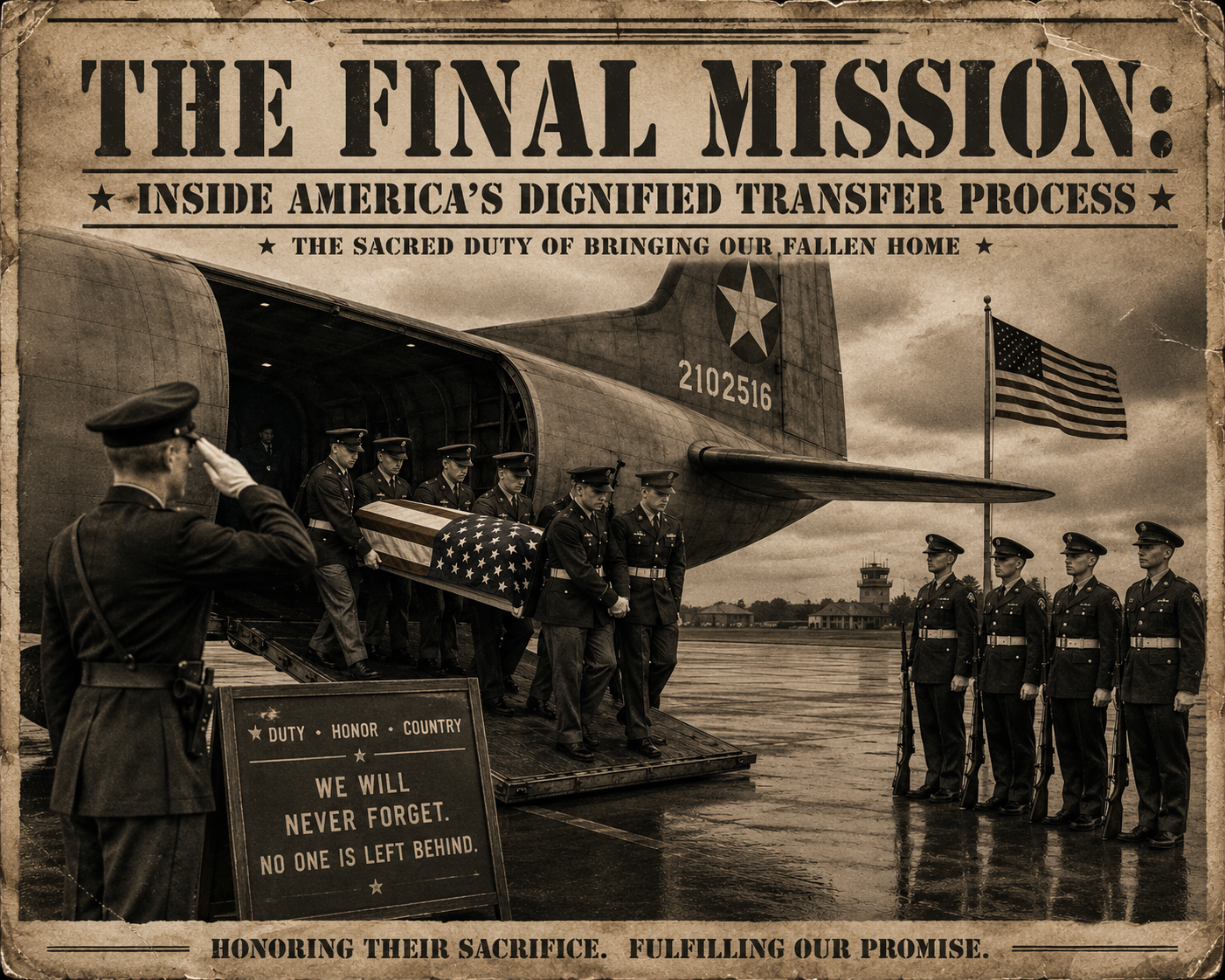
“No one is left behind.”
Those words have become one of the defining promises of the United States military. They are spoken in combat zones, repeated in training, and carried in the hearts of service members deployed around the world. But that promise does not end when the fighting stops. It continues until America’s fallen have been recovered, identified, returned to their families, and laid to rest with honor.
For most Americans, the term dignified transfer evokes a brief and unforgettable image: a flag-draped transfer case emerging from the cargo hold of a military aircraft, a silent carry team moving in perfect step, senior leaders standing at attention, and grieving family members waiting nearby as their loved one begins the final journey home. What the public rarely sees is the extraordinary network of military members, mortuary specialists, aircrews, forensic experts, casualty officers, escorts, chaplains, funeral directors, and support personnel behind those solemn minutes.
Every salute, every measured step, every hand placement, and every fold of the flag carries meaning. A dignified transfer is not simply a transportation procedure. It is one of the most sacred responsibilities entrusted to the United States Armed Forces.
A Tradition Forged Through American History
The respectful recovery of fallen warriors is far older than the United States. Ancient armies recognized that the treatment of the dead reflected the character of the living. Temporary truces were sometimes negotiated so opposing forces could recover those killed in battle, and abandoning a comrade’s body was considered a grave dishonor.
America inherited that moral obligation, but the realities of early warfare made returning the dead home extremely difficult. During the Revolutionary War and the War of 1812, those killed were commonly buried near the place of death. Transportation was slow, preservation methods were primitive, and recordkeeping was inconsistent. Families often received only a letter—or no confirmed information at all.
The Civil War fundamentally changed public expectations. The war killed Americans on an unprecedented scale, often far from home. The growth of railroads, improvements in embalming, the work of the U.S. Sanitary Commission, and the creation of national cemeteries made organized recovery and transportation more possible. President Abraham Lincoln’s funeral train also demonstrated the emotional power of a fallen American being carried home through a mourning nation.
Even then, however, thousands of soldiers were buried as unknowns or remained where they fell. Identification relied on personal papers, uniform markings, possessions, dental features, and the testimony of comrades. Metal identification tags were not yet standard issue.
“Bring Them Home”: The Spanish-American War and a New National Commitment
The Spanish-American War marked a major shift in American policy. The United States undertook a broad effort to recover and return its war dead from overseas, particularly from Cuba and Puerto Rico. The undertaking was controversial, expensive, and logistically difficult, but it established an expectation that would distinguish the American approach to casualty recovery: the nation would make an extraordinary effort to return its fallen.
That commitment expanded during World War I. The federal government created a more formal Graves Registration Service, improved identification procedures, and developed systems for temporary battlefield burial followed by permanent disposition. Families were eventually offered choices that included return to the United States or burial in an American military cemetery overseas.
Those choices carried deep emotion. Some families wanted their loved one brought back to the hometown cemetery. Others believed the fallen should remain beside the comrades with whom they had fought. Both decisions were treated as honorable.
World War II and the Birth of the Modern Recovery System
World War II transformed casualty recovery on a global scale. More than 400,000 Americans died during the conflict. Graves Registration units followed advancing forces across Europe, North Africa, and the Pacific, establishing temporary cemeteries, documenting remains, collecting personal effects, and attempting identification under conditions that were often dangerous and traumatic.
After the war, the United States conducted a massive repatriation program. Families were again asked whether they wanted their loved ones returned to the United States or permanently buried overseas. Ships and aircraft carried thousands of fallen Americans across oceans. The effort took years and required coordination among military units, diplomats, funeral homes, railroads, local governments, and families.
The Korean and Vietnam Wars further refined identification and transportation procedures. Advances in aviation shortened the time between death overseas and return to the United States. Fingerprints, dental records, blood typing, radiographs, and eventually DNA analysis gave investigators tools earlier generations did not possess.
The modern system is faster and more scientifically advanced, but its central purpose remains unchanged: recover the fallen, establish identity, maintain accountability, preserve dignity, and return the service member to the people who loved them.
What a Dignified Transfer Is—and What It Is Not
A dignified transfer is the solemn movement of a fallen service member from an aircraft to a transfer vehicle at the arrival installation. It is often associated with Dover Air Force Base, Delaware, which serves as the primary entry point for service members who die in overseas contingency operations and other circumstances requiring mortuary processing.
The dignified transfer is not a funeral. It does not include a eulogy, rifle volley, the playing of “Taps,” or presentation of the burial flag. Those honors generally occur later at the funeral or interment. The transfer is deliberately quiet, restrained, and operational. Its dignity comes from precision, military bearing, and the shared understanding of everyone present.
The official focus is the fallen service member and the family. The event is not conducted for spectacle. Media access, when permitted, is governed by policy and the wishes of the primary next of kin. This balance reflects two important responsibilities: respecting family privacy and allowing the American people, when the family agrees, to witness the human cost of military service.
Dover Air Force Base: America’s Gateway Home
At Dover Air Force Base, Air Force Mortuary Affairs Operations and the Charles C. Carson Center for Mortuary Affairs perform one of the military’s most demanding missions. Personnel receive fallen service members, conduct mortuary processing, coordinate forensic examination, prepare remains for final disposition, and work with the service branches and families.
The center brings together mortuary officers, embalmers, autopsy and forensic personnel, dress-and-restoration specialists, personal-effects specialists, chaplains, mental-health professionals, administrators, and transportation experts. Their work may involve remains that are intact, fragmented, burned, commingled, or recovered long after death.
The professionalism required is both technical and emotional. Personnel must maintain exact chain-of-custody procedures while never losing sight of the fact that every case represents a person and a family. Clothing is prepared carefully. Decorations and insignia are verified. Personal effects are inventoried and protected. Identification is confirmed through scientific and documentary evidence.
Nothing is treated as routine, even when the procedures are familiar.
The Flag-Draped Transfer Case
The rectangular aluminum container seen during a dignified transfer is properly called a transfer case. It protects the remains during transportation and allows the service member to be moved safely and respectfully through multiple stages of the journey.
The transfer case is draped with the flag of the United States. The union—the blue field of stars—is positioned over the service member’s left shoulder area. The flag is kept taut, centered, and secure. It is not allowed to touch the ground.
The use of the flag makes the movement instantly recognizable as a national act of honor. Yet participants are trained to remember that the flag does not turn the transfer case into a symbol alone. Inside is an individual service member with a name, a history, a family, and a life interrupted.
The Carry Team: Respect Made Visible
The carry team performs the most visible duty during the transfer. Team members are selected, trained, and rehearsed to move the transfer case from the aircraft to the waiting vehicle with flawless control.
The work is physically demanding. A transfer case may be heavy, the aircraft ramp may be steep, and weather conditions can include rain, snow, wind, extreme heat, or freezing temperatures. The team must maintain even weight distribution, consistent pace, correct hand placement, and synchronized turns.
Precision is not pursued for theatrical effect. It protects the remains, preserves the flag, and demonstrates respect. The team’s discipline communicates what words cannot: this person mattered, this sacrifice is recognized, and this final movement will be performed correctly.
Commands are limited and controlled. There is no casual conversation. Salutes are rendered at designated moments, and everyone on the flight line maintains appropriate military bearing. The result is a ceremony defined not by noise, but by silence.
The Ramp Ceremony
When the aircraft arrives, senior military representatives, members of the fallen service member’s branch, chaplains, mortuary personnel, and family members may be present. The aircraft is positioned, the surrounding area is secured, and the movement begins only after coordination is complete.
The carry team boards the aircraft, approaches the transfer case, and lifts on command. The team then moves down the ramp at a slow, deliberate pace. At the appropriate point, those assembled render honors. The transfer case is carried to a specialized vehicle and secured for movement to the mortuary facility.
The ceremony may last only several minutes. For the family and the people performing it, however, those minutes often remain vivid for life.
Customs and Courtesies Across the Services
Department-wide mortuary policies create common standards, but every service brings its own culture and traditions to the mission. Differences may appear in uniforms, unit representation, service terminology, ceremonial drill, and the offices responsible for casualty assistance. The underlying obligations—dignity, accountability, precision, and compassion—are shared by all.
United States Army
Army carry teams reflect the service’s drill traditions and emphasis on disciplined movement. Casualty Assistance Officers guide families through notification, benefits, funeral planning, records, personal effects, and long-term survivor programs.
United States Marine Corps
The Marine Corps applies its ethos of fidelity beyond death. Marine representatives, escorts, and casualty personnel emphasize personal accountability to the fallen Marine and sustained contact with the family.
United States Navy
Navy customs draw upon centuries of maritime tradition, including reverence for those lost at sea. Navy casualty personnel coordinate honors, escorts, transportation, and long-term assistance for surviving families.
United States Air Force
Airmen are central to airlift, port mortuary operations, and dignified transfers at Dover. Air Force teams combine ceremonial precision with the technical responsibilities of global transportation and mortuary care.
United States Coast Guard
The Coast Guard renders the same military respect to members lost in maritime rescue, law enforcement, homeland defense, aviation, and overseas operations, supported by its casualty and Gold Star programs.
United States Space Force
As the newest armed service, the Space Force follows Department of Defense mortuary and casualty standards while developing service-specific traditions for honoring fallen Guardians and supporting their families.
During a dignified transfer, personnel in uniform generally stand at attention and salute when directed under the established protocol. Civilian participants place the right hand over the heart when appropriate. Uniform and ceremonial details are carefully controlled, because inconsistency can distract from the person being honored.
Rank does not determine the level of dignity. A junior enlisted service member receives the same careful movement and national respect as a general or admiral. The ceremony honors service and sacrifice, not status.
The Military Escort: The Final Traveling Companion
The military escort—sometimes called a person authorized to direct disposition escort or remains escort depending on the circumstance and service procedures—accompanies the fallen during the journey to the funeral home or final destination. The escort may be a member of the deceased’s unit, a friend, or another qualified service member selected for the assignment.
The escort’s responsibilities are practical, ceremonial, and deeply personal. The escort maintains awareness of the remains throughout transportation, coordinates with airline and airport personnel, verifies transfers between carriers and funeral directors, safeguards required documentation, and immediately addresses delays or irregularities.
When commercial air travel is used, the escort may remain with the casket or transfer case as long as security and operational rules permit. At intermediate stops, the escort confirms that the remains have been transferred correctly. Upon arrival, the escort observes the movement to the receiving funeral home and ensures the proper representative accepts custody.
The escort is also a visible representative of the military to the family. That duty requires judgment and humility. Some families want stories about their loved one. Others want silence. Some ask detailed questions about the final mission. Others cannot bear to hear them. The escort must respect the family’s pace and never make the moment about the escort’s own grief.
For someone who knew the fallen personally, the assignment can be emotionally overwhelming. The escort may be grieving while simultaneously maintaining uniform standards, tracking documents, coordinating travel, and supporting relatives. Many later describe the duty as the hardest honor of their career.
Personal Effects: Returning the Pieces of a Life
Alongside the return of remains is another sensitive mission: the recovery, inventory, cleaning, and delivery of personal effects. A wallet, wedding ring, watch, identification card, notebook, photograph, religious item, or piece of field gear may carry enormous meaning for a family.
Personal-effects personnel document items carefully and preserve their chain of custody. Some objects can be cleaned and returned. Others may be damaged, contaminated, or retained temporarily as part of an investigation. Families must be informed with honesty and compassion.
These belongings can become the last physical connection to a service member. Their handling is therefore not a secondary administrative task. It is part of the same sacred obligation.
Supporting Gold Star Families
The military’s responsibility does not end when the transfer case reaches American soil. Each service maintains a casualty assistance structure to help surviving families navigate notification, funeral arrangements, travel, burial benefits, survivor compensation, insurance, legal questions, investigations, personal effects, and military records.
The assigned casualty assistance officer serves as the family’s principal guide through a process that can otherwise be overwhelming. Families may be asked to make consequential decisions while experiencing shock and grief. The officer explains options, helps complete forms, coordinates with agencies, and ensures the family understands available benefits.
Long-term programs extend beyond the funeral. Army Survivor Outreach Services, the Marine Corps Long Term Assistance Program, the Navy Gold Star Program, Air Force Families Forever, and the Coast Guard Gold Star Program provide continuing connections and advocacy. Gold Star and Surviving Family Member Liaisons can intervene when survivors encounter problems receiving authorized assistance or benefits.
Nonprofit organizations also play a critical role. The Tragedy Assistance Program for Survivors offers peer support, grief resources, youth programs, mentoring, seminars, and connections among military survivors. Other organizations provide counseling, retreats, scholarships, remembrance events, and assistance for children who grow up without the parent they lost.
Gold Star support is not charity. It is the continuation of a national obligation created by the service member’s sacrifice.
Stories That Define the Mission
The dignified transfer is not defined by protocol alone. Its meaning is found in the individual stories behind every flag-draped transfer case. Across generations of conflict, Americans have crossed oceans, climbed mountains, searched dense jungles, excavated crash sites, and returned to battlefields decades after the guns fell silent to fulfill a promise made to every service member.
The names change. The wars change. The uniforms change. The mission does not.
World War II: The Long Journey of the USS Oklahoma Sailors and Marines
On the morning of December 7, 1941, the battleship USS Oklahoma was moored at Ford Island in Pearl Harbor when Japanese aircraft attacked. Multiple torpedoes struck the ship, causing it to roll and capsize with terrifying speed. Hundreds of sailors and Marines were trapped in the overturned hull.
Rescue crews cut through the exposed bottom of the ship and pulled some men alive from compartments beneath the waterline. For many others, there was no escape. A total of 429 crew members were killed.
Recovery work continued as the wreck was raised and entered. The condition of the remains, the passage of time, and the limits of 1940s forensic science made individual identification extraordinarily difficult. Remains were initially buried in cemeteries on Oahu, later disinterred for attempted identification, and then reburied as unknowns at the National Memorial Cemetery of the Pacific—the Punchbowl.
For decades, families knew their relatives had died aboard the Oklahoma, but many did not have an individually identified grave. The uncertainty became an inheritance passed from parents to siblings, nieces, nephews, and grandchildren.
The breakthrough came through persistent historical research and modern forensic science. Limited disinterments beginning in the early 2000s demonstrated that additional identifications were possible. In 2015, the Department of Defense authorized the full disinterment of the remaining USS Oklahoma unknowns.
At the Defense POW/MIA Accounting Agency laboratory, specialists confronted a difficult reality: earlier recovery and burial practices had resulted in extensive commingling. Anthropologists, odontologists, historians, genealogists, and DNA specialists had to reconstruct individual identities from thousands of skeletal elements and decades-old records.
They compared dental charts, personnel files, chest radiographs, mitochondrial DNA, Y-chromosome DNA, autosomal DNA, age estimates, stature, skeletal characteristics, and material evidence. Families supplied DNA reference samples, sometimes without knowing whether the effort would succeed.
It did succeed—on a historic scale. By June 2021, DPAA reported that 338 individuals from the USS Oklahoma had been identified, representing nearly 86 percent of the unknowns and the first successful completion of an identification project of such scope and complexity.
One of those cases was Marine Corps Private First Class John F. Middleswart, a 19-year-old from San Diego. He was accounted for on January 28, 2021, becoming the 300th identification of the project. Nearly eight decades after Pearl Harbor, his name was restored to his remains.
Across the country, families received notifications that once seemed impossible. Identified service members were returned for burial in hometown cemeteries or reinterred with individual recognition. Military escorts accompanied them. Honor guards rendered salutes. Flags were folded and presented to relatives who had inherited the memory of someone they never had the chance to know.
The USS Oklahoma project demonstrated that the promise to bring the fallen home has no expiration date. The war was over. The generation that fought it was disappearing. But the duty remained.
Vietnam: Captain Douglas David Ferguson’s Final Wingman
On December 30, 1969, Air Force First Lieutenant Douglas David Ferguson flew in the rear seat of an F-4D Phantom II assigned to the 555th Tactical Fighter Squadron. His aircraft commander was Captain Fielding Featherston. The crew was conducting an armed reconnaissance mission over Laos.
Ferguson had recently received the Silver Star. During the mission, the F-4 formation attacked a target, and Ferguson’s aircraft completed two passes. On the final pass, the Phantom went down. Ferguson and Featherston were declared missing. Ferguson was later promoted to captain.
His name was inscribed on the Vietnam Veterans Memorial and at the National Memorial Cemetery of the Pacific, but his family had no remains to bury. Like thousands of Vietnam-era families, they lived with the particular grief of the missing: death without physical return, uncertainty mixed with hope, and years measured by official updates that often brought no resolution.
Recovery teams continued working in Southeast Asia long after the war. Investigators studied wartime reports, interviewed witnesses, surveyed terrain, and excavated suspected crash sites. The work was slow and physically demanding. Tropical vegetation, unstable soil, unexploded ordnance, fragmented wreckage, and the passage of decades complicated every search.
Remains connected to Ferguson’s loss were eventually recovered and identified through the joint POW/MIA accounting process. In 2014—more than forty-four years after his aircraft went down—Ferguson was prepared for his final journey to Tacoma, Washington.
Air Force Captain Jason Christie was assigned to serve as his military escort. Christie traveled with Air Force funeral director Danielle Van Orden to the identification facility in Hawaii. There they met members of Ferguson’s family, including his nephew, retired Marine Corps Lieutenant Colonel Bryan Scott, and his cousin Sally Savard.
The group accompanied Ferguson home together. Their journey included grief, stories, laughter, and the growing realization that they were completing a mission delayed for nearly half a century. They adopted a simple phrase—“What would Doug do?”—as they prepared for the welcome he had been denied in 1969.
At Seattle-Tacoma International Airport, a military honor guard transferred Ferguson’s remains to a waiting hearse. Police officers, firefighters, Airmen, community members, and Patriot Guard Riders participated in the procession. Many of the riders were Vietnam veterans escorting one of their own.
At the funeral, a small wooden box was placed where people who had worn POW/MIA bracelets bearing Ferguson’s name could leave them. For decades, those bracelets had represented an unresolved promise. Placing them in the box marked the end of the vigil: the missing Airman had returned.
Christie had not worn Ferguson’s bracelet, but he wanted to leave something of his own. Earlier in his career he had been an aircraft maintainer, part of a profession built around launching aircraft safely and ensuring they returned. With the family’s permission, he removed his maintenance badge and placed it in the box.
He described Ferguson as his “final wingman.” The gesture captured the meaning of the escort duty. Christie could not change what happened over Laos. He could not give the family back the lost decades. But he could ensure that, on the last leg of the journey, Ferguson was not alone.
The Global War on Terror: A Freezing Rain at Dover
On February 22, 2010, a Boeing 757 came to a stop on the runway at Dover Air Force Base as freezing rain struck the aircraft. Inside were Army Staff Sergeant Michael David P. Cardenaz of Corona, California, and Army Private First Class Jesus “JR” Salvacion of Ewa Beach, Hawaii. Both had been killed in Afghanistan days earlier.
Their return was not marked by cheering crowds or ceremonial fanfare. It was marked by silence.
On the flight line, an Army carry team waited in formation. Senior leaders and officials stood nearby. Mortuary personnel, aircrew members, security forces, and support staff had already coordinated the arrival. Every person had a designated position and responsibility.
When the aircraft was ready, the carry team entered and approached the flag-draped transfer cases. On command, the Soldiers lifted each case and moved down the aircraft ramp. Their steps remained synchronized despite the weather and the weight. The flags stayed level.
Each transfer case was carried to a waiting vehicle that would take the fallen to the mortuary operations center. Salutes were rendered. Doors closed. The vehicles departed.
The visible ceremony lasted minutes, but it was only one part of a much larger operation. Before the aircraft landed, units overseas had recovered and prepared the fallen. Aircrews had transported them across continents. Documentation and chain of custody had been maintained through every transfer. After arrival, mortuary specialists would continue identification, examination, preparation, and coordination with each family and service branch.
Cardenaz and Salvacion returned together, but each would leave Dover on an individual journey to a different family and community. Escorts would accompany them. Funeral homes would receive them. Honor guards would stand final watch.
The scene in the freezing rain represented the modern dignified transfer as the nation came to know it during the wars in Afghanistan and Iraq: operationally precise, emotionally restrained, and intensely personal. There were no speeches because none were needed. The flag-draped cases, the rigid salutes, and the silence communicated the cost.
The Hidden Weight Carried by Those Who Serve the Fallen
Dignified-transfer and mortuary duties can leave lasting emotional effects on the people who perform them. Carry-team members may remember the weight of a case, the expression of a parent, or the sound of rain on an aircraft decades later. Escorts may form enduring relationships with surviving families. Mortuary specialists may work repeatedly with the consequences of combat while being expected to maintain flawless technical standards.
Strong programs recognize that these personnel also require care. Chaplains, behavioral-health professionals, peer support, leadership engagement, rest cycles, and unit cohesion help them process the mission. Seeking support does not diminish the honor of the duty. It helps preserve the people entrusted to perform it.
A Mission That Never Ends
Even after burial, America’s commitment continues. Recovery teams still search Pacific islands and European forests. Investigators still examine maps, eyewitness accounts, aircraft records, and battlefield reports. Divers survey wrecks. Archaeologists excavate crash sites. Scientists compare DNA with samples donated by relatives.
Each identification triggers another chain of solemn duties: notification, preparation, transportation, escort, funeral honors, and return to a family. Sometimes the next of kin is a sibling who remembers the service member. Sometimes it is a niece, nephew, or grandchild born decades after the war.
The words delivered to the family remain among the most powerful the government can offer: your loved one has been accounted for.
More Than Ceremony
To an outside observer, a dignified transfer may appear to be a carefully choreographed military ritual. To those who perform it, it is far more.
Every salute represents gratitude. Every measured step reflects discipline. Every flag symbolizes a nation acknowledging an immeasurable sacrifice. For the carry teams, escorts, casualty assistance officers, mortuary specialists, pilots, maintainers, chaplains, forensic scientists, and countless others involved, this is the final act of service they can provide to a fellow American who can no longer speak for themselves.
In an age of rapid headlines and fleeting attention, the dignified transfer endures because it expresses the military’s highest values. It tells a grieving family that their loved one will not return as anonymous cargo, but as a son or daughter, husband or wife, mother or father, brother or sister—a service member whose life and sacrifice are worthy of the nation’s deepest respect.
The journey home is the final mission. It is carried out with quiet professionalism, unwavering precision, and profound compassion.
In that solemn procession, the United States keeps one of its oldest and most sacred promises:
Sources and Further Reading
- Defense POW/MIA Accounting Agency: Update on Pearl Harbor Identifications
- Defense POW/MIA Accounting Agency: USS Oklahoma Remains Honorable Carry
- Defense POW/MIA Accounting Agency: Marine Pfc. John F. Middleswart Accounted For
- U.S. Air Force: Captain Honored to Escort Fallen Vietnam Hero Home
- Defense Visual Information Distribution Service: Dignified Transfer Pays Tribute to Fallen
- Military OneSource: Casualty Assistance Program
- Military OneSource: Gold Star and Surviving Family Member Liaisons
- Tragedy Assistance Program for Survivors