Traumatic brain injury has become one of the defining medical issues of the post-9/11 veteran generation, yet it remains remarkably easy to misunderstand.
A traumatic brain injury, or TBI, does not always involve a dramatic battlefield wound, a skull fracture, or an extended period of unconsciousness. A person can sustain a brain injury, remain on their feet, finish a mission, return to work, and only later realize that something has changed.
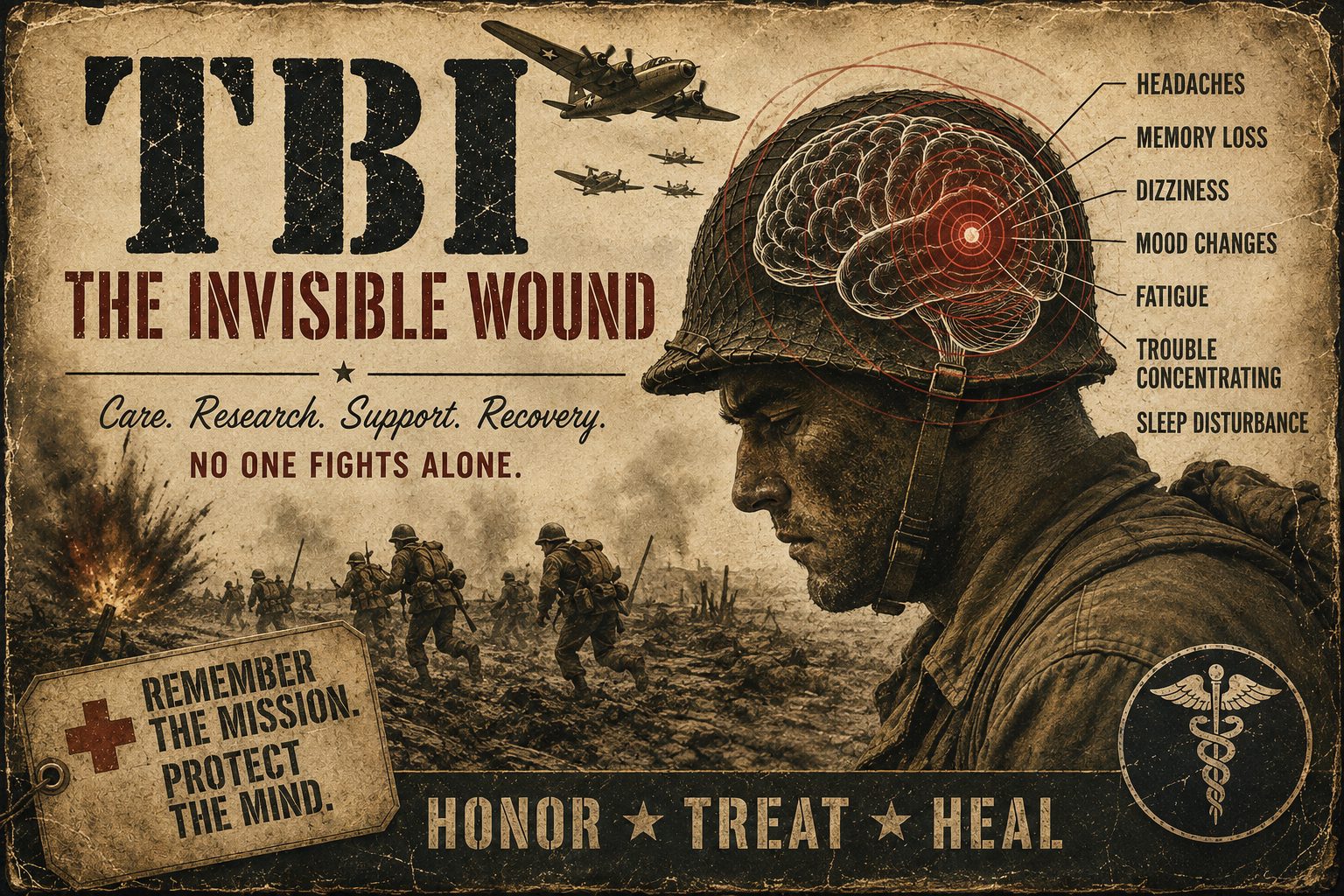
The headaches may not stop. Sleep becomes difficult. Concentration disappears halfway through a conversation. Names and appointments become harder to remember. Bright lights or crowded rooms suddenly become exhausting. A normally patient person becomes irritable. Anxiety increases. Balance feels slightly off. A ringing in the ears becomes impossible to ignore.
For military personnel in particular, the injury may have occurred years earlier during an improvised explosive device attack, mortar blast, vehicle accident, breaching operation, parachute landing, training exercise, combatives session, or repeated exposure to heavy weapons.
That history matters because traumatic brain injury is not one single disease with one single presentation.
It is an injury to the brain that can produce cognitive, physical, behavioral, emotional, sensory, and neurological consequences that vary enormously from one person to another.
The Department of Defense defines TBI as a disruption of normal brain function caused by an external force, including a blow or jolt to the head. The overwhelming majority of military TBIs have historically been classified as mild TBIs, commonly called concussions. DoD data show that more than 80% of diagnosed service-member TBIs from 2000 through 2024 were classified as mild.
For veterans who continue to live with those symptoms—and for families trying to understand what happened to the person they knew before an injury—understanding TBI begins with understanding how the brain is injured in the first place.
What Actually Happens During a Traumatic Brain Injury?
The brain is a soft, highly organized organ suspended inside a rigid skull.
When the head experiences sudden acceleration, deceleration, rotation, penetration, or pressure, the brain can move or deform within the skull. Brain tissue may stretch, twist, compress, bruise, bleed, or undergo microscopic cellular changes.
Depending on the severity and mechanism of injury, this can disturb the networks responsible for memory, emotional regulation, concentration, movement, sleep, balance, sensory processing, language, judgment, and dozens of other functions.
Severe injuries may be obvious on CT or MRI because physicians can see bleeding, swelling, bruising, skull fractures, or structural damage.
Mild traumatic brain injury is more complicated.
A conventional CT scan or MRI may appear normal even when a legitimate concussion has occurred. VA researchers specifically note that mTBI can be difficult to identify because there may be no visible injury on conventional imaging and because its symptoms can overlap with conditions such as PTSD.
This is one of the reasons a normal brain scan does not automatically mean that a person never suffered a concussion.
Diagnosis involves the entire clinical picture.
How TBIs Happen
In the civilian population, traumatic brain injuries commonly result from falls, automobile crashes, sports injuries, assaults, workplace accidents, bicycle accidents, and other incidents involving impact or rapid movement of the head.
Military service adds several unique mechanisms.
Service members can certainly experience the same falls, traffic accidents, sports injuries, and training accidents as civilians. But military occupations also expose personnel to explosions, weapons fire, breaching charges, artillery, rockets, mortars, grenades, aircraft operations, parachuting, armored vehicles, hand-to-hand training, and other situations capable of generating substantial forces.
Blast-Related TBI
Blast injury deserves particular attention.
An explosion can injure a person through several different mechanisms.
The pressure wave itself can interact with the body and brain. Fragments or debris propelled by the explosion can strike or penetrate the head. The blast can physically throw a person into a wall, vehicle, ground, or other object. Additional effects can come from burns, smoke, toxic exposures, or other consequences of the explosion.
Military blast researchers describe primary blast injuries associated with the pressure wave as well as secondary injuries from fragments and tertiary injuries resulting from acceleration and blunt-force trauma.
The result is that a single explosion can expose the brain to several injury mechanisms simultaneously.
And not every military blast exposure occurs during combat.
The Emerging Concern Over Repeated Low-Level Blast Exposure
A major area of current military brain-health research involves repetitive blast overpressure.
Personnel working around shoulder-fired weapons, artillery, mortars, explosives, breaching charges and certain heavy weapons can experience repeated pressure waves during training over the course of a career.
That does not mean every pressure wave produces a concussion.
It does mean researchers are increasingly examining whether cumulative exposure may matter.
The Department of Defense has acknowledged that service members may experience blast exposure without immediately meeting criteria for a diagnosable injury while still potentially experiencing effects on the brain. DoD's Traumatic Brain Injury Center of Excellence is studying blast thresholds and developing tools for clinicians dealing with occupational blast exposure.
Recent military research has also associated repeated low-level blast exposure with increased risk for deployment-related mild TBI, while studies of Special Operations personnel have identified associations between repeated blast exposure and changes in brain structure, brain function, and quality-of-life measures. This remains an active area of research rather than proof that every exposed service member has sustained brain damage.
That distinction is important.
Scientists are attempting to determine where ordinary exposure ends and biologically meaningful injury begins.
Mild, Moderate and Severe TBI
TBI severity is typically determined by what happened around the time of the injury rather than simply by how badly someone feels years afterward.
Physicians consider factors including loss or alteration of consciousness, post-traumatic amnesia, neurological responsiveness and abnormalities found on imaging. VA researchers note that CT findings, duration of loss or alteration of consciousness, duration of memory loss and responsiveness after the injury are among the tools used in assessing severity.
A mild TBI is commonly synonymous with concussion.
Someone may have been dazed, confused or disoriented without completely losing consciousness.
Moderate and severe TBIs generally involve progressively longer periods of altered consciousness or amnesia and a greater likelihood of structural brain injury and substantial neurological impairment.
However, severity categories should not be interpreted as guarantees about long-term outcome.
Most people with mild TBI improve substantially. VA research states that most mTBI symptoms resolve within hours to weeks, although a minority experience symptoms lasting months or longer.
That minority can face significant difficulties.
The Symptoms of TBI
TBI can change how a person thinks, moves, sleeps, senses the environment and interacts with other people.
Symptoms frequently overlap.
Physical
Headaches, dizziness, balance problems, fatigue, nausea, visual changes, light or noise sensitivity, tinnitus, speech changes, and in more serious cases seizures or motor impairment.
Cognitive
Problems with memory, attention, concentration, processing speed, organization, multitasking, planning, problem solving, word retrieval, and executive functioning.
Sleep
Difficulty falling asleep, staying asleep, excessive daytime fatigue, or a disrupted sleep schedule that can make other TBI symptoms worse.
Emotional & Behavioral
Irritability, impulsivity, frustration, anxiety, depression, emotional instability, or personality and behavioral changes.
Headaches
Headache is one of the most common complaints following mild TBI, particularly among veterans and service members.
A post-traumatic headache can resemble a migraine, tension-type headache or another headache syndrome. That distinction matters because treatment is generally directed toward the type of headache the patient is experiencing rather than toward a generic diagnosis of "TBI headache." VA/DoD headache guidance specifically recognizes post-traumatic headache as a common problem following mTBI.
Dizziness and Balance Problems
Veterans may describe feeling as though the room is moving, experiencing disequilibrium when walking, becoming uncomfortable turning their head quickly or having difficulty in visually busy environments.
Vestibular injuries can occur alongside TBI and may benefit from specialized vestibular rehabilitation.
Cognitive Problems
Some people experience difficulty with memory, attention, concentration, processing speed, planning, organization, multitasking, problem solving, word retrieval, or executive functioning.
VA's TBI rating regulation describes cognitive impairment as potentially affecting memory, concentration, attention and executive functions such as planning, prioritizing, decision-making, problem-solving and information-processing speed.
A veteran may therefore appear perfectly capable during a short conversation but struggle considerably when required to manage a complicated workday, follow several instructions simultaneously or remember information hours later.
Sleep Disturbances
Difficulty falling asleep, staying asleep, excessive daytime fatigue and disrupted sleep schedules frequently accompany TBI.
Sleep deserves serious attention because poor sleep itself worsens memory, concentration, headaches, mood and fatigue.
The current VA/DoD insomnia guideline emphasizes behavioral treatments including Cognitive Behavioral Therapy for Insomnia and Brief Behavioral Therapy for Insomnia rather than relying exclusively on medication.
Vision Problems
Some individuals experience blurry vision, difficulty focusing, light sensitivity, eye strain or trouble coordinating the eyes.
Hearing and Tinnitus
Tinnitus is particularly relevant in military populations because the same blast or weapon exposure that affects the brain can affect the auditory system.
DoD research has found associations between repeated blast exposure and hearing problems, particularly tinnitus and high-frequency hearing loss.
Emotional and Behavioral Changes
TBI can be associated with irritability, impulsivity, frustration, anxiety, depression, emotional instability and personality changes.
This becomes diagnostically complicated in veterans because PTSD, depression, chronic pain, sleep deprivation and TBI can produce overlapping symptoms.
A person can also have more than one of these conditions simultaneously.
VA research has found higher rates of PTSD, depression, substance-use disorders and anxiety disorders among service members with TBI histories than among those without TBI.
Other Possible Symptoms
Additional problems can include fatigue, nausea, sensitivity to light or noise, decreased sense of smell or taste, speech difficulties, motor impairment, seizures and sexual or endocrine problems.
The CDC describes common mild-TBI symptoms including headaches, dizziness, fatigue, light and noise sensitivity, vision problems, problems concentrating, slowed thinking, memory difficulties, anxiety, irritability and sadness.
Moderate or severe TBI can produce much more serious neurological disability.
When a Head Injury Becomes an Emergency
Some symptoms following head trauma require immediate medical attention rather than monitoring at home.
A worsening or severe headache, repeated vomiting, seizures, increasing confusion, unusual behavior, profound drowsiness, slurred speech, weakness, numbness or significant neurological deterioration can indicate a potentially serious intracranial injury.
VA specifically advises emergency evaluation for severe or worsening neurological symptoms after TBI.
How TBI Is Diagnosed
There is no single test that universally answers the question: "Does this person have TBI?"
That is particularly true for mild TBI.
Diagnosis begins with history.
A clinician wants to know exactly what happened.
Was the person struck in the head? Were they inside a vehicle hit by an IED? How close were they to an explosion? Were they thrown? Did they lose consciousness? Did they feel dazed or confused? Can they remember what happened immediately before and after the incident? Did other people observe strange behavior? Were there immediate headaches, ringing ears, dizziness, nausea or balance problems? What happened in the hours and days afterward?
Those details can become extremely important years later, especially for veterans whose original injury was never formally documented.
Neurological Examination
Clinicians may examine strength, sensation, coordination, balance, eye movements, speech, reflexes, mental status and other neurological functions.
Glasgow Coma Scale
In acute injury settings, the Glasgow Coma Scale assesses eye opening, verbal responses and motor responses and can help characterize neurological impairment.
CT Scanning
CT is extremely valuable after acute head trauma because it can detect problems such as intracranial bleeding, skull fractures, swelling and significant structural injury.
But again, a normal CT does not exclude concussion.
MRI
MRI can provide considerably more anatomical detail and may reveal injuries not visible on CT, particularly later in the clinical course.
Yet even MRI can appear normal after mild TBI.
Neuropsychological Testing
When persistent cognitive complaints are present, neuropsychological testing can evaluate areas such as attention, memory, processing speed, executive functioning and emotional health.
Testing is particularly useful because a complaint like "my memory is terrible" can result from multiple interacting problems including TBI, depression, PTSD, poor sleep, chronic pain, medication effects and other neurological disorders.
Biomarkers and Advanced Imaging
Researchers are studying blood biomarkers, sophisticated MRI techniques, EEG patterns and other technologies that may eventually make subtle brain injuries easier to identify.
The military and VA are also participating in long-term research examining biomarkers and neurological changes following concussion and blast exposure.
These technologies are promising, but many are not yet routine diagnostic tests for chronic TBI.
TBI and PTSD: Two Conditions That Can Look Alike
This is one of the most important issues in veteran medicine.
TBI and PTSD are different disorders.
TBI results from physical injury to the brain.
PTSD is a psychiatric disorder that can develop following exposure to traumatic events.
But the symptoms can overlap substantially.
Sleep problems, irritability, concentration problems, memory complaints, anxiety, fatigue and emotional changes may occur with either condition.
A veteran can also have both.
VA emphasizes that a positive TBI screening is not itself a diagnosis and that further specialty evaluation may be necessary.
Importantly, having a history of mTBI does not prevent someone from receiving evidence-based PTSD treatment. VA guidance indicates that trauma-focused PTSD therapies are generally tolerated and effective even among patients with co-occurring histories of mild TBI, with appropriate modifications when needed.
How TBI Is Treated Today
There is currently no universal medication that repairs every neurological effect of TBI.
Treatment is individualized.
VA describes TBI care as potentially including physical therapy, occupational therapy, speech-language therapy, cognitive strategies, mental-health treatment, assistive technology, medications, medical procedures and, in serious acute injuries, surgery.
That multidisciplinary approach is critical.
Early Recovery After Concussion
For uncomplicated concussion, clinicians generally encourage a period of relative rest followed by a gradual and medically supervised return to normal activities.
Prolonged complete inactivity is generally not the objective.
DoD reports that many service members with mild TBI can return to full duty within approximately 10 to 14 days through a progressive return-to-activity process, although persistent symptoms require further evaluation and treatment.
Physical Therapy
Physical therapy may address neck problems, weakness, conditioning, gait, musculoskeletal pain and balance problems.
Vestibular Rehabilitation
Veterans suffering dizziness or balance dysfunction may undergo vestibular evaluation and targeted therapy.
Occupational Therapy
Occupational therapists may help patients compensate for cognitive problems while restoring independence in everyday activities.
That can involve schedules, reminder systems, environmental modifications, task organization and strategies for reducing cognitive overload.
Speech-Language Pathology
Speech-language pathologists treat far more than speech.
They may work with patients experiencing problems with memory, attention, organization, language and cognitive communication.
Cognitive Rehabilitation
Cognitive rehabilitation attempts to improve or compensate for deficits involving memory, attention and executive functioning.
Rather than simply telling someone to "try harder to remember," rehabilitation may teach structured strategies for managing the neurological limitations they are experiencing.
Mental-Health Treatment
Depression, anxiety, PTSD and behavioral changes should be treated rather than automatically attributed to brain injury.
This frequently requires coordination between neurology, rehabilitation medicine, psychology and psychiatry.
What Medications Are Used?
This subject requires an important clarification.
There is no standard "TBI pill."
VA's own patient guidance explains that medications may be prescribed to relieve individual symptoms but are not the primary treatment for mild TBI. Categories can include pain relievers, antidepressants, anti-anxiety medications, sleep medications and muscle relaxants.
Doctors therefore treat the residual condition.
For example, someone who develops migraine-like post-traumatic headaches may be treated using medications also used for migraine prevention or acute migraine attacks.
Depending on the patient, civilian and VA clinicians may consider drugs from established headache-treatment categories including traditional analgesics, migraine-specific medications and preventive therapies. The exact choice depends upon headache type, other medical conditions and medication interactions. VA maintains a separate evidence-based clinical practice guideline specifically for headache management.
Depression and anxiety may be treated with psychotherapy and, when appropriate, antidepressant medication consistent with established psychiatric guidelines. VA and DoD maintain separate evidence-based guidelines for major depressive disorder and PTSD.
Sleep disorders may be treated behaviorally, pharmacologically or both depending upon the diagnosis, although the 2025 VA/DoD insomnia guideline emphasizes CBT-I and other behavioral approaches as important treatments for chronic insomnia.
Patients with post-traumatic seizures may require antiseizure medication under neurological care.
Patients should also be cautious about attempting to self-medicate TBI symptoms with alcohol, recreational drugs or unregulated supplements, because substances affecting cognition or sleep may complicate neurological symptoms and make diagnosis more difficult.
What About Alternative and Experimental TBI Treatments?
This is where the conversation becomes especially interesting.
Researchers are investigating methods that attempt to influence neuroplasticity, inflammation, blood flow, cellular repair and brain-network activity.
Some may ultimately become important treatments.
But "being studied" and "proven to work" are not the same thing.
Repetitive Transcranial Magnetic Stimulation
Repetitive transcranial magnetic stimulation, or rTMS, uses magnetic pulses delivered noninvasively through the scalp to influence specific brain circuits.
TMS already has established uses for certain psychiatric and neurological conditions.
Researchers are now investigating whether particular stimulation protocols could improve symptoms associated with TBI.
ClinicalTrials.gov lists research specifically investigating rTMS for military TBI-related depression and separate studies examining neuromodulation of brain networks involved in cognitive impairment among veterans and warfighters with mild TBI.
Other studies have investigated theta-burst stimulation for chronic headaches following TBI.
This is particularly intriguing because rather than treating only an outward symptom, neuromodulation may eventually allow clinicians to target dysfunctional brain networks.
It remains an evolving research area.
Photobiomodulation
Another experimental approach is transcranial photobiomodulation, sometimes described as near-infrared or red-light brain stimulation.
The basic concept involves delivering specific wavelengths of light through the scalp with the goal of influencing cellular metabolism, blood flow or neurological function.
A currently listed ClinicalTrials.gov study is recruiting older adults with TBI to examine whether transcranial photobiomodulation affects prefrontal cerebral blood flow and executive functioning.
Other clinical studies are examining photobiomodulation in various neurological settings.
Early work is interesting, but photobiomodulation should not yet be regarded as established standard treatment for TBI.
Hyperbaric Oxygen Therapy
Few alternative TBI treatments have generated as much debate as hyperbaric oxygen therapy, or HBOT.
HBOT places a patient inside a pressurized chamber where the person breathes oxygen at increased atmospheric pressure.
The treatment is medically established for several specific conditions.
TBI is different.
HBOT continues to be investigated for persistent post-concussion symptoms, including among veterans. ClinicalTrials.gov currently lists research specifically examining hyperbaric oxygen treatment for veterans with TBI and describes HBOT for TBI as experimental.
Earlier studies have produced conflicting interpretations, which is why veterans should be cautious when commercial clinics portray hyperbaric oxygen as a guaranteed cure for chronic brain injury.
Continuing research is justified.
Declaring the question settled before those studies are completed is not.
Stem-Cell Therapy
Regenerative medicine raises another fascinating possibility.
Researchers have investigated whether various forms of stem or stromal cells could reduce inflammation, promote repair or improve neurological recovery following brain injury.
ClinicalTrials.gov contains human studies examining mesenchymal stromal cells and other stem-cell approaches for TBI.
That does not mean commercially advertised stem-cell treatment is proven therapy for chronic TBI.
Stem-cell research ranges from legitimate controlled clinical investigation to expensive commercial services making claims that exceed available evidence.
Veterans considering regenerative therapies should therefore distinguish between enrollment in legitimate clinical research and purchasing an unproven intervention.
Precision Medicine and Biomarkers
The future of TBI treatment may ultimately depend upon abandoning the idea that every concussion is biologically identical.
Two veterans can stand near the same explosion and experience completely different outcomes.
One recovers in days.
Another develops migraines.
Another develops balance problems.
Another reports memory difficulties.
Another develops severe PTSD with comparatively little objective cognitive impairment.
Researchers therefore want biomarkers capable of identifying different biological types of brain injury.
The ultimate goal is precision medicine: matching the right patient with the right treatment rather than treating "TBI" as a single condition.
The VA's Role in TBI Care
The Department of Veterans Affairs has built one of the country's largest integrated systems for treating complex TBI and polytrauma.
Its Polytrauma System of Care is a national network designed for veterans and service members with TBI and multiple associated injuries.
Patients with complex injuries can receive coordinated care involving rehabilitation medicine, neurology, psychology, physical therapy, occupational therapy, speech pathology, prosthetics, pain management and other specialties.
VA also screens certain combat veterans for possible TBI.
VA describes the screening tool as a four-question process intended to identify veterans who experienced events associated with possible brain injury and who report related symptoms. A positive screen leads to more comprehensive evaluation when appropriate—it does not by itself establish a TBI diagnosis.
The VA's Role in Research
The VA's contribution extends far beyond treatment.
VA researchers are studying detection methods, biomarkers, brain-network abnormalities, rehabilitation, headache treatments, psychiatric complications and long-term neurological outcomes.
One major initiative is the Long-term Impact of Military-Relevant Brain Injury Consortium, commonly known as LIMBIC-CENC.
The program is a joint VA/DoD research network examining chronic effects of mild TBI in service members and veterans.
Its work includes studying biological mechanisms, neurodegeneration, psychological and neurological comorbidities, sensory and cognitive effects and possible treatments. VA reports that the larger research effort includes thousands of veterans and service members as well as databases encompassing military, medical and administrative information from millions of individuals.
The VA TBI Model System also follows veterans and active-duty service members who undergo inpatient TBI rehabilitation to understand long-term recovery and improve evidence-based rehabilitation.
Another important program is TRACTS—the Translational Research Center for TBI and Stress Disorders—which investigates the complicated relationship between traumatic brain injury and PTSD.
Meanwhile, the VA Brain Rehabilitation Research Center investigates therapies intended to harness neuroplasticity and improve cognitive, motor and emotional functioning.
This kind of long-term work may ultimately prove more important than any individual experimental treatment.
Other Organizations Helping the TBI Community
Government programs are only part of the network.
The Brain Injury Association of America provides education, advocacy and connections to services through a nationwide network of state affiliates and its National Brain Injury Information Center.
Cohen Veterans Bioscience is a nonprofit biomedical research organization focused on improving diagnostics and developing more individualized treatments for TBI, PTSD and other brain-health conditions affecting veterans and others exposed to trauma.
Wounded Warrior Project provides veteran-specific programs and access to treatment models addressing TBI, PTSD and related conditions. Its Warrior Care Network connects veterans and service members with intensive clinical programs that address complex neurological and psychological health problems.
And within the Department of Defense, the Traumatic Brain Injury Center of Excellence serves as a central organization for military TBI research, clinical education, surveillance and brain-health initiatives.
The Second Battle: Filing a VA Disability Claim for TBI
For some veterans, recognizing and treating TBI is only half the battle.
The next question becomes:
VA disability claims revolve around evidence.
For an original service-connected disability claim, VA generally looks for evidence of three basic components:
1. Current Disability
Evidence that the veteran currently has a diagnosed disability or identifiable residuals associated with TBI.
2. In-Service Event
Evidence of a head injury, blast, accident, fall, assault, or other event during qualifying military service.
3. Nexus
Evidence connecting the present disability to the in-service injury or event.
Supporting Evidence
Medical records, deployment or incident records, personal statements, buddy statements, and other credible evidence can help establish the history.
VA explains that the link is commonly established through medical records or medical opinions, although lay evidence can also be important.
In TBI cases, reconstructing that evidence can sometimes be difficult.
Why Military TBI Claims Can Be Complicated
Imagine a soldier whose vehicle was hit by an IED in Afghanistan.
He felt dazed afterward.
His ears rang.
He developed a headache.
Nobody lost a limb.
Nobody evacuated him.
He drank some water, took ibuprofen and continued the mission.
Twenty years later he experiences migraines, concentration problems and memory complaints.
There may be no medical record saying:
That does not automatically mean the event never occurred.
Military culture—particularly during intense operational periods—historically contributed to service members pushing through symptoms rather than immediately seeking treatment.
The challenge becomes documenting what occurred as accurately as possible.
What Evidence Should a Veteran Consider?
A strong TBI claim tells a coherent story from the original injury through the veteran's present-day impairment.
Potentially valuable evidence can include service treatment records, civilian or VA medical records, deployment records, incident reports, line-of-duty documents, award citations describing attacks, blast or accident documentation, neurological evaluations, imaging, neuropsychological testing, headache treatment records and records showing persistent cognitive or behavioral complaints.
VA specifically accepts VA medical records, private medical records and supporting statements from people such as fellow service members, relatives and friends as evidence in disability claims.
A veteran should not exaggerate the history.
Accuracy is far more useful.
If you never lost consciousness, do not claim that you did.
A veteran can sustain a mild TBI without becoming unconscious.
Being dazed, confused, disoriented or unable to remember portions of an event can be medically relevant.
The Importance of a Detailed Personal Statement
A veteran's own statement can help reconstruct events that occurred years earlier.
This is particularly valuable when medical documentation from deployment is sparse.
The statement should explain the injury mechanism clearly.
Where were you?
What happened?
How close were you to the explosion or impact?
Were you inside a vehicle or structure?
Did your head strike anything?
Were you thrown?
What did you experience immediately afterward?
Did you have ringing ears?
Headache?
Nausea?
Confusion?
Memory loss?
Blurred vision?
Balance problems?
Did anyone observe your behavior?
Did you seek medical treatment?
If not, why not?
When did continuing symptoms become apparent?
And how have those symptoms affected life since?
Specific examples are far more persuasive than vague statements.
"Memory problems" is vague.
"I repeatedly forget instructions at work unless I immediately write them down, and my wife now manages appointments because I miss them" communicates functional impairment.
Buddy Statements Can Matter
Buddy statements can be especially useful when the original injury was not formally documented.
VA specifically recognizes lay evidence and identifies VA Form 21-10210 as one method of submitting a buddy or lay statement.
The strongest buddy statement normally comes from someone with firsthand knowledge.
A fellow service member may remember the explosion.
A squad leader might remember that the veteran became confused.
A medic might remember evaluating the veteran even if the treatment record has disappeared.
A spouse may be able to describe noticeable changes after deployment.
Again, details matter.
"I know John has TBI" is not particularly useful because the writer is attempting to make a medical diagnosis.
"I was in the vehicle directly behind John's when his vehicle was struck. Afterward he repeatedly asked what had happened, complained of a severe headache and appeared disoriented for the rest of the afternoon" provides factual observations.
Those are the kinds of details a medical examiner can evaluate.
What Is a Nexus?
Veterans frequently hear the word nexus during disability claims.
It simply means the connection between the current disability and military service.
For TBI, the nexus question might essentially be:
Medical records themselves may establish the connection in straightforward cases.
More complicated cases may benefit from a medical opinion addressing the relationship.
A useful medical opinion should do more than state a conclusion.
The clinician ideally reviews the history, relevant records, mechanism of injury, symptoms following the event, subsequent medical history and alternative explanations before explaining why the present condition is—or is not—consistent with the claimed military injury.
This can become particularly important in cases involving delayed diagnosis.
Secondary Conditions May Also Matter
A veteran's disability picture may extend beyond the TBI diagnosis itself.
TBI can be associated with separately identifiable conditions such as migraine headaches, seizure disorders, hearing problems, tinnitus, balance disorders and psychiatric conditions.
VA's rating regulation specifically recognizes cognitive, emotional/behavioral and physical consequences of TBI and instructs evaluators to separately evaluate certain distinctly diagnosed residuals where appropriate without compensating the same manifestation twice.
That means the disability evaluation may be significantly more complicated than simply assigning one number labeled "TBI."
How VA Rates TBI
VA rates residuals of traumatic brain injury under Diagnostic Code 8045.
The regulation recognizes three major areas of dysfunction:
cognitive,
emotional/behavioral,
and physical.
For cognitive impairment and certain subjective symptoms not otherwise separately rated, VA evaluates ten different "facets" of TBI-related impairment.
Those facets examine areas such as memory and cognition, judgment, social interaction, orientation, motor activity, visual-spatial orientation, subjective symptoms, neurobehavioral effects, communication and consciousness.
Each facet receives an impairment level.
The overall TBI evaluation is generally determined by the highest facet rather than by adding all the facet scores together.
Under the current regulation, when no facet is considered "total," a highest facet level of 0 corresponds with a 0% evaluation, level 1 with 10%, level 2 with 40%, and level 3 with 70%. A "total" impairment level in an applicable facet produces a 100% evaluation.
Separately diagnosable consequences may sometimes receive their own evaluations.
For example, VA regulations specifically note that a separately diagnosable condition such as migraine headache may be evaluated under its own diagnostic code rather than simply being folded into the general subjective-symptom portion of the TBI evaluation.
The prohibition against "pyramiding" still applies: VA cannot compensate the exact same symptom twice under two different diagnostic labels.
The TBI C&P Exam
A Compensation and Pension examination can become one of the most important pieces of evidence in a TBI claim.
VA maintains specific Disability Benefits Questionnaires for initial and review evaluations of residuals of TBI.
Veterans should prepare for that examination by reviewing their own history beforehand.
Not to memorize a script.
Not to maximize symptoms.
But because cognitive problems themselves can make it difficult to accurately explain a complicated 10-, 20- or 30-year history during a short appointment.
Think about concrete examples of the condition's impact on:
work,
relationships,
memory,
driving,
finances,
appointments,
communication,
sleep,
headaches,
balance,
mood,
and everyday independence.
Do not describe only your best day.
Do not describe every day as your worst day either.
Describe the condition accurately, including its frequency, severity and functional consequences.
A Practical TBI Claim File
Before filing, it can be useful to assemble one organized packet containing the key evidence rather than expecting a reviewer to reconstruct the entire history from thousands of pages of records.
Service Evidence
Service and deployment records, treatment records, post-deployment health assessments, and documentation of IEDs, blasts, vehicle accidents, falls or other incidents.
Medical Evidence
Current TBI or neurological diagnoses, VA and private records, and relevant headache, audiology, vestibular, psychiatric and neuropsychological evaluations.
Lay Evidence
A detailed personal statement, firsthand buddy statements, and records showing continuity or progression of symptoms.
Connection & Impact
A competent nexus opinion when needed and records demonstrating how residual symptoms interfere with employment and everyday life.
VA Form 21-526EZ is used to file a disability compensation claim, and VA allows veterans to submit supporting medical and lay evidence with the application.
Accredited Veterans Service Organizations, accredited claims agents and accredited attorneys can also assist veterans navigating particularly complicated cases.
Do Not Wait for a Disability Claim to Seek Medical Care
There is an important distinction between health care and compensation.
A veteran who thinks he or she may have suffered a TBI should not wait until a disability claim is assembled before asking for medical evaluation.
Treatment records may eventually become relevant evidence.
More importantly, however, persistent neurological symptoms deserve treatment regardless of whether compensation is ever awarded.
The goal should be improvement in health first.
The Future of TBI Medicine
For decades, medicine frequently treated concussion as something that simply required rest and time.
That understanding is changing.
Scientists now recognize TBI as an extraordinarily diverse biological event.
The future may involve blood biomarkers capable of identifying different injury patterns, imaging that detects abnormalities invisible to conventional MRI, individualized neurological rehabilitation, targeted neurostimulation, better therapies for post-traumatic headache and sleep disorders, and perhaps regenerative approaches capable of influencing damaged neural networks.
The VA, DoD, universities and nonprofit research organizations are all trying to determine which of those possibilities actually work.
That last part is important.
Veterans have historically been attractive targets for companies selling hope.
Stem cells.
Hyperbaric chambers.
Supplements.
Light therapy.
Unregulated neurological devices.
Some of those ideas may eventually produce valuable treatments.
But veterans deserve evidence—not marketing.
Clinical research exists precisely because plausible treatments sometimes work and sometimes do not.
The Injury You Cannot See
A missing limb is visible.
A scar is visible.
A wheelchair is visible.
A brain injury may not be.
A veteran living with TBI can look completely normal while simultaneously calculating how to survive the day without forgetting an appointment, becoming overwhelmed in a crowded room or triggering another migraine.
That invisibility has contributed to misunderstanding both inside and outside the military community.
It also makes proper diagnosis enormously important.
Not every headache in a veteran is TBI.
Not every memory problem is TBI.
Not every emotional change following deployment is TBI.
PTSD, depression, sleep apnea, hearing damage, medication effects, chronic pain, substance use and numerous neurological conditions can produce similar complaints.
But neither should legitimate brain injuries be dismissed simply because a veteran walked away from the blast or because a CT scan years later looked normal.
The modern approach is more sophisticated.
Understand the mechanism.
Document the history.
Identify the symptoms.
Investigate competing explanations.
Treat each residual appropriately.
And continue researching what we do not yet understand.
For veterans who believe their injury occurred during military service, the same methodical approach applies to the disability process.
Document what happened.
Document what changed.
Document what remains.
Find people who witnessed the event when official records are incomplete.
Obtain competent medical evaluation.
And build the claim around evidence rather than assumptions.
Traumatic brain injury remains one of the most complicated invisible wounds carried by America's veterans.
The science is improving.
The treatments are improving.
The military is paying greater attention to blast exposure.
And researchers are beginning to understand that the effects of brain injury may extend far beyond the few minutes immediately following an explosion.
For a veteran who has spent years wondering why something has never felt quite right since that blast, accident or training injury, that evolving understanding may finally provide something exceptionally important:
Sources and Further Reading
- Department of Defense / Health.mil: Traumatic Brain Injury
- DoD Traumatic Brain Injury Center of Excellence: Blast Overpressure Exposure and TBI
- VA Research: Traumatic Brain Injury
- VA Polytrauma System of Care: Understanding TBI
- VA Mental Health: Traumatic Brain Injury
- VA National Center for PTSD: TBI and PTSD
- CDC: Signs and Symptoms of Mild TBI and Concussion
- VA/DoD Clinical Practice Guideline: Management of Headache
- VA/DoD Clinical Practice Guideline: Chronic Insomnia Disorder and Obstructive Sleep Apnea
- ClinicalTrials.gov: rTMS and Military TBI-Related Depression
- ClinicalTrials.gov: Theta-Burst Stimulation and Chronic Post-TBI Headache
- ClinicalTrials.gov: Transcranial Photobiomodulation and TBI
- ClinicalTrials.gov: Hyperbaric Oxygen Treatment for Veterans with TBI
- ClinicalTrials.gov: Mesenchymal Stromal Cell Research in TBI
- Brain Injury Association of America
- Cohen Veterans Bioscience
- Wounded Warrior Project: Traumatic Brain Injury
- VA: Evidence Needed for a Disability Claim
- VA Form 21-526EZ: File a Disability Compensation Claim
- 38 CFR § 4.124a: Diagnostic Code 8045, Residuals of Traumatic Brain Injury
- VA Disability Benefits Questionnaires