
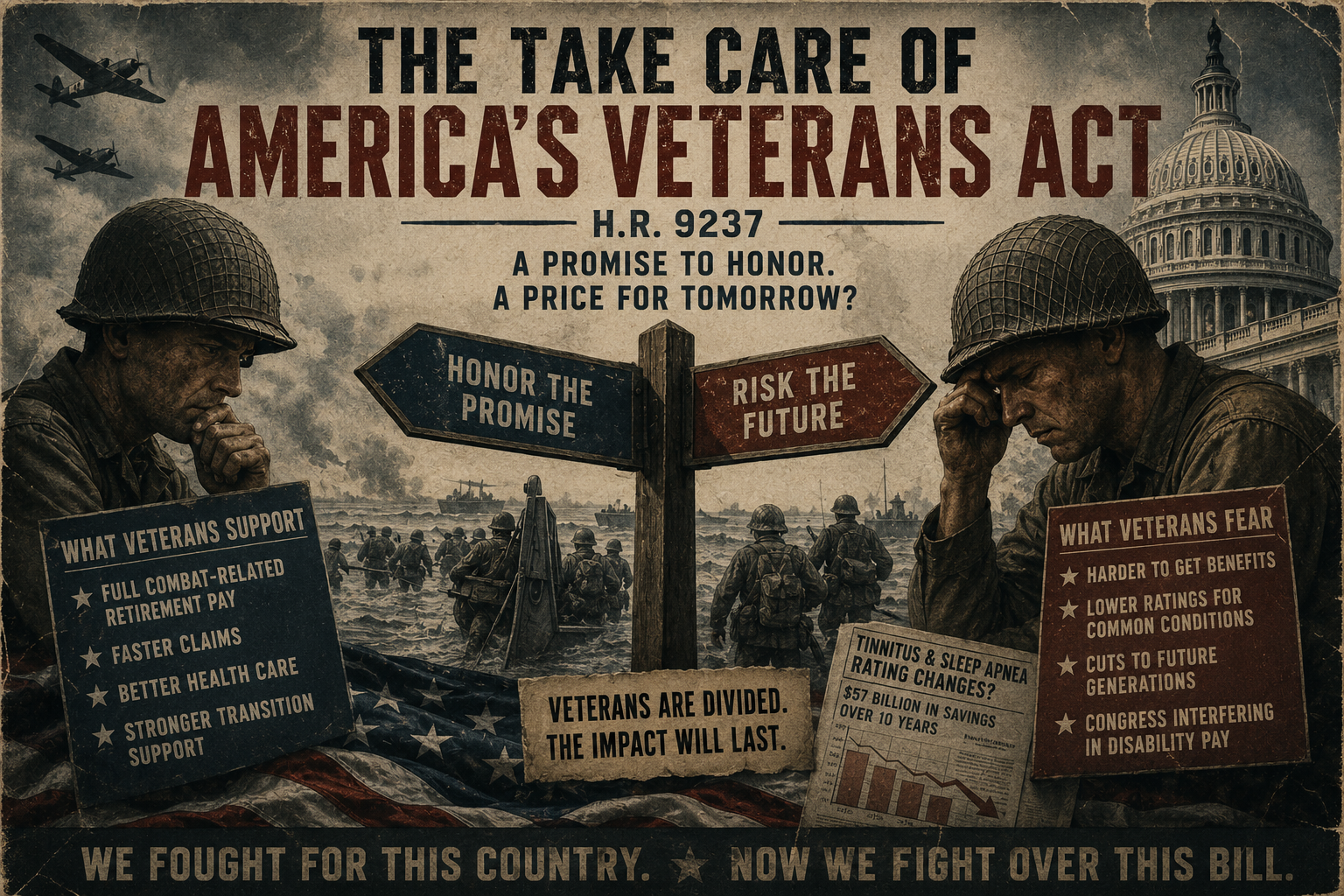
Washington has introduced one of the most ambitious veterans bills in recent memory: H.R. 9237, the Take Care of America’s Veterans Act. The bill is being presented as a major legislative package designed to improve veteran care, expand benefits, streamline the Department of Veterans Affairs, and address several long-standing priorities that veteran advocates have fought for over many years.
On the surface, the bill contains many provisions that most veterans would support. It includes reforms aimed at speeding up claims, strengthening transition support, expanding rural care access, improving research, and correcting benefit gaps for certain combat-disabled retirees. But the bill has also drawn sharp criticism because of language that could change how some future disability claims are rated, especially for conditions such as tinnitus and sleep apnea.
That is why H.R. 9237 has quickly become more than a standard veterans bill. It has become a test of how Congress balances expanding benefits today with protecting compensation for the veterans of tomorrow.
What Is H.R. 9237?
H.R. 9237 is a large veterans omnibus bill. Instead of focusing on one narrow issue, it pulls together a broad collection of veteran-related proposals into one legislative package. Supporters argue that packaging these measures together gives Congress a rare opportunity to pass meaningful reforms across several areas of veteran care and benefits at the same time.
The bill is titled the Take Care of America’s Veterans Act, and its purpose is clear from the name: to improve how the federal government serves veterans after they leave the military. In practice, that means changes involving disability compensation, retirement pay, claims processing, healthcare access, transition assistance, research, and VA administration.
For many veterans, the most important part of the bill is the inclusion of the Major Richard Star Act. This long-supported proposal would help medically retired combat-injured veterans receive both their military retirement pay and VA disability compensation without the offset that has reduced benefits for many retirees with fewer than 20 years of service.
That provision alone is a major reason many veterans and military organizations have paid close attention to the bill. The Major Richard Star Act has been one of the most visible unfinished pieces of veterans legislation for years. Its inclusion in H.R. 9237 makes the bill attractive to many combat-disabled veterans who believe the current offset system is unfair.
Major Provisions in the Bill
While the bill is broad, several major themes stand out. First, H.R. 9237 seeks to improve access to VA healthcare, especially for veterans who live far from major medical centers. Rural veterans often face long travel times, fewer specialists, and limited transportation options. The bill attempts to address some of those barriers through expanded care coordination, transportation efforts, temporary lodging support, and better use of community-based care.
Second, the bill focuses on claims processing. Veterans have long complained that the VA disability system can be confusing, slow, and inconsistent. H.R. 9237 includes language aimed at standardizing evidence requirements, reducing unnecessary paperwork, and improving the speed of claims and appeals. If implemented properly, these changes could help veterans spend less time fighting the system and more time receiving the support they earned.
Third, the bill strengthens transition assistance. The period before and after separation from military service is one of the most important windows in a veteran’s life. Poor transition support can lead to missed benefits, employment struggles, financial instability, mental health stress, and a loss of purpose. H.R. 9237 attempts to improve counseling, documentation, and benefit education before service members leave active duty.
Fourth, the legislation supports additional research and program development in areas that matter to the veteran community. These include traumatic brain injury, toxic exposure, military sexual trauma, service dog programs, rural care models, and other emerging needs. Research does not always create immediate change, but it often lays the groundwork for future policy and better treatment.
What Supporters Like
Concurrent receipt for some combat-disabled retirees, faster claims, improved transition support, and broader VA care reforms.
What Critics Fear
Changes to disability-rating standards for common conditions could reduce future compensation and set a dangerous precedent.
Who Could Benefit
Current combat-disabled retirees, rural veterans, veterans stuck in claims delays, and separating service members.
Who Could Lose
Future veterans filing claims for conditions that may become harder to rate or compensate under revised standards.
Where the Bill Stands in Congress
H.R. 9237 has been introduced in the House of Representatives and referred to the appropriate committees for review. Because the bill touches both veterans benefits and military retirement issues, portions of the legislation are expected to involve the House Veterans’ Affairs Committee and the House Armed Services Committee.
At this stage, the bill has not yet become law. It must still move through the committee process, survive any amendments, pass the House, move through the Senate, and ultimately be signed by the President. That means the language can still change, and the controversial provisions could be removed, rewritten, or kept intact depending on political pressure and negotiation.
Veterans should pay attention to the committee process. That is where the real fight often happens. A bill may be introduced with one version of the language, then emerge from committee with major changes. If veteran organizations apply enough pressure, lawmakers may be forced to decide whether they are willing to keep the popular benefit expansions while removing the language that has caused alarm.
Why Veterans Are Concerned
The concern is not that H.R. 9237 does nothing good. The concern is that some of the good may be tied to language that reduces or limits future disability compensation. Many veterans see this as a dangerous trade: helping one group of veterans today by making it harder for another group of veterans tomorrow.
The most criticized provisions involve changes to how certain conditions may be rated, particularly tinnitus and sleep apnea. These are two of the most common disability issues seen across the veteran population. Tinnitus is especially common among veterans because of repeated exposure to gunfire, aircraft, engines, explosions, heavy equipment, and other military noise. Sleep apnea is also common and often appears alongside other service-connected conditions such as PTSD, respiratory problems, weight changes, and toxic exposure concerns.
Critics argue that changes to the rating schedule could make it harder for future veterans to receive compensation for these conditions or could reduce the ratings they receive. Even if current veterans are protected or grandfathered in, future service members may face a different system when they file claims years from now.
This is why the language has been described by some veteran advocates as a “poison pill.” The bill contains widely supported reforms, but those reforms may be attached to provisions that many veterans believe should not be part of the package at all.
The Tinnitus and Sleep Apnea Fight
Tinnitus may sound minor to people who have never experienced it, but many veterans know it is not simply “ringing in the ears.” It can affect sleep, concentration, communication, work performance, and mental health. For some veterans, it is a constant reminder of weapons fire, blast exposure, flightline work, engine rooms, or years spent around military noise.
Sleep apnea can also have serious consequences. Poor sleep affects nearly every part of a person’s life, including memory, mood, heart health, energy, reaction time, and emotional regulation. For veterans already dealing with PTSD, chronic pain, traumatic brain injury, or toxic exposure concerns, untreated or undercompensated sleep disorders can make recovery and daily life even harder.
The concern is that Congress may be using common claims as a budget lever. If rating changes save the government money, the savings may help pay for other parts of the bill. But from the veteran’s perspective, that means future disabled veterans are being asked to fund today’s reform.
That is the heart of the backlash. Veterans are not opposed to fixing the retirement offset. Veterans are not opposed to faster claims. Veterans are not opposed to better transition support. They are opposed to paying for those priorities by narrowing the path to compensation for the next generation.
The Bigger Issue: Precedent
The deeper fear is precedent. If Congress can use disability-rating changes as a funding mechanism in this bill, what stops future lawmakers from targeting other common conditions? Migraines, back injuries, knee injuries, PTSD, traumatic brain injury symptoms, respiratory conditions, and other service-connected issues could all become targets in future budget fights.
Disability compensation is supposed to reflect the impact of service-connected injury or illness on a veteran’s life. Veterans are concerned that if disability ratings become bargaining chips in legislative negotiations, the system could slowly shift away from medical need and toward budget politics.
That fear is not paranoia. Veterans have seen promises change over time. They have watched burn pit exposure take years to be recognized. They have watched Agent Orange claims take decades. They have watched Gulf War illness, PTSD, traumatic brain injury, and military sexual trauma survivors fight for recognition. The veteran community understands that language matters because bad language can take years to undo.
How Passage Could Impact Current Veterans
For current veterans, the most immediate impact could be positive if the bill passes with its benefit expansions intact. Combat-disabled retirees who qualify under the Major Richard Star Act language could see a meaningful financial correction. That would be a major victory for veterans who have argued for years that they should not have to give up earned retirement pay because they also receive disability compensation for combat-related injuries.
Current veterans could also benefit from improved claims processing, better VA coordination, expanded rural care, and program reforms. If the VA implements these changes effectively, veterans may see a system that is easier to navigate and less punishing to those who do not have the time, health, or resources to fight through bureaucracy.
However, current veterans should not assume they are unaffected simply because they may be grandfathered in on certain benefits. Once Congress establishes a willingness to revise rating standards as part of budget negotiations, every veteran has a stake in what happens next. Even veterans protected today could face a different policy environment tomorrow.
How Passage Could Impact Future Veterans
Future veterans are the group most likely to feel the long-term impact of the disputed language. A service member currently on active duty may not file a VA claim for years. If the rating standards change before that claim is filed, that future veteran may enter a system that is less generous or more difficult to navigate than the one today’s veterans used.
That matters because military service is still producing the same kinds of injuries. Noise exposure has not disappeared. Sleep problems have not disappeared. Blast exposure, respiratory hazards, stress injuries, musculoskeletal damage, and mental health conditions remain part of the cost of service. A future veteran should not be told that the injury counts less because Congress needed savings in a bill passed years earlier.
The long-term impact could also affect trust. Service members are repeatedly told that the country will take care of them if they are injured or become ill because of service. If younger troops believe the disability system is being narrowed before they even leave the military, that trust erodes.
A Bill Veterans Can Support — If Congress Fixes the Problem
The difficult truth is that H.R. 9237 contains real wins. It should not be dismissed as a bad bill from top to bottom. Many of its provisions are overdue, and many veterans would benefit if the strongest parts became law.
But the veteran community is right to scrutinize the bill. A veterans package should not force veterans to choose between helping combat-disabled retirees and protecting future disability compensation. Congress should be able to do both. If lawmakers believe the Major Richard Star Act, faster claims, better rural care, and stronger transition support are the right thing to do, they should pass them without attaching cuts or restrictions that divide the veteran community.
The best path forward is not to abandon the entire bill. The best path forward is to remove or rewrite the language that threatens future compensation, protect the strongest reforms, and pass a version that veterans can stand behind without reservation.
The Bottom Line
H.R. 9237 has put Congress at a crossroads. On one side is a real opportunity to expand benefits, correct old injustices, and improve how America serves veterans. On the other side is a warning sign: disability compensation should not become a funding source for other priorities, even worthy ones.
Veterans are divided because the bill itself is divided. It contains promises worth keeping and language worth challenging. That is why this debate matters.
The country made a promise to those who served. The question now is whether Congress will honor that promise fully, or whether future veterans will be handed the bill.
Sources and Further Reading
- Congress.gov: H.R. 9237 — Take Care of America’s Veterans Act
- GovInfo: Text of H.R. 9237 as Introduced
- House Committee on Veterans’ Affairs
- Veterans of Foreign Wars: Legislative Statements and Releases
- Iraq and Afghanistan Veterans of America: Advocacy and Legislative Updates
- Representative Tom Barrett: Take Care of America’s Veterans Act Release