
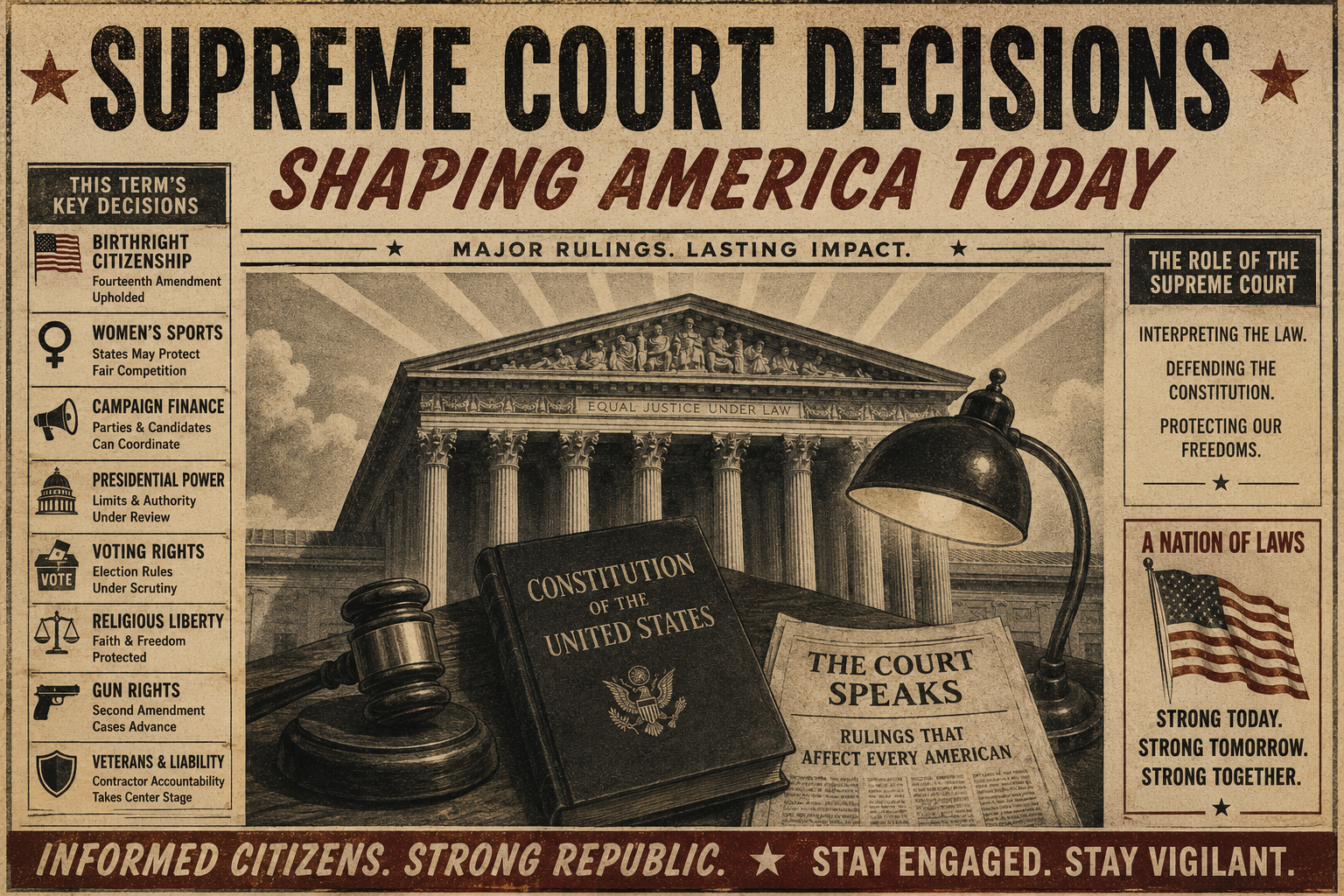
The Supreme Court closed this term with a docket that reached deep into the machinery of American life: citizenship, elections, presidential authority, speech, religion, guns, criminal justice, regulation, and the legal accountability of institutions that operate in the shadow of war. The cases were different, but the central question kept returning: who gets to decide, and where does the Constitution draw the line?
This was not a quiet term. It was a term about power. The justices repeatedly faced disputes where Congress, the president, the states, federal agencies, courts, and private citizens all claimed authority. In case after case, the Court had to decide whether power had been properly used, improperly stretched, or wrongly blocked.
Birthright Citizenship: The Constitutional Line Holds
The term’s most consequential immigration ruling involved the administration’s attempt to limit birthright citizenship by executive action. The dispute forced the Court back to the text and history of the Fourteenth Amendment, especially its command that persons born or naturalized in the United States and subject to its jurisdiction are citizens of the United States.
The majority treated birthright citizenship as a constitutional guarantee rather than a policy lever. The opinion leaned on the long-standing understanding of citizenship after the Civil War and the historic precedent recognizing citizenship for children born on American soil. The Court’s reasoning was structural as much as textual: a president may enforce immigration law, but a president cannot rewrite the constitutional definition of American citizenship by order.
The dissent took a narrower view of the Citizenship Clause and placed greater weight on the government’s argument about allegiance, jurisdiction, and the authority of the political branches to define immigration-related consequences. But the dissent did not carry the day. The ruling drew a hard constitutional wall around one of the most basic questions in American law: who belongs to the nation at birth.
Women’s Sports and Title IX: States Gain Room to Draw Lines
Another headline case involved state laws limiting girls’ and women’s scholastic sports teams to biological females. The majority concluded that Title IX allows schools and states to maintain sex-separated athletics and that states may rely on fairness and safety concerns when regulating competitive sports.
The opinion emphasized that biological sex has long been used in athletics because physical differences can matter in competition. The conservative majority viewed the state laws as an attempt to preserve female athletic opportunity rather than as a simple expression of hostility. Concurring justices pushed even harder on the idea that courts should not force states to abandon sex-based categories where the Constitution and federal law historically allowed them.
The dissent argued that categorical exclusions sweep too broadly and place transgender students outside ordinary school life without enough individualized review. The dissenters warned that the ruling gives states too much room to burden vulnerable students. The practical implication is significant: states now have strong legal cover to regulate school sports by biological sex, even as other transgender-rights questions remain unsettled.
Campaign Finance: Party Power Expands
The campaign-finance decision striking down limits on coordinated spending between political parties and candidates may change how modern campaigns are fought. The majority framed coordinated party spending as political speech at the heart of the First Amendment. In that view, limiting how parties support their own candidates restricts political association and suppresses protected expression.
The dissent warned that the decision weakens guardrails designed to prevent corruption or its appearance. If donors can route more influence through party structures and party-candidate coordination becomes easier, the dissent argued, the line between independent support and direct campaign machinery becomes thinner.
The result is likely to be more money, more nationalized races, and greater party control over local contests. For voters, that means campaigns may become even more centralized, professionalized, and expensive.
Presidential Power: Control, Removal, and the Administrative State
The Court also spent much of the term wrestling with presidential power. Cases involving emergency economic authority, tariffs, independent agencies, and removal protections put the justices in the middle of a constitutional argument that has been building for years: how much control must the president have over the executive branch, and how much independence may Congress give federal officials?
The conservative bloc generally showed skepticism toward limits on presidential control, especially when independent officers exercised executive power without direct presidential accountability. For those justices, democratic responsibility runs through the president. If an official wields executive authority, the people need a clear path to hold someone accountable.
The liberal dissenters saw the issue differently. They warned that Congress created independent agencies for a reason: to protect certain functions from short-term political pressure. In their view, too much presidential removal power risks turning expert agencies into extensions of the White House.
Elections and Voting: Rules of the Game Under Review
Election-law cases this term covered mail ballots, absentee deadlines, redistricting, and the Voting Rights Act. These disputes may sound procedural, but procedure is power. Rules about when ballots count, how districts are drawn, and when federal law overrides state choices can shape the outcome before a single campaign ad airs.
In ballot-deadline cases, the Court examined whether states may count mail ballots received after Election Day if voters completed the required steps on time. Supporters of stricter deadlines argued that federal Election Day rules require finality. Defenders of more flexible rules argued that states have long administered elections with practical safeguards for mail delivery and absentee voting.
In redistricting disputes, the Court returned to the difficult line between preventing racial vote dilution and avoiding unconstitutional racial sorting. The majority opinions tended to emphasize constitutional limits and state authority, while the dissents warned that weakening Voting Rights Act protections can reduce minority voters’ ability to elect candidates of their choice.
Guns, Police Stops, and Public Safety
Second Amendment and Fourth Amendment cases again placed the Court between individual rights and public safety. One major gun-rights dispute involved restrictions on carrying firearms on private property open to the public. The question was whether the government can presume firearms are barred in those places unless property owners clearly say otherwise.
The conservative justices generally viewed broad carry restrictions with suspicion after the Court’s recent Second Amendment cases. The liberal justices were more willing to allow legislatures to regulate firearms in crowded public-facing spaces. The ruling’s implications reach beyond one state: courts will continue testing modern gun laws against historical traditions of firearm regulation.
Police-stop cases brought a different constitutional pressure point. When officers respond to reports of danger, suspicious vehicles, firearms, mental-health crises, or possible violence, how much suspicion is enough to stop, search, or seize someone? The Court continued to balance real-world danger against the Fourth Amendment’s protection from unreasonable government intrusion.
Religious Liberty and Speech: Counseling, Advocacy, and Prison Rights
The First Amendment docket included religious counseling, pregnancy-resource centers, and prisoners’ religious exercise. These cases showed the Court’s continued willingness to closely examine government action that burdens religious speech, religious practice, or faith-based advocacy.
The majority opinions in this area generally treated speech and religion as preferred constitutional rights requiring strong protection. When the government regulates counseling, compels disclosures, investigates advocacy organizations, or restricts prisoners’ religious practices, the Court often demands a clear and narrow justification.
The dissents warned that the majority sometimes converts ordinary regulation into constitutional injury. In their view, states must retain room to protect minors, regulate professional conduct, investigate possible violations, and manage prisons safely. The divide reflects one of the Court’s deepest disagreements: when does regulation become censorship or religious discrimination?
Veterans, War, and Contractor Accountability
One of the most important veterans-adjacent cases involved claims against a military contractor after a service member was injured in a war-zone attack. The broader issue was whether and when private contractors operating alongside the military can face civil liability for conduct connected to combat-zone support.
These cases matter because modern war is not fought by uniformed service members alone. Contractors operate bases, manage logistics, build infrastructure, handle support functions, and sometimes work in spaces where negligence can carry life-or-death consequences. The majority focused on separation-of-powers concerns, military decision-making, and the danger of courts second-guessing battlefield-related judgments.
The dissent stressed accountability. If private companies profit from wartime support contracts, the dissent argued, they should not be placed beyond ordinary legal responsibility when their conduct causes harm. For veterans and families, this issue is not abstract. It touches the privatized battlefield and the question of who answers when things go wrong.
Business, Regulation, and Agency Power
The Court also decided major regulatory and business disputes involving environmental liability, telecommunications data, pharmaceutical labeling, securities enforcement, patents, copyright, and consumer claims. The common thread was skepticism toward broad agency power unless Congress clearly authorized it.
Businesses often argued that regulators or plaintiffs were stretching statutes beyond their original meaning. Agencies and consumers argued that modern industries require flexible enforcement tools. The conservative majority frequently favored clearer statutory limits, while the liberal dissenters warned that rigid readings can leave regulators unable to respond to new technologies, new markets, and new harms.
Criminal Law: Finality Versus Fairness
The criminal docket involved sentencing, firearm enhancements, plea agreements, habeas review, confessions, mental illness, and death-penalty procedure. These cases did not always split along predictable ideological lines. Justices who disagree sharply in political cases sometimes find common ground in criminal procedure, especially when the text of a statute is clear or when a defendant’s procedural rights are at stake.
Still, the Court remained cautious about reopening final convictions. The majority opinions often emphasized finality, statutory limits, and respect for state-court judgments. The dissents emphasized fairness, reliability, and the danger of leaving constitutional violations uncorrected because of procedural barriers.
Major Theme
The Court kept returning to power: presidential power, state power, agency power, party power, and individual rights.
Conservative Majority
The majority often favored original meaning, clear statutory authority, state discretion, and limits on the administrative state.
Liberal Dissents
The dissenters often warned that the majority weakened protections for vulnerable groups, voters, consumers, defendants, and regulated communities.
Veteran Angle
The term matters to veterans because citizenship, elections, rights, agency power, and contractor accountability all shape the country they served.
The Justices: How the Court Divided
Chief Justice Roberts remained the institutional center of the Court. He often joined the conservative majority but continued to show concern for the Court’s legitimacy and the manageability of its rulings. Justice Kavanaugh had a high-profile term, writing in major disputes involving social policy and political power. Justice Barrett continued to serve as a key conservative vote, sometimes narrowing the reasoning even when joining conservative outcomes.
Justices Thomas, Alito, and Gorsuch pressed originalist and structural arguments, especially in cases involving agency authority, speech, religion, and constitutional rights. Justice Gorsuch also remained capable of crossing expected lines in criminal and statutory cases where text and procedure drove the analysis.
Justices Sotomayor, Kagan, and Jackson formed the core dissenting bloc in the most ideologically charged cases. Their dissents repeatedly warned that the majority was giving too much room to states, presidents, political parties, corporations, and institutions while narrowing protections for individuals.
Bottom Line
This term was about boundaries. The Court protected constitutional citizenship from executive revision. It gave states room to regulate women’s sports by biological sex. It expanded party-candidate campaign coordination. It continued reshaping presidential control over agencies. It revisited voting rules, gun rights, religious liberty, criminal procedure, and the legal reach of federal regulators.
For Americans watching from outside the legal world, the lesson is simple: Supreme Court opinions are not distant paperwork. They decide who has power, who gets protection, who can sue, who can vote under what rules, how campaigns operate, how agencies function, and how rights are enforced.
For veterans, the lesson is familiar. Institutions matter. Rules matter. The Constitution is not self-executing. It depends on citizens willing to read it, defend it, argue over it, and live with the consequences.