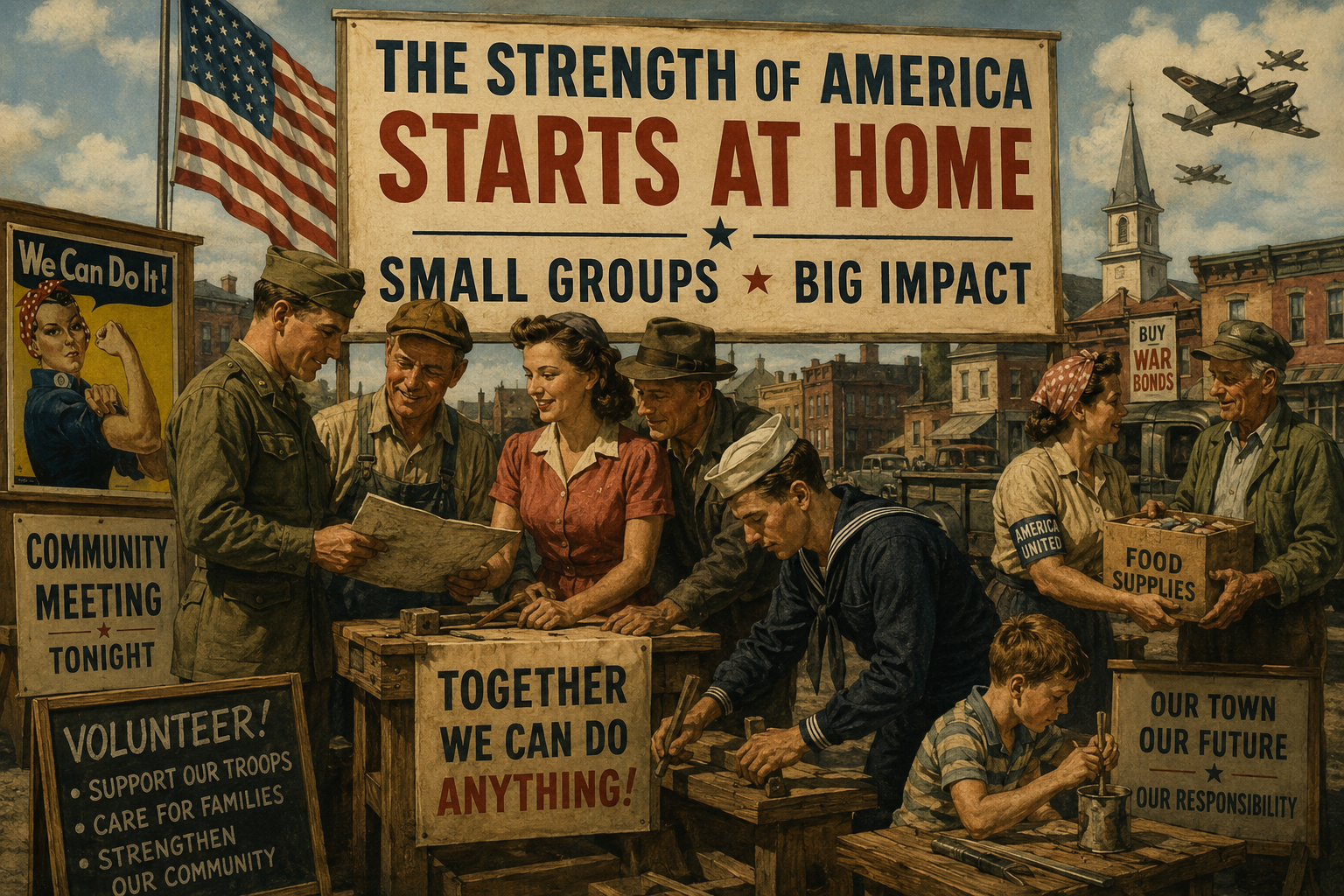
Long before the United States became a global power, before Washington, D.C., became the center of national politics, and before social media amplified every national controversy, America was built one town at a time.
The history of the United States is, in many ways, the history of ordinary citizens organizing themselves to solve local problems. Neighbors gathered to defend settlements, establish schools, maintain roads, care for widows, extinguish fires, organize churches, improve agriculture, create businesses, and protect individual liberties. These organizations were often small—sometimes only a few dozen members—but their combined influence shaped the character of an entire nation.
Today it is easy to believe meaningful change happens only through Congress, presidential elections, federal agencies, or national movements. Yet history repeatedly demonstrates the opposite. America has always been strongest when citizens were active in their own communities.
America Was Built Before America Existed
Long before independence, the American colonies depended upon local organizations for survival. There were no federal agencies, no centralized emergency services, no national police force, and no standing military capable of protecting every settlement. Communities learned quickly that cooperation meant survival.
Town Meetings and Local Self-Government
New England town meetings became one of the earliest and most enduring forms of participatory democracy in North America. Residents gathered to debate roads, taxes, schools, local defense, public works, and community rules. The process was imperfect and participation was restricted by the standards of the time, but the larger idea was revolutionary: government was not merely something imposed from above. It was something citizens were expected to help conduct.
Those meetings created habits that would later become essential to the American experiment. Citizens learned to speak publicly, argue policy, vote, serve on committees, accept compromise, and hold local leaders accountable. The Constitution did not emerge from a population unfamiliar with self-government. It emerged from colonies where many communities had practiced local decision-making for generations.
The Colonial Militia
Perhaps no local organization had greater influence on early America than the colonial militia. Unlike a modern professional military, colonial militias consisted largely of ordinary citizens—farmers, blacksmiths, merchants, tradesmen, and laborers—who trained together and were responsible for protecting their own communities.
At Lexington and Concord in April 1775, it was not a fully developed national army that first confronted British regulars. It was a network of local militia companies whose members knew one another, trained together, and understood the roads, fields, bridges, and towns they were defending. The Minutemen were citizens prepared to respond rapidly because their organization already existed before the crisis arrived.
These units did more than provide military manpower. They created local command structures, communication networks, supply systems, and a culture of shared obligation. Their effectiveness showed that a small community organization, if disciplined and prepared, could influence events far beyond the borders of its town.
Committees of Correspondence
The Committees of Correspondence were among the most important nonmilitary organizations of the revolutionary era. Beginning in places such as Boston and spreading through the colonies, these committees exchanged information about British laws, colonial grievances, protests, and possible responses.
They functioned as a decentralized communications network. A local committee could document events in one town, send reports to neighboring communities, and coordinate action across colonial boundaries. Boycotts, public meetings, petitions, and political resistance became more effective because communities no longer acted in isolation.
The Continental Congress did not appear out of nowhere. It became possible because local and colonial networks had already built trust, shared information, and developed the habit of organized cooperation.
The Sons of Liberty and Grassroots Resistance
The Sons of Liberty were another example of local groups creating national consequences. Rather than operating as one tightly controlled national organization, they functioned through local chapters in cities including Boston, New York, Philadelphia, and Charleston.
They organized public meetings, distributed pamphlets, enforced boycotts, raised money, and mobilized public opposition to British policy. Some of their tactics were confrontational and remain debated by historians, but their larger impact is clear: they demonstrated how local organization, messaging, and coordinated pressure could shape public opinion and political action.
Churches, Mutual-Aid Societies, and Civic Care
Religious congregations were also among the earliest civic institutions in American life. Churches often served as meeting halls, schools, relief centers, information hubs, and places where aid was collected for families facing sickness, poverty, fire, or death.
Mutual-aid societies developed among tradesmen, immigrants, ethnic communities, fraternal groups, and workers. Members pooled money and labor to help one another through unemployment, injury, burial expenses, disasters, and family hardship. Long before modern public assistance programs, these organizations formed an informal social safety net.
The importance of these groups was not merely financial. They created belonging. They gave people a structure through which responsibility for neighbors became more than a good intention.
Volunteer Fire Companies
Before professional municipal fire departments became common, citizens created volunteer fire companies. Members raised funds, purchased equipment, trained, maintained readiness, and responded when homes or businesses caught fire.
These companies were practical examples of civic organization at its best: the danger was obvious, the need was local, and waiting for a distant authority was not an option. Many volunteer fire departments still serve American communities today, especially in rural and suburban areas.
Civic Organizations That Built Modern Communities
During the nineteenth and twentieth centuries, local civic organizations multiplied. Rotary clubs, Lions Clubs, Kiwanis chapters, historical societies, conservation groups, volunteer ambulance corps, veterans’ posts, youth leagues, neighborhood associations, parent organizations, libraries, and community theaters became part of the architecture of American life.
Individually, most did not appear powerful. Collectively, they built playgrounds, funded scholarships, supported hospitals, preserved landmarks, sponsored youth programs, aided families, improved public spaces, and created traditions that gave towns their identity.
Veterans Have Always Led Communities
After every major American conflict, veterans returned home carrying experience in leadership, planning, logistics, teamwork, and operating under pressure. Many applied those skills to community life.
Veterans organized local posts, memorial associations, relief funds, scholarship programs, scouting units, youth sports, disaster response teams, employment networks, and advocacy campaigns. Organizations such as the American Legion, Veterans of Foreign Wars, Disabled American Veterans, and countless smaller local groups became both support systems for veterans and service institutions for entire communities.
Their greatest strength has never been advocacy alone. It has been organization. Veterans understand missions, standards, accountability, and the importance of placing the objective above individual recognition.
Why Local Organizations Matter Now
Modern Americans are constantly exposed to problems presented at national scale: political polarization, addiction, veteran suicide, food insecurity, housing costs, public safety, education, loneliness, mental-health challenges, and economic uncertainty. The scale of the discussion can make individuals feel powerless.
But many national problems are experienced locally. Addiction affects a specific family. Food insecurity affects a specific school. Isolation affects a specific veteran. A dangerous intersection sits in a specific neighborhood. A neglected park belongs to a specific town. These are places where organized citizens can act directly.
Local groups also create something increasingly rare in the modern political climate: relationships between people who may disagree nationally but share the same roads, schools, parks, and concerns. Working together on a practical mission can rebuild trust in ways that online argument rarely does.
Start With a Problem
Strong organizations begin with a clearly defined local need, not with a logo, title, or desire for recognition.
Set One Mission
A narrow, achievable first objective is more useful than a broad promise to “fix the community.”
Recruit for Skills
Look for organizers, communicators, fundraisers, subject-matter experts, and dependable workers—not just people who agree.
Show Results
Visible progress builds credibility, attracts volunteers, and gives the group momentum for larger goals.
Find a Cause, Then Find Your People
The best organizations rarely begin with someone saying, “I want to start an organization.” They begin with someone recognizing that a problem is not being solved.
Ask practical questions. What frustrates people in the town? Who is falling through the cracks? What service is missing? What issue appears repeatedly at school-board, town, or neighborhood meetings? Which existing organizations are overwhelmed? What could a small group accomplish within ninety days?
Once the problem is clear, find people who care about the same outcome. They do not need to agree on every political or cultural question. They need to agree on the mission.
Problems Well Suited for Local Action
Many issues are especially suited to small organizations because they require local knowledge, personal trust, and consistent human contact.
Veteran Support
Peer mentoring, transition assistance, employment networking, outdoor activities, family support, and transportation to appointments.
Youth Development
Tutoring, trades mentorship, financial literacy, coaching, career exposure, and leadership development.
Community Readiness
CPR classes, disaster preparation, emergency communications, supply drives, and volunteer response teams.
Food and Family Needs
Community gardens, food pantries, meal delivery, school-supply drives, and support for families in crisis.
Public Spaces
Neighborhood cleanups, park restoration, historic preservation, tree planting, and accessibility improvements.
Civic Education
Candidate forums, local-government workshops, voter information, Constitution classes, and public-meeting guides.
How to Start a Local Organization
Begin with a one-sentence mission statement. It should identify the problem, the people served, and the outcome the group seeks. A clear mission makes every later decision easier.
Next, choose a small first project. Do not begin by promising to eliminate homelessness, end addiction, or repair the entire school system. Begin with a coat drive, one mentorship program, one cleaned park, one public forum, or one month of transportation assistance. Small victories prove the concept and reveal what the group can realistically sustain.
Build a founding team with complementary skills. One person may be an inspiring speaker but poor with schedules. Another may dislike public attention but excel at logistics. A third may understand budgets, grants, insurance, or local government. Organizations become durable when responsibilities are distributed according to ability.
Meet somewhere accessible and inexpensive. Libraries, churches, veterans’ halls, community centers, firehouses, and local businesses may provide space. Establish a regular schedule and keep meetings focused. Every meeting should end with assigned tasks, deadlines, and a clear next step.
Informal Group or Nonprofit?
A new group does not always need to become a formal nonprofit immediately. Informal volunteer groups can conduct cleanups, educational events, mutual aid, and many other projects without creating a complex legal structure.
Formal incorporation or tax-exempt status may become useful when the group begins raising significant funds, signing contracts, hiring staff, purchasing insurance, owning property, or applying for grants that require nonprofit status. At that stage, organizers should seek guidance from an attorney, accountant, established nonprofit, community foundation, or nonprofit assistance center familiar with state and federal requirements.
The Hurdles New Organizations Face
Enthusiasm is common at the beginning. Sustainability is harder. New groups frequently face volunteer burnout, poor communication, unclear authority, limited funding, personality conflicts, and the temptation to expand too quickly.
Burnout develops when a few dependable people carry nearly every responsibility. Leaders should delegate early, create small teams, rotate duties, and avoid building a mission that depends on one person being available at all times.
Funding can become another distraction. Many groups spend too much time chasing money before proving they can produce results. Start with low-cost projects, donated space, borrowed equipment, in-kind support, small local sponsors, and partnerships with established organizations. A record of completed work is often more persuasive than an ambitious proposal.
Internal conflict is inevitable. Written expectations, simple bylaws, transparent financial records, defined roles, and a consistent decision-making process can keep disagreements from becoming personal battles. The mission must remain more important than titles or credit.
Build Partnerships, Not Rivalries
Before launching a new organization, identify who is already working on the issue. The goal should not be to duplicate services or compete for attention. A new group may be most useful as a volunteer arm, fundraising partner, communications team, or neighborhood extension of an existing nonprofit.
Partnerships can provide experience, insurance coverage, training, facilities, credibility, and access to people already being served. Cooperation also prevents limited community resources from being divided among organizations performing the same work.
Maintaining Momentum
People remain involved when they can see that their time matters. Set measurable goals and report progress. Share photographs, totals, testimonials, completed milestones, and the next objective. Recognize volunteers publicly and privately.
Consistency matters more than spectacle. A group that performs one useful service every month may accomplish more over five years than a group that launches with a major event and disappears six months later.
The Veteran Advantage
Veterans possess skills that translate naturally into community leadership: mission planning, logistics, resilience, risk assessment, adaptability, team building, and operating with limited resources.
Those skills make veterans valuable force multipliers in local organizations—not because veterans have every answer, but because they understand how to turn an objective into a plan and a plan into action.
That philosophy is central to initiatives such as Operation 9-12, which encourages veterans and citizens to work together at the local level, move beyond political division, and strengthen communities through service and practical leadership. The idea is not to wait for distant institutions to repair every problem. It is to begin building solutions where people live.
America’s Future Is Still Local
America’s founders understood that strong nations are built from strong communities, and strong communities are built by citizens who accept responsibility for something beyond themselves.
History rarely records the name of every person who repaired a bridge, mentored a child, organized a fire company, delivered food, raised scholarship money, preserved a landmark, or sat through a long local meeting. Yet those people created the America later generations inherited.
The problems have changed. The technology has changed. The politics are louder. But the basic method remains familiar: find a problem, gather good people, develop a plan, serve your neighbors, and repeat.
The next organization that transforms a town may not begin with a large grant, celebrity endorsement, or national office. It may begin with five people around a table asking a simple question: Who is going to fix this?
The answer can still be: We are.