
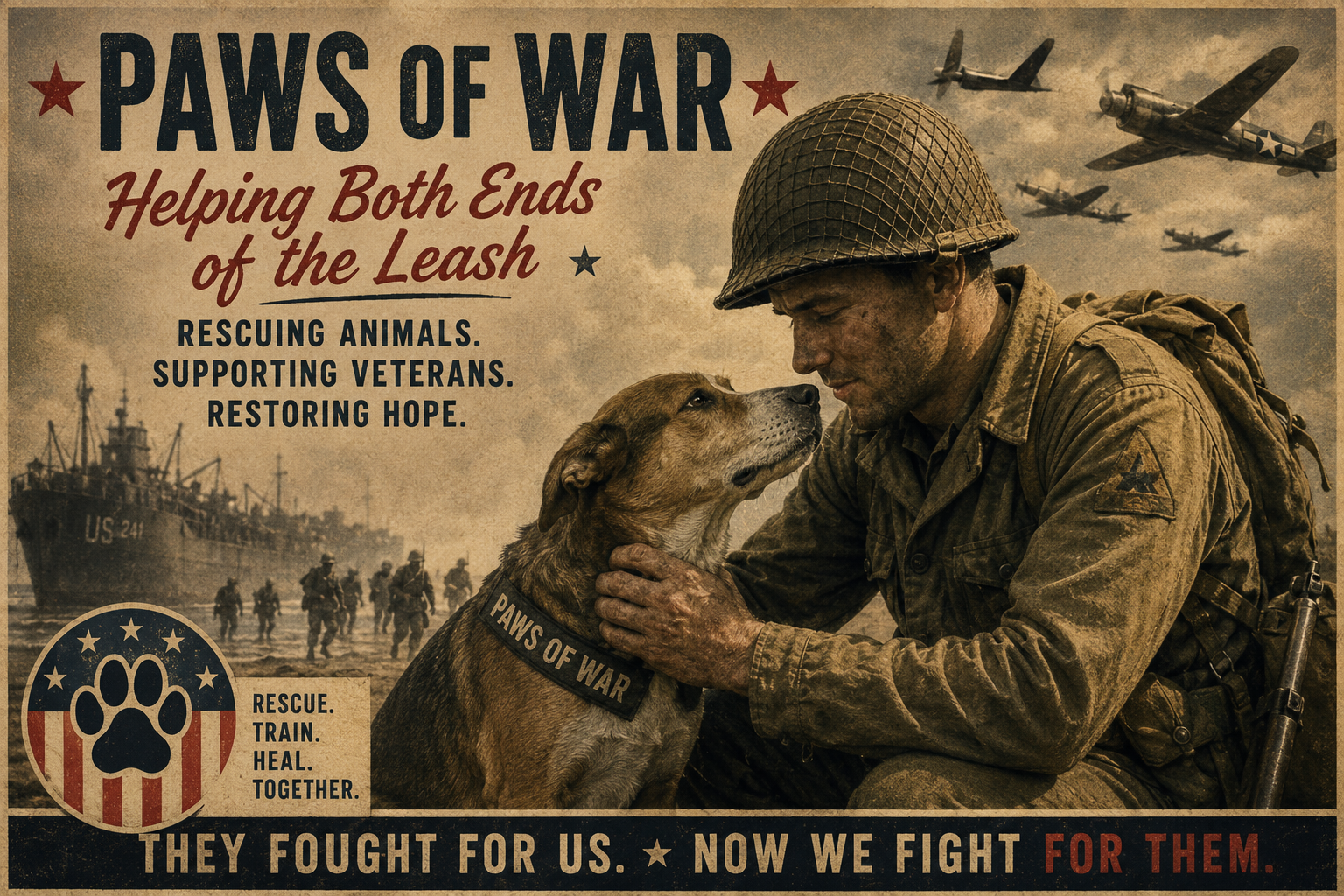
For many veterans, the most difficult part of military service begins after the uniform comes off. Post-traumatic stress, traumatic brain injury, anxiety, depression, isolation, and the loss of a clearly defined mission can make civilian life feel unfamiliar and unsteady. At the same time, abandoned animals in local shelters and dangerous overseas environments are waiting for someone to give them a second chance. Paws of War was built around the idea that those two needs can meet—and that healing can happen at both ends of the leash.
Headquartered in Nesconset, New York, Paws of War is a nonprofit organization serving veterans, active-duty military members, first responders, Gold Star families, and animals in need. Its work includes service-dog placement, companion-animal adoption, emergency fostering, therapy-dog visits, mobile veterinary care, support for retired military working dogs, disaster response, and international rescue missions that reunite service members with the dogs and cats they bonded with while deployed.
How the Mission Began
Paws of War traces its beginnings to 2014. From the start, the organization focused on bringing rescued dogs together with veterans who needed companionship, trained assistance, and a renewed sense of connection. That mission later expanded into overseas animal rescue, veterinary assistance, housing support, emergency pet fostering, therapy programs, and services for first responders and military families.
The organization’s Long Island base has remained central to that growth. Its Nesconset headquarters serves as a hub for training, rescue coordination, adoption, volunteer work, and the complex logistical planning required to move animals safely across states and international borders.
Rescuing and Training Shelter Dogs
One of the organization’s defining features is its use of rescued animals. Rather than assuming every service dog must come from a purpose-bred program, Paws of War evaluates dogs from shelters and rescue situations to determine whether they have the health, temperament, stability, intelligence, and work drive needed for service work.
Not every dog is suited to become a service dog, and that is not considered a failure. Dogs that do not meet service-work requirements may still be excellent companion animals. The goal is to find the right role and the right home for each animal rather than forcing a placement that is unsafe or unsustainable.
Service Dogs
Dogs are trained to perform specific tasks that mitigate a veteran’s disability, including needs associated with PTSD or traumatic brain injury.
Companion Animals
Fully vetted rescue animals may be placed with veterans, first responders, active-duty members, and Gold Star families for companionship and emotional support.
War-Torn Rescues
The organization coordinates international transport and veterinary clearances to reunite troops with animals they bonded with overseas.
Veterinary Support
A mobile clinic provides scheduled veterinary care for pets belonging to veterans and first responders, including those living with disabilities or limited income.
Service-Dog Training as a Partnership
Paws of War’s training program is not simply a process in which a fully trained dog is handed to a veteran. The organization emphasizes the development of a working team. The veteran must learn how to communicate with the dog, reinforce trained behaviors, recognize stress, maintain obedience, and care for the dog’s physical and emotional needs.
Service dogs may be trained to interrupt escalating anxiety, assist during emotional or medical emergencies, create space in public settings, provide grounding through physical contact, help with memory-related tasks, or respond to subtle changes in a handler’s stress level. The exact tasks depend on the veteran’s documented needs and the dog’s capabilities.
Applicants are expected to attend training, provide transportation, participate consistently, and remain involved after placement. That long-term approach matters because service-dog work is a living skill. Training must be reinforced throughout the dog’s working life, and the veteran must remain an active handler rather than a passive recipient.
Who Qualifies for a Service Dog?
Paws of War lists several baseline requirements for service-dog applicants. Veterans generally must have been honorably discharged, be able to travel to and from training sessions, and demonstrate that they can meet a dog’s physical, mental, emotional, and financial needs. Applicants also need an adequate support system for times when they cannot care for the dog themselves.
For requests involving a mental-health condition, the applicant must be current and remain in treatment with a mental-health practitioner. That requirement reflects an important distinction: a service dog can be a powerful part of recovery, but it is not intended to replace professional medical or mental-health care.
The application and matching process also protects the dogs. Paws of War must assess the veteran’s needs, home environment, lifestyle, support network, ability to attend training, and readiness for the responsibility of caring for a working animal. A successful match depends on compatibility, not simply availability.
Adoption Criteria and Companion Placement
Not every veteran needs a task-trained service dog. Some need a stable companion that encourages routine, reduces loneliness, and helps make home feel less isolated. Paws of War offers rescued dogs and cats for adoption to approved veterans, first responders, active-duty military members, and Gold Star families. The organization states that these adoptions are provided without an adoption fee to eligible applicants.
Animals are fully vetted and come with training and support, but approval is based on the needs of the specific animal. Some dogs may require another friendly dog in the home, a secure fenced yard, a quieter setting, or an adopter experienced with fearful or recovering animals. Applicants should expect the organization to examine household members, other pets, housing arrangements, daily schedule, and the ability to provide lifelong care.
That animal-specific approach is essential. The best home for a young high-energy dog may be very different from the best home for a timid rescue recovering from neglect or a senior animal needing a calm environment.
Fostering: The Bridge Between Rescue and Home
Foster families give Paws of War the time and space needed to evaluate animals outside the stress of a shelter. A foster home can reveal how a dog or cat reacts to household sounds, visitors, children, other animals, routines, and basic training. It can also help an animal recover from medical treatment or learn that a home can be safe.
Paws of War welcomes foster applicants and specifically notes the value of people with professional veterinary or medical experience. Some animals need extra support while adjusting to home life or preparing for possible service-dog work. Foster caregivers may be asked to follow training plans, attend appointments, observe behavior, administer approved care, and communicate regularly with the organization.
Fostering is temporary by design, but its effect can be permanent. Every foster home expands the organization’s rescue capacity and helps staff make a more informed match for adoption or advanced training.
The War-Torn Pups and Cats Program
Among Paws of War’s most visible missions is the War-Torn Pups and Cats program. During deployments, service members often bond with stray dogs and cats living near bases, checkpoints, camps, or communities affected by war. Those animals may provide comfort during long and dangerous months, but military transportation rules and international veterinary requirements make it extremely difficult for a service member to bring an animal home alone.
Paws of War works through those barriers by arranging local rescue, temporary shelter, veterinary treatment, vaccinations, health documents, government clearances, international transportation, customs processing, and final delivery in the United States. The organization reports that more than 600 dogs and cats have reached safety through the program and been reunited with service members.
These missions are expensive and unpredictable. Borders can close, flight routes can change, paperwork can be delayed, and animals may need weeks or months of care before travel. In active conflict zones, the local rescuers and transport teams may also be assuming personal risk simply to reach an animal.
Rescue Stories That Reveal the Mission
The impact of the work is best understood through individual reunions. In one story highlighted by Paws of War, an Army veteran named Stormy formed a bond with a dog named Jasmine while overseas. The organization coordinated Jasmine’s rescue and transport to the United States while Stormy was battling cancer. A Paws of War team member traveled overseas, secured the necessary clearances, and brought Jasmine to the organization’s Long Island headquarters before a birthday reunion in Pennsylvania.
Stories like Stormy and Jasmine demonstrate why these animals matter so deeply. They are often tied to a specific chapter of service, a difficult deployment, fallen friends, or the daily rituals that helped a service member endure. Bringing that animal home can preserve a connection to the deployment while allowing the veteran to rebuild in a safer environment.
Emergency Foster, Housing, and Veterinary Care
Paws of War also works to keep veterans and their pets together during periods of crisis. Emergency foster support can provide temporary care when a veteran is hospitalized or temporarily unable to care for an animal. Housing assistance addresses situations in which a veteran risks losing a pet because of displacement or a housing-related emergency.
The organization’s mobile veterinary clinic provides free scheduled care for pets belonging to veterans and first responders at locations around Long Island. Volunteer veterinarians, technicians, and assistants staff the program. For a disabled veteran on a fixed income, access to veterinary care can be the difference between keeping a vital companion and facing an impossible financial decision.
Therapy Dogs and Community Outreach
Service dogs are trained to assist one handler, while therapy dogs are prepared to provide comfort to many people in settings such as veterans’ facilities, hospitals, nursing homes, schools, hospices, and community programs. Paws of War’s therapy-dog work uses suitable rescued animals with stable, friendly temperaments and handlers capable of safely managing public visits.
These visits can create a low-pressure point of human connection. A veteran who is reluctant to join a group or speak openly may still be willing to sit with a dog. That interaction may seem small, but small moments of trust are often how isolation begins to break.
The Impact on Veterans
The effect of a trained dog cannot be measured only by the tasks it performs. A dog creates structure. It requires a person to get up, go outside, maintain a schedule, provide care, and engage with the world. For someone struggling with isolation or a loss of purpose, those responsibilities can become an anchor.
A service dog can also change how a veteran moves through public spaces. The dog may help interrupt panic, reduce the fear of being alone during an episode, provide grounding after a nightmare, or make it possible to enter crowded places that once felt unmanageable. A companion animal may not perform disability-related tasks, but it can still provide consistency, affection, and a reason to remain connected.
Paws of War’s model does not suggest that an animal erases trauma. Instead, it treats the human-animal bond as one part of a larger support system that may include therapy, medical care, family, peer support, training, and community resources.
A Mission Built on Community Support
Paws of War is a 501(c)(3) nonprofit funded through public contributions. Its work depends on donors, foster families, volunteers, veterinary professionals, trainers, transport partners, businesses, and community organizations. The international rescues alone can involve multiple teams working across borders, while local programs require reliable support every week.
The organization’s motto—“Helping both ends of the leash”—captures why the mission resonates. A shelter dog receives safety, medical care, training, and a home. A veteran receives a teammate, a source of stability, and sometimes the confidence to reenter parts of life that had become inaccessible.
The Road Ahead
The demand for service dogs and veteran support remains greater than the capacity of any single organization. International conflict continues to leave animals in danger, while local shelters remain crowded and veterinary costs continue to rise. Paws of War’s future will depend on careful growth, sustainable funding, qualified trainers, responsible matching, and a community willing to foster and volunteer.
Its central lesson is already clear: service does not always end when a deployment is over, and rescue does not always move in one direction. Sometimes the dog pulled from a shelter or war zone becomes the one that leads a veteran home.
Sources and Further Reading
- Paws of War: What We Do
- Paws of War: Service Dog Application Requirements
- Paws of War: Service Dog and Support Animal Training
- Paws of War: Rescue Dogs, Cats, and Service Dog Selection
- Paws of War: Animal Adoption Program
- Paws of War: Foster an Animal
- Paws of War: War-Torn Pups and Cats Program
- Paws of War: Mobile Veterinary Clinic
- Paws of War: Stormy and Jasmine’s Story
- Paws of War: Financial Information and Charity Ratings