
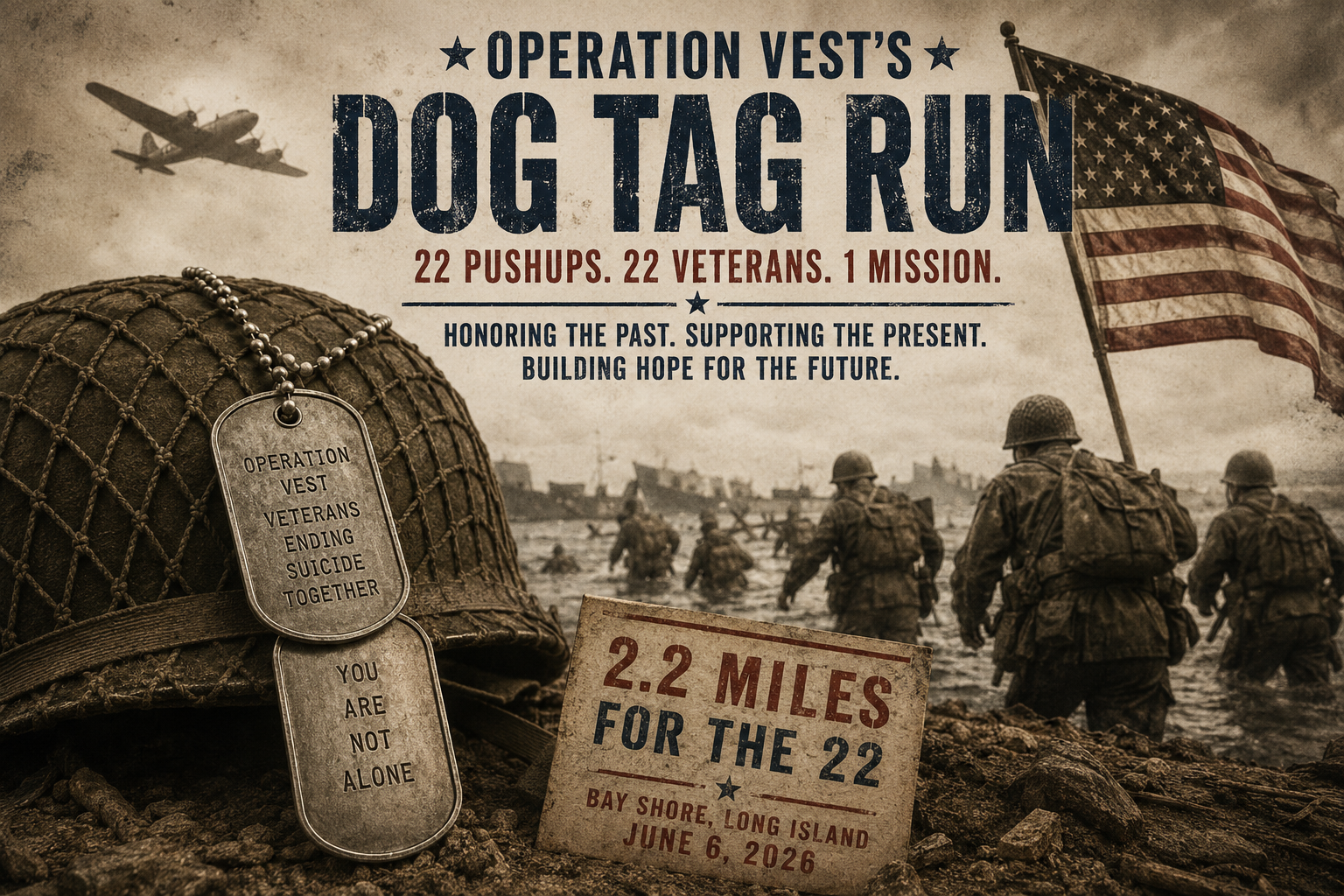
On June 6, the grounds of Gardiner County Park in Bay Shore filled with runners, walkers, ruckers, veterans, families, first responders, dogs, and supporters who came together for a mission bigger than a finish line. Operation VEST's Dog Tag Run once again showed what happens when a local community turns awareness into action and remembrance into movement.
The event featured a 2.2-mile run, walk, ruck march, and dog walk, along with a children's fun run and opening ceremony. The 2.2-mile distance carried special meaning. It served as a visible reminder of the long-running national conversation around veteran suicide and the symbolic number 22, which has become a rallying point for awareness, prevention, and support.
For some participants, the day was a race. For others, it was a walk with family, a ruck with weight on the shoulders, or a quiet tribute to someone lost. Together, those groups formed one clear message: no veteran should have to carry the burden alone.
The Mission Behind Operation VEST
Operation VEST stands for Veterans Ending Suicide Together. The Long Island-based nonprofit was created to help prevent veteran suicide by connecting veterans, active-duty service members, first responders, and their families with resources, community support, and organizations already doing the work on the ground.
The organization's approach is built around connection. Operation VEST does not treat suicide prevention as a slogan or a one-day awareness campaign. It works to build bridges between people in crisis and the networks that can help them: veteran service organizations, nonprofits, community partners, mental health resources, peer-support groups, and local advocates.
That mission matters because veterans often face complicated barriers when they are struggling. Pride, stigma, isolation, transition stress, service-related trauma, financial pressure, and difficulty navigating resources can all make it harder to ask for help. Operation VEST pushes back against those barriers by making the community visible, approachable, and active.
How Operation VEST Started
The roots of Operation VEST began before the nonprofit formally took shape. In April 2016, Stefan Hespeler began performing 22 pushups a day to raise awareness for veteran suicide. What started as a daily act of awareness became something much larger: a public commitment to keep the issue in front of the community and remind veterans that people were paying attention.
Stefan and Jenny Hespeler later helped turn that commitment into Operation VEST, which was founded in 2020. Their goal was to build an organization that did more than talk about the crisis. They wanted a group that could organize, fundraise, partner with others, and help connect veterans with the support they needed before a crisis became irreversible.
Since then, Operation VEST has grown into a recognized part of Long Island's veteran-support network. Through events, partnerships, fundraisers, community outreach, and direct advocacy, the organization has worked to keep resources local and strengthen the safety net around veterans and their families.
What Operation VEST Has Done
Operation VEST has supported the veteran community by raising awareness, building partnerships, and assisting other veteran-focused organizations. Its work has included community events like the Dog Tag Run, outreach campaigns, and collaboration with groups that provide direct services to veterans.
The organization has also helped bring attention to the broader ecosystem of veteran support on Long Island. By working with community partners and veteran organizations, Operation VEST helps amplify resources that veterans may not otherwise know exist. That is one of the most important roles a local nonprofit can play: not replacing every service, but making sure veterans can find the right door when they need help.
The Dog Tag Run is one of the clearest examples of that mission in action. It raises funds, brings people together, honors those lost, and creates a public moment where veterans, families, and civilians stand shoulder to shoulder.
The Founders and Leadership
Stefan Hespeler is one of Operation VEST's founders and a driving force behind the organization's daily visibility. His 22-pushup commitment, which began in 2016, became a foundation for the organization's culture: consistent action, public awareness, and a refusal to let the issue fade into the background.
Jenny Hespeler, co-founder of Operation VEST, has helped shape the organization's community-centered approach. Her work has been central to building relationships, supporting events, and creating a nonprofit culture rooted in compassion, trust, and action.
Operation VEST is also supported by board members, volunteers, sponsors, and community leaders who help carry the mission forward. Their work matters because veteran suicide prevention cannot be handled by one person or one organization. It requires a network: people who organize events, make calls, raise funds, set up tables, share resources, and show up when the community needs them.
The 22 Pushup Streak
One of the most powerful traditions tied to Operation VEST is the ongoing streak of 22 pushups a day. The pushups are simple, but the message behind them is heavy. They represent remembrance for veterans lost to suicide, awareness for those still struggling, and a daily promise to keep fighting for solutions.
At the June 6 Dog Tag Run, that tradition became a shared act. Participants joined together to perform 22 pushups before taking on the course. Veterans, families, children, first responders, runners, walkers, ruckers, and supporters all took part in the moment. It was not about athletic ability. It was about unity.
Watching the crowd drop down together made the meaning of the day impossible to miss. The race was not only about miles. It was about remembering the lives lost, supporting the people still fighting, and making sure the community keeps showing up after the banners come down and the course is cleared.
Why the Dog Tag Run Matters
Veteran suicide prevention is often discussed in statistics, but events like the Dog Tag Run bring the issue back to people. Behind every number is a name, a family, a unit, a friend group, and a community left searching for answers. Operation VEST's work reminds people that awareness must lead to action.
The June 6 event was a local race with a national message. It showed that communities do not have to wait for someone else to solve the problem. They can gather, fundraise, connect, remember, and build a stronger support network where they live.
The image of runners, walkers, ruckers, and dogs moving together through Bay Shore captured the spirit of the mission. It was not polished or distant. It was personal. It was local. It was people showing up for veterans in a way that can be seen, felt, and carried forward.
This Years Race Recap
While the mission of the Dog Tag Run extends far beyond competition, the event also featured impressive performances across several divisions. In the men's running category, Peter Bagattine claimed first place with a blazing time of 12 minutes and 9 seconds, setting the pace for the field from start to finish. On the women's side, Nancy Tantone captured first place with a strong finish of 15 minutes and 39 seconds. The ruck divisions showcased the grit and determination that have become synonymous with the event. In the Male Ruck Backpack Division, Eric D'Arce earned top honors, while Doreen Chin led the way in the Female Ruck Backpack Division. The Male Ruck Vest Division was won by Matthew Furino, and Mina Timmons claimed victory in the Female Ruck Vest Division. Their performances highlighted the unique spirit of the Dog Tag Run, where speed, endurance, and determination come together in support of a cause greater than any individual result. While each winner crossed the finish line first in their respective category, every participant who showed up to support Operation VEST's mission contributed to the event's true success—raising awareness, building community, and standing together in support of veterans and their families.
Perhaps the most powerful moment of the day came long after the fastest runners had crossed the finish line. As many participants gathered near the finish area, attention turned toward Jeremy Davila, the son of a veteran, who was still making his way along the course. Battling a physical disability and relying on a cane for support, Jeremy refused to quit. What happened next captured the very spirit of Operation VEST. A group of runners who had already completed the race turned around and went back out onto the course to accompany him for the final stretch. With cane in hand and surrounded by supporters, Jeremy steadily pushed forward until he finally crossed the finish line with a time of 1 hour, 34 minutes, and 15 seconds. The crowd, gathered along the finish chute, erupted in applause as the event announcer led a thunderous chant of "Jeremy! Jeremy! Jeremy!" that echoed across the park. It was a moment that transcended the race itself. Jeremy's determination, resilience, and refusal to surrender in the face of adversity embodied everything Operation VEST stands for. Equally inspiring was the community that rallied around him, reminding everyone in attendance that no one has to face life's challenges alone. In that moment, surrounded by cheers and support, Jeremy's finish became more than a personal victory—it became a living example of perseverance, hope, and the power of a community that refuses to leave anyone behind.
Looking Forward
Operation VEST's Dog Tag Run continues to grow because the mission continues to matter. The fight against veteran suicide requires more than one race, one speech, or one social media post. It requires consistency. It requires resources. It requires people willing to step into uncomfortable conversations and say clearly that help is available.
On June 6, Operation VEST gave Long Island another reminder of what community action looks like. The day honored the fallen, supported the living, and strengthened the network around veterans and their families.
In the end, the Dog Tag Run was not just about 2.2 miles. It was about the 22 pushups, the people standing together, and the promise at the heart of Operation VEST: Veterans Ending Suicide Together.