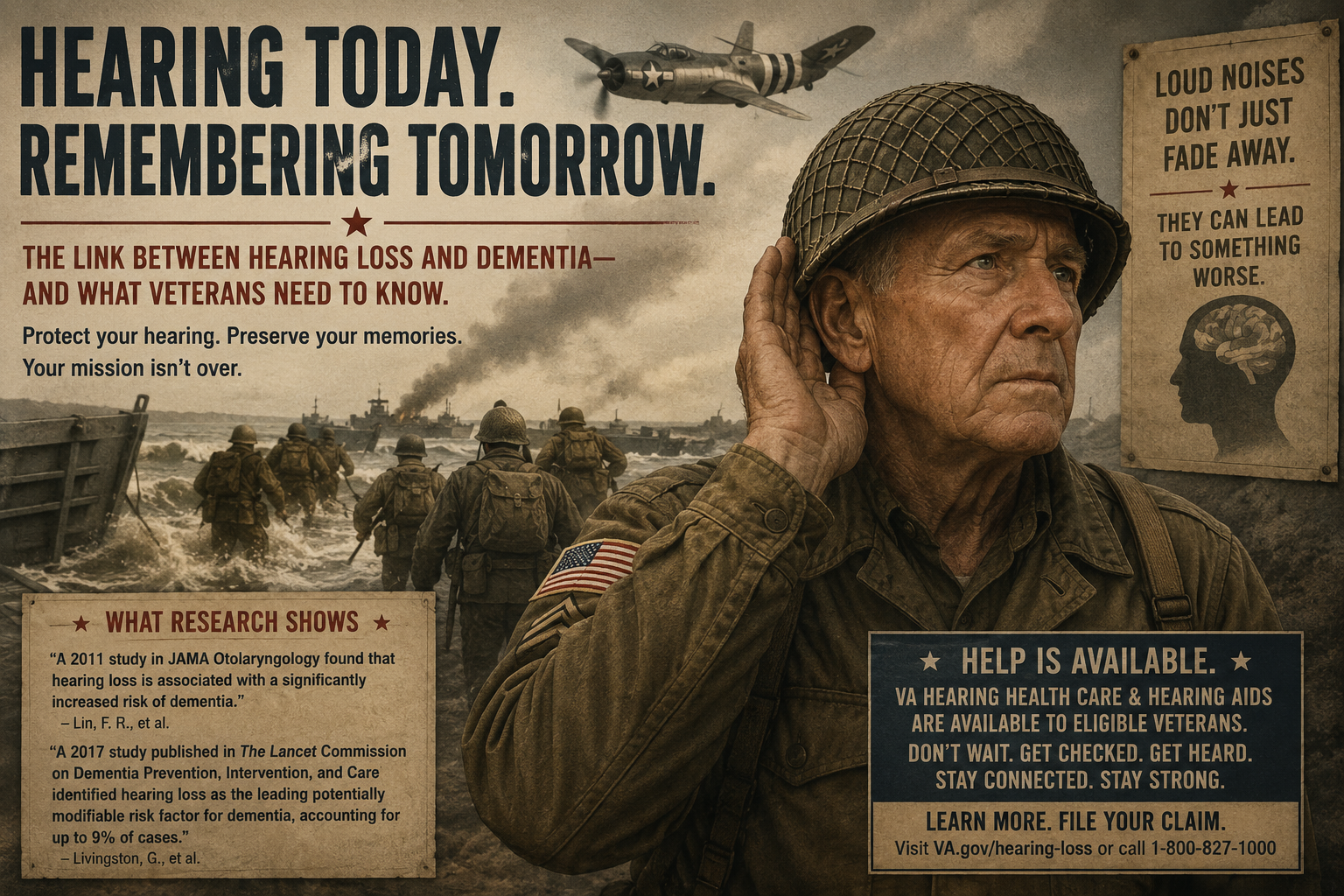
For generations, hearing loss has been treated largely as an inconvenience of aging or an unavoidable occupational injury: turn up the television, ask people to repeat themselves, eventually get hearing aids.
Modern neuroscience is painting a much more complicated picture.
Hearing is deeply connected to the way the brain processes information, maintains social connections, allocates attention, forms memories, and interacts with the world. When hearing begins to deteriorate, the consequences may therefore extend beyond simply missing parts of a conversation.
A growing body of epidemiological, neurological, and clinical research has established a significant association between hearing loss and cognitive decline, including dementia. The 2024 Lancet Commission on dementia prevention identified midlife hearing loss as one of the largest potentially modifiable risk factors for dementia, estimating a population-attributable fraction of approximately 7 percent. The Commission estimates that addressing 14 potentially modifiable factors collectively could potentially prevent or delay nearly 45 percent of dementia cases.
That does not mean seven percent of dementia is simply “caused by bad hearing.” Population-attributable estimates depend on assumptions about causality, prevalence, interaction between risk factors, and the possibility that those risks could actually be eliminated.
For America's veterans, that connection deserves particular attention.
Gunfire, artillery, aircraft, armored vehicles, heavy equipment, generators, shipboard machinery, explosives, rockets, repeated weapons qualification, blast exposure and traumatic brain injury make military service an unusually hazardous environment for the auditory system. VA data consequently place both tinnitus and hearing loss among the most common service-connected disabilities in the veteran population.
Understanding—and treating—hearing loss may therefore be one of the simplest health interventions available to millions of veterans as they age.
First, What Do We Mean by Dementia?
Dementia is not a single disease.
It is a general term describing a decline in cognitive abilities severe enough to interfere with everyday life. Those abilities can include memory, language, judgment, attention, executive functioning, orientation, problem solving and behavior.
Alzheimer's disease is the most common cause of dementia, but others include vascular dementia, dementia with Lewy bodies, frontotemporal dementia and mixed forms in which several pathological processes occur simultaneously.
Normal aging can make a person occasionally forget a name or take longer to retrieve information. Dementia involves something considerably different: progressive impairment that changes someone's ability to function independently.
The connection between dementia and hearing becomes especially interesting because hearing itself is not simply an ear function.
The ear receives sound. The brain has to make sense of it.
The Evidence Connecting Hearing Loss and Dementia
One of the landmark studies came from researchers led by Dr. Frank Lin at Johns Hopkins University.
Published in Archives of Neurology in 2011, the researchers followed 639 adults who initially did not have dementia. Participants underwent formal hearing testing and were followed for a median of nearly 12 years.
The results showed what researchers described as a dose-response relationship: the greater the hearing loss, the greater the subsequent risk of dementia.
Compared with people with normal hearing, the study reported an adjusted dementia hazard ratio of approximately:
- 1.89 for mild hearing loss
- 3.00 for moderate hearing loss
- 4.94 for severe hearing loss
The risk increased approximately 27 percent for every additional 10 decibels of hearing loss measured at baseline.
The authors also emphasized that further research was needed to determine whether hearing loss itself was contributing to dementia or serving as an early marker of another process. That distinction remains important today.
Since that study, however, evidence supporting the association has accumulated across multiple populations.
A later umbrella review combining evidence from systematic reviews and meta-analyses found that age-related hearing loss was associated with approximately a 59 percent higher pooled risk of dementia, although the authors characterized the overall quality of some underlying evidence as limited.
A 2025 global systematic review and meta-analysis involving 49 cohort studies found hearing loss associated with an approximately 32 percent increase in dementia risk, with broadly consistent associations across different regions of the world.
Meanwhile, a contemporary clinical review summarized the epidemiological literature as linking hearing loss with nearly twice the risk of dementia in some populations.
So the basic association is no longer particularly controversial. The more difficult question is why it happens.
How Could Hearing Loss Affect the Brain?
Researchers have proposed several overlapping mechanisms.
The important word is overlapping. There may not be one single pathway.
Hearing loss could contribute directly to cognitive decline in some people, accelerate existing vulnerability in others, and in still other patients may partly reflect neurological changes already developing in the brain.
1. The Brain Has to Work Harder Just to Hear
Imagine trying to carry on a conversation through a badly tuned radio.
The words are technically present, but portions are distorted or missing.
The listener begins filling in gaps: “Did he say Tuesday or Thursday?” “Was that fifteen or fifty?” “What was the first part of that sentence?”
That reconstruction requires brain power.
Researchers call this increased listening effort or cognitive load.
With normal hearing, much of speech recognition happens automatically. When auditory information becomes degraded, the brain may recruit working memory, attention and executive resources merely to decode what is being said.
Those cognitive resources are then less available for other tasks. Think of cognitive capacity as a limited operational budget. A person with good hearing can devote most of that budget to understanding the meaning of a conversation. A person with significant hearing loss may be spending part of the budget simply figuring out what sounds were spoken.
That creates another problem. You cannot remember information particularly well if you never encoded it correctly in the first place. Someone may appear forgetful when the original problem was partially auditory.
2. Reduced Sound May Alter the Brain
The brain is adaptable. Neural networks reorganize depending upon what information they repeatedly receive—or stop receiving.
Researchers studying hearing loss have observed structural and functional brain differences associated with diminished auditory input. Longitudinal research discussed in contemporary reviews has associated hearing loss with accelerated volume loss in portions of the temporal cortex involved in spoken-language processing, semantic memory and sensory integration.
This has contributed to what is sometimes called the sensory deprivation hypothesis. When the auditory system provides less meaningful stimulation, the neural networks involved in processing that information may change.
That does not mean someone becomes demented because they cannot hear the television. It means that years or decades of reduced sensory stimulation could potentially influence brain organization and cognitive reserve.
The brain functions through use. Hearing is one major pathway through which humans continuously challenge it.
3. Hearing Loss Can Gradually Remove People From Their Social World
One of the most damaging aspects of hearing loss is that it frequently happens slowly. Someone may not realize how much communication they are losing.
First they stop participating fully in large conversations. Restaurants become difficult because of background noise. Then family gatherings become exhausting. They stop attending meetings because they cannot follow everyone. They may avoid phone calls. They stop going out as often.
Eventually, someone who once participated actively in social life begins sitting quietly on the edge of conversations.
That matters because social engagement itself appears protective of cognitive health. The 2024 Lancet Commission identifies social isolation as another potentially modifiable dementia risk factor.
The intuitive hypothesis is therefore:
Reality is probably more complicated. A 2024 systematic review of longitudinal research confirmed an association between hearing loss and later cognitive impairment and dementia, but concluded that available evidence was still insufficient to determine how much of that relationship was actually mediated by social isolation.
Social isolation remains a highly plausible contributor—but researchers have not proved that it explains the entire hearing-dementia relationship.
4. Depression, Fatigue and Reduced Activity May Join the Chain
Struggling to communicate is exhausting. People with untreated hearing loss may experience frustration, embarrassment, anxiety, loneliness or depression.
They may also participate in fewer hobbies, organizations, community events and intellectually demanding activities. Each of those changes can potentially influence cognitive health independently.
A 2026 systematic review examining loneliness, isolation and cognitive decline identified several possible pathways, including depression, reduced engagement, sleep disturbance, inflammation, cardiovascular pathways and chronic stress.
This illustrates why the hearing-dementia relationship should not be thought of as a straight line. It may be an interconnected web.
5. Hearing Loss and Dementia May Share the Same Risk Factors
There is another possibility. Some of the processes damaging hearing may also damage the brain.
Aging, diabetes, smoking, cardiovascular disease, hypertension and vascular dysfunction can potentially affect both neurological and auditory systems.
Under this common-cause hypothesis, hearing loss does not necessarily cause dementia. Instead, hearing loss and dementia may sometimes be two manifestations of underlying biological deterioration.
6. Early Neurodegeneration Could Affect Hearing Processing
There is also the possibility of reverse causation.
The ear may still detect a tone normally while the brain becomes less effective at interpreting complicated auditory information. Researchers increasingly distinguish peripheral hearing loss from central auditory-processing dysfunction.
Someone might pass portions of a standard hearing test and still struggle enormously to understand speech when several people are talking or when background noise is present.
Changes in central auditory processing could potentially occur alongside—or perhaps precede—other manifestations of neurodegenerative disease. Recent neurological reviews therefore urge clinicians to view hearing loss as a strongly associated and potentially modifiable marker of dementia risk rather than describing it simplistically as a proven direct cause.
What About Hearing Aids?
This is where the story becomes especially important.
If hearing loss contributes to cognitive decline, then theoretically restoring access to sound could interrupt at least some of those mechanisms.
Hearing aids may:
- reduce listening effort,
- improve communication,
- increase social participation,
- improve access to environmental sounds,
- reduce conversational misunderstandings,
- increase confidence,
- reduce communication-related withdrawal,
- and provide greater sensory stimulation.
Observational research has generally been encouraging.
A massive Danish cohort study published in JAMA Otolaryngology–Head & Neck Surgery in 2024 examined more than 573,000 people.
Hearing loss was associated with greater dementia risk, but the association differed based on hearing-aid use. Compared with people without hearing loss, individuals with untreated hearing loss had an adjusted dementia hazard ratio of approximately 1.20, whereas hearing-aid users with hearing loss had a considerably smaller elevation, approximately 1.06.
That does not prove hearing aids caused the difference. People who obtain hearing aids may differ from non-users in healthcare access, socioeconomic status, education, general health behaviors and willingness to seek treatment.
Randomized trials therefore matter.
The ACHIEVE Trial
The Aging and Cognitive Health Evaluation in Elders—or ACHIEVE—study was a large multicenter randomized controlled trial specifically designed to investigate whether treating hearing loss could slow cognitive decline.
Researchers enrolled 977 adults between 70 and 84 years old who had untreated hearing loss but did not have substantial baseline cognitive impairment.
Participants were randomized to either:
- a comprehensive hearing intervention including hearing aids and audiological counseling, or
- a health-education program.
They were followed for three years.
The headline result requires careful interpretation. Across the entire study population, the hearing intervention did not significantly reduce three-year cognitive decline compared with the control group.
If we stopped there, we might conclude hearing treatment does not affect cognition. But the trial contained two distinctly different populations.
One consisted of healthier community volunteers. The other came from the long-running ARIC cardiovascular study and had considerably more baseline risk factors for cognitive decline.
In that higher-risk ARIC population, the hearing intervention was associated with approximately 48 percent slower cognitive decline over three years.
Later analyses reinforced the idea that baseline risk mattered. A secondary ACHIEVE analysis found that among participants in the highest quarter of predicted cognitive-decline risk, the hearing intervention was associated with approximately 62 percent slower cognitive decline than the control intervention.
That is significant.
It does not establish hearing aids as a drug-like treatment capable of preventing Alzheimer's disease. But it provides randomized clinical evidence suggesting that correcting hearing impairment may be particularly meaningful in people whose brains already face multiple risk factors.
Hearing Aids Are Not an Alzheimer's Vaccine
This deserves emphasis.
A person should not buy hearing aids believing they are guaranteed to prevent dementia. They are not.
Dementia develops through complicated interactions involving genetics, vascular health, aging, lifestyle, neurodegenerative pathology, environmental exposures and numerous other factors.
But hearing loss is unusual among those risk factors because it is often relatively easy to identify and treat.
There is very little downside to improving someone's ability to communicate with their spouse, children, grandchildren, coworkers and community. And there may be cognitive benefits as well.
A 2026 systematic review and meta-analysis combining 46 studies and more than 231,000 participants found hearing-aid use associated with modestly better global cognition, memory and executive/attention performance and a lower risk of cognitive impairment, although results varied among populations and study designs.
It is: untreated hearing loss is associated with dementia risk, hearing rehabilitation may reduce cognitive decline in some populations, and treating hearing impairment provides numerous established benefits even while researchers continue determining how much dementia risk can actually be prevented.
Why Early Identification Matters
People frequently wait years between developing meaningful hearing loss and seeking treatment. That delay matters.
The earlier hearing loss is detected, the sooner a person can protect remaining hearing and restore access to communication.
Early evaluation can also identify problems that should not simply be attributed to aging. Sudden hearing loss, asymmetric hearing loss, severe tinnitus, dizziness or other neurological symptoms may require medical evaluation.
Early hearing testing also establishes a baseline. That can be especially valuable for veterans whose hearing may already have been affected by decades of military or occupational noise exposure.
Most importantly, hearing treatment is easier when someone remains actively connected to the auditory world.
Waiting until communication becomes profoundly impaired can mean years of unnecessary isolation, misunderstanding and cognitive effort.
Why Veterans Are Especially Vulnerable
For veterans, hearing loss is not an obscure age-related problem. It is one of the signature occupational injuries of military service.
The Department of Veterans Affairs explicitly identifies harmful military noise exposure as arising from combat, training and routine job duties.
Sources include:
- gunfire,
- explosives,
- rockets,
- heavy weapons,
- jets and aircraft,
- machinery,
- vehicle noise,
- and repeated high-intensity vibration and sound.
Many civilian occupations have hearing-conservation requirements. Military operations do too—but combat does not always cooperate.
Hearing protection may be unavailable, improperly fitted, removed to maintain situational awareness or overwhelmed by extremely high noise levels.
A rifle shot does not wait until your ear protection is seated correctly. Neither does an IED.
Weapons Exposure
Military firearms produce impulse noise capable of damaging the delicate hair cells inside the cochlea.
The problem is cumulative. A service member may fire thousands of rounds during a career through qualification ranges, crew-served weapons, live-fire exercises and combat.
Artillery, mortars, machine guns and explosives can generate extreme peak sound levels.
Once enough cochlear sensory cells or associated neural structures are damaged, sensorineural hearing loss is generally permanent. Hearing aids do not regrow those cells. They compensate for the loss.
Aircraft and Flight-Line Noise
Anyone who has spent time around military aircraft understands the intensity.
Jet engines, helicopters, auxiliary power units, generators and ground-support equipment can create sustained hazardous noise.
Pilots and aircrew are exposed. So are mechanics, maintainers, fuelers, ground crews and countless other specialties working near flight operations.
Repeated exposure may occur for years.
Armor, Vehicles and Heavy Equipment
Tanks, armored vehicles, tracked vehicles, engineering equipment, generators and heavy diesel machinery can create prolonged noise exposure.
A single event does not necessarily need to cause obvious immediate hearing loss. Years of accumulated exposure can gradually degrade auditory function.
Shipboard Noise
Sailors face their own environment.
Engine rooms, machinery spaces, flight decks, weapons systems and confined metal compartments create intense and sometimes continuous noise.
Unlike a short visit to an industrial worksite, sailors may live in this environment for months.
Blast Exposure Is Different
Blast injury deserves particular attention.
An explosion can affect both the peripheral ear and the neurological pathways connecting hearing to the brain.
VA researchers specifically note that blast exposure can cause hearing problems even without obvious external physical injury and may compromise “not only the ear itself, but also the connection between the ear and the brain.”
Blast-associated auditory injury can include:
- conventional hearing loss,
- tinnitus,
- difficulty understanding speech,
- reduced tolerance for sound,
- central auditory-processing problems,
- vestibular problems,
- and impaired spatial hearing.
Research involving service members and veterans with histories of blast exposure and traumatic brain injury has found communication difficulties that sometimes extend beyond what traditional audiograms would predict.
That complaint deserves evaluation.
Traumatic Brain Injury and Hearing
TBI creates another layer of concern.
Hearing involves extensive neurological processing. The brain must determine where sounds originate, separate speech from competing noise, identify patterns, direct attention and integrate auditory information with memory.
Research involving service members and veterans has found that TBI and blast exposure can be associated with deficits in speech recognition, tinnitus and auditory processing even when standard measures do not tell the entire story.
For GWOT veterans in particular, the overlap between hearing loss, tinnitus, blast exposure and TBI makes comprehensive evaluation especially important.
Military Chemical and Ototoxic Exposures
Military hearing risks are not limited to loud sound.
Research reviews examining service-member auditory-processing disorders also identify ototoxicant and neurotoxin exposures as potential military risk factors.
Some medications can also damage hearing under particular circumstances.
This does not mean every veteran exposed to a chemical or medication will develop hearing loss. It means military auditory history should include more than the question: “Were you around loud guns?”
The Numbers: Hearing Loss Among Veterans
The scale becomes obvious when VA compensation statistics are examined.
According to the Veterans Benefits Administration's Fiscal Year 2025 Annual Benefits Report, tinnitus remained the single most prevalent service-connected disability among compensation recipients, affecting approximately 3.58 million veterans.
Hearing loss was also among the ten most prevalent service-connected disabilities, with approximately 1.69 million compensated disabilities recorded among recipients.
In that report, hearing loss ranked sixth among the most prevalent service-connected disabilities overall.
Among new compensation recipients in FY2025, tinnitus accounted for approximately 287,000 service-connected disabilities and hearing loss approximately 105,000.
In other words, auditory damage is not a niche veteran issue. It is one of VA's largest disability populations.
Tinnitus
About 3.58 million veterans were compensated for tinnitus in FY2025, making it VA's most prevalent service-connected disability.
Hearing Loss
About 1.69 million compensated hearing-loss disabilities were reported, ranking hearing loss sixth overall.
Military Risk
Weapons, aircraft, armor, machinery, shipboard noise, blasts and TBI can all contribute to auditory injury.
Brain Health
Hearing loss is a major potentially modifiable dementia risk factor, making early evaluation especially important as veterans age.
The Veteran Aging Question
This creates a potentially important public-health issue.
Millions of veterans already have documented hearing damage.
At the same time, large populations of Vietnam, Gulf War and early GWOT veterans are moving into age ranges in which dementia risk begins increasing substantially.
Many veterans may also carry additional dementia-associated risk factors including:
- traumatic brain injury,
- hypertension,
- diabetes,
- cardiovascular disease,
- smoking history,
- depression,
- social isolation,
- physical inactivity,
- high cholesterol,
- and other chronic conditions.
That combination makes hearing treatment especially worthy of attention.
The 2024 Lancet Commission separately identifies hearing loss, TBI, depression, social isolation, hypertension, diabetes, smoking, physical inactivity and elevated LDL cholesterol among potentially modifiable dementia risk factors.
For some veterans, hearing loss may therefore be one component of a much larger risk profile.
VA Hearing Care: Veterans May Have More Access Than They Realize
One of the most important points veterans should understand is this:
Current VA patient guidance states that veterans who are enrolled and eligible for VA healthcare may contact Audiology directly.
VA guidance says:
- a primary-care referral is generally not required for routine audiology,
- a veteran does not have to be service-connected for hearing loss to receive hearing aids,
- prescription hearing aids require a hearing evaluation,
- and VA provides premium hearing-aid technology from multiple manufacturers.
VA guidance also states that hearing aids themselves are provided without charge to eligible veterans, although healthcare copayments for visits may apply depending on the veteran's eligibility category.
VA audiology services can include much more than basic hearing aids.
Depending on clinical need, services and devices may include:
- diagnostic hearing evaluations,
- hearing-aid fitting and programming,
- cochlear implants,
- bone-anchored hearing systems,
- tinnitus treatment,
- auditory rehabilitation,
- assistive listening devices,
- alerting devices,
- remote microphones,
- television streaming accessories,
- smartphone connectivity,
- and tele-audiology services.
VA can also provide replacement hearing-aid batteries and eligible accessories to enrolled veterans whose devices are prescribed through VA.
How a Veteran Can Start the VA Hearing-Aid Process
For an enrolled veteran, the process can be relatively straightforward.
Contact the Audiology clinic at the nearest VA medical center or outpatient facility offering audiology services.
VA's facility locator allows veterans to search by location and filter for Audiology services. Current VA guidance indicates that eligible enrolled veterans can generally schedule directly rather than first obtaining a primary-care referral.
The audiologist will conduct appropriate testing. That may include measurements of hearing thresholds as well as speech-recognition testing and other assessments depending upon symptoms.
Veterans should clearly explain functional problems, particularly if the biggest difficulty is understanding speech in noise.
Do not simply say: “My hearing isn't great.”
Explain what actually happens:
- “I can hear my wife talking but cannot understand the words.”
- “I can't follow conversations in restaurants.”
- “I hear fine one-on-one but lose everything when several people talk.”
- “I can't determine where sounds are coming from.”
- “I have trouble understanding radio traffic.”
- “I was exposed to blasts and my hearing hasn't felt right since.”
- “I passed hearing tests but cannot process speech in noise.”
Those details matter clinically.
VA Healthcare and VA Disability Compensation Are Two Different Things
This distinction causes considerable confusion.
Receiving hearing aids from VA does not automatically mean hearing loss is service-connected.
Conversely, a veteran does not necessarily need a service-connected rating to obtain hearing healthcare through VA if otherwise eligible for VA healthcare.
Healthcare treatment and disability compensation are separate benefit systems.
A veteran who believes military service caused or aggravated hearing loss may separately file a VA disability claim.
Filing a VA Disability Claim for Hearing Loss
For an original service-connected disability claim, VA generally looks for three fundamental elements:
- A current disability.
- An in-service event, injury, disease or exposure.
- A link—or nexus—between the current disability and military service.
For hearing loss, that often translates into:
Document the Current Hearing Problem
A formal audiological evaluation is important.
Do not assume that saying “I can't hear” will establish the level or type of hearing impairment. Hearing loss is measurable.
Veterans with years of private audiograms, occupational hearing tests or VA hearing evaluations should identify those records.
Document the Military Noise Exposure
Think beyond combat.
Relevant evidence might include:
- MOS or rating,
- weapons qualification,
- artillery service,
- infantry service,
- armor,
- aviation,
- flight-line duties,
- engine-room duties,
- heavy-equipment operation,
- vehicle maintenance,
- combat deployments,
- blast incidents,
- TBI,
- demolitions,
- range operations,
- shipboard machinery,
- generator exposure,
- or other hazardous military noise.
VA explicitly acknowledges that harmful military noise can arise during combat, training and general job duties.
A veteran does not need to have been in a firefight for military noise exposure to matter.
Explain the Timeline
A strong personal statement can describe:
- what military noises you encountered,
- approximately how frequently,
- whether hearing protection was used,
- whether protection was practical or unavailable,
- when you first noticed hearing difficulty,
- whether ringing began during service,
- whether hearing progressively worsened afterward,
- what civilian noise exposure you experienced after discharge,
- and how the condition affects daily life today.
Precision is more valuable than exaggeration.
If hearing loss appeared gradually, say so. If tinnitus began immediately after a specific blast, say so. If family members noticed the hearing problem before you did, their statements may also help describe the timeline.
VA accepts lay evidence and buddy statements, including VA Form 21-10210, as potential supporting evidence.
The Nexus Question
The nexus is the connection between the current disability and service.
In some cases, service treatment records may demonstrate changes in hearing while someone was serving.
In other cases, the connection may depend upon the nature of the veteran's occupational noise exposure, post-service history, audiometric findings and medical opinion.
The absence of a dramatic hearing-loss diagnosis at separation does not mean a veteran should automatically assume there is no claim.
However, service connection is not automatic simply because someone served around noise. VA evaluates claims individually.
Do Not Forget Tinnitus
Hearing loss and tinnitus are different conditions.
A veteran may have one without the other.
Tinnitus is the perception of sound—frequently ringing, buzzing, humming or similar noise—without a corresponding external sound.
FY2025 VA data show tinnitus as the most prevalent service-connected disability among compensation recipients, with roughly 3.58 million compensated veterans.
Veterans experiencing both hearing loss and tinnitus should accurately identify both conditions when discussing symptoms and possible claims.
Where to Start a VA Claim
VA currently allows disability claims to be filed:
- online,
- by mail using VA Form 21-526EZ,
- in person at a VA regional office,
- by fax,
- or with assistance from an accredited representative.
A veteran can also obtain assistance from an accredited Veterans Service Organization representative, accredited claims agent or accredited attorney.
Veterans who intend to file but need time to collect records should pay attention to effective-date rules.
When starting an online disability application, VA states that the date the application is started may be protected as the date of claim if the application is completed within 365 days.
For some paper claims, submitting an Intent to File may similarly preserve a potential effective date while evidence is assembled.
What Evidence Should a Veteran Gather?
For a hearing-loss claim, useful evidence may include:
- DD214 or separation documentation,
- service treatment records,
- entrance and separation audiograms,
- periodic military hearing tests,
- deployment records,
- documentation of MOS/rating and duties,
- records of blast injuries or TBI,
- VA audiology records,
- private audiology records,
- occupational hearing evaluations,
- personal statements,
- buddy statements,
- spouse or family observations,
- and relevant medical opinions.
VA states that it reviews discharge documents, service treatment records and medical evidence and may consider lay evidence from the veteran or others familiar with the condition.
Hearing Loss Should Be Treated Even if the Claim Is Pending
One of the biggest mistakes a veteran can make is waiting for the disability process before getting medical treatment.
The two processes are separate.
If you cannot hear properly, seek an audiological evaluation.
Do not spend several years fighting over whether VA considers something service-connected while simultaneously allowing an untreated hearing problem to interfere with your relationships and daily life.
Treatment addresses the health problem. Compensation addresses the service connection.
Both may matter, but they serve different purposes.
When Hearing Problems May Look Like Memory Problems
Another important issue involves dementia evaluation itself.
Someone with significant hearing loss may appear cognitively impaired simply because they cannot hear portions of the assessment.
Imagine being asked: “I am going to give you five words. Repeat them now, and remember them because I'll ask you again later.”
If the patient only hears three of those words clearly, the subsequent memory score may look worse even though the original encoding failure was auditory.
Recent reviews therefore emphasize the importance of accounting for hearing impairment during cognitive assessment.
For families, this creates another useful question.
Before assuming a loved one “isn't paying attention anymore,” ask whether they actually heard what was said.
Sometimes the answer will be dementia. Sometimes the answer will be hearing loss. Sometimes it will be both.
Either way, knowing matters.
What Veterans and Families Should Watch For
Possible signs of hearing loss include repeatedly asking people to repeat themselves, increasing television volume, difficulty understanding higher-pitched voices, misunderstanding words, trouble following conversations in noisy rooms, difficulty localizing sounds and withdrawing from social situations.
A particularly important warning sign is:
That may reflect conventional high-frequency hearing loss, which affects speech clarity, but in some veterans—especially those with blast exposure or TBI—it may also justify evaluation for more complicated auditory-processing problems.
Protect the Hearing You Still Have
Treatment should also include prevention of additional damage.
Use appropriate hearing protection around:
- firearms,
- power tools,
- motorcycles,
- loud recreational equipment,
- concerts,
- machinery,
- lawn equipment,
- and other high-noise environments.
Veterans accustomed to military noise sometimes normalize extreme sound exposure. That does not make it harmless.
Hearing damage accumulates.
Hearing Aids Work Best When They Are Actually Used
Modern prescription hearing aids are dramatically more sophisticated than earlier generations.
Directional microphones can prioritize speech. Noise-processing algorithms can improve difficult listening environments. Wireless microphones can transmit another person's voice directly to the hearing aids. Televisions and phones can stream audio. Apps allow individualized control.
But the device has to be fitted appropriately and worn consistently.
There is often an adaptation period.
The brain may not have processed certain frequencies normally for years, and suddenly restoring those sounds can initially make the world seem strange or excessively loud.
Follow-up appointments matter. Programming can be adjusted. Communication strategies can be taught.
Hearing rehabilitation is not simply handing someone two devices and sending them home.
Treat Hearing Loss as Part of a Larger Brain-Health Strategy
No one should view hearing treatment in isolation.
The research increasingly supports a broader approach to protecting cognitive function throughout adulthood.
That means treating hearing loss while also controlling cardiovascular risks, remaining physically active, maintaining social connections, managing diabetes and blood pressure, avoiding tobacco, treating depression, addressing elevated cholesterol and minimizing additional head trauma.
The Lancet Commission's larger message is encouraging precisely because many dementia risks appear potentially modifiable.
Genetics cannot be changed. Aging cannot be stopped.
But many contributors to cognitive decline can be addressed.
Hearing may be one of the most overlooked.
For Veterans, This Is an Opportunity
Military culture teaches people to tolerate inconvenience.
That mentality is useful when the mission requires it.
It can become counterproductive when carried into healthcare.
Not hearing your spouse clearly is not something you earn extra points for enduring.
Neither is spending years unable to understand your grandchildren.
There is no award for leaving hearing aids in a drawer.
Veterans already represent one of the populations most heavily affected by hearing injury, and VA has consequently built one of the largest audiology systems in the country. VA research notes that its audiology and speech pathology workforce provides services at hundreds of VA sites, encompassing hearing evaluation, tinnitus management and auditory rehabilitation.
That resource exists because the problem is enormous.
Veterans should use it.
The Bottom Line
Science has moved well beyond the idea that hearing loss only affects the ears.
Untreated hearing impairment is consistently associated with cognitive decline and dementia.
The mechanisms probably involve several overlapping processes: increased cognitive effort, reduced sensory stimulation, brain reorganization, social disengagement, depression, shared vascular or neurological disease and possibly early neurodegenerative changes affecting auditory processing itself.
No researcher can currently promise that hearing aids will prevent Alzheimer's disease.
The randomized ACHIEVE trial did not show a cognitive benefit for every participant.
But it did produce an extremely important signal: among older adults already at greater risk of cognitive decline, comprehensive hearing treatment substantially slowed cognitive decline over three years.
Meanwhile, hearing aids have immediate benefits that require no dementia hypothesis at all.
They help people hear.
They help people communicate.
They help people participate.
They help families remain connected.
For veterans—millions of whom spent careers exposed to weapons, engines, aircraft, machinery and explosions—that should be enough reason to stop dismissing hearing loss as simply part of getting older.
And if protecting hearing also helps protect the brain, the case for early treatment becomes even stronger.
Treat hearing loss before isolation becomes normal.
Protect the hearing that remains.
And if military service caused the damage, learn what VA healthcare and disability benefits are available.
The ringing in the ears may be the most obvious reminder of military noise exposure.
The consequences of not hearing the world around us may be far less obvious—and potentially much more important.
Veteran Resources
Veterans concerned about hearing loss can use the VA facility locator to find a VA Audiology clinic and can contact Audiology directly once enrolled and eligible for VA healthcare. VA information on hearing healthcare and hearing aids is available through its Audiology and Speech Pathology program.
Veterans who aren't enrolled in VA healthcare can review current eligibility requirements and apply through VA. Expanded eligibility includes many veterans with qualifying toxic or hazardous exposures and combat-zone service.
Veterans who believe their hearing loss or tinnitus resulted from military service can begin a VA disability claim online or file VA Form 21-526EZ. Accredited VSO representatives, claims agents and attorneys can also assist with filing.
For veterans with military noise-exposure concerns, VA's Public Health program maintains specific information regarding hazardous military noise and related healthcare and compensation resources.
Sources and Further Reading
- The Lancet Commission: Dementia prevention, intervention, and care — 2024 report
- Lin FR et al.: Hearing Loss and Incident Dementia
- Umbrella review of hearing loss and dementia risk
- Global systematic review and meta-analysis of hearing loss and dementia risk
- ACHIEVE randomized controlled trial
- ACHIEVE secondary analysis by baseline cognitive-decline risk
- Danish cohort study: Hearing loss, hearing aids, and dementia risk
- 2026 systematic review and meta-analysis of hearing aids and cognitive outcomes
- VA Public Health: Noise Exposure and Hearing Loss
- VA Research: Hearing Loss
- Veterans Benefits Administration: FY2025 Compensation Report
- VA Health Care: Eligibility and Enrollment
- VA Facility Locator
- VA: Order Hearing Aid Batteries and Other Medical Supplies
- VA: How to File a Disability Claim
- VA: Evidence Needed for a Disability Claim