
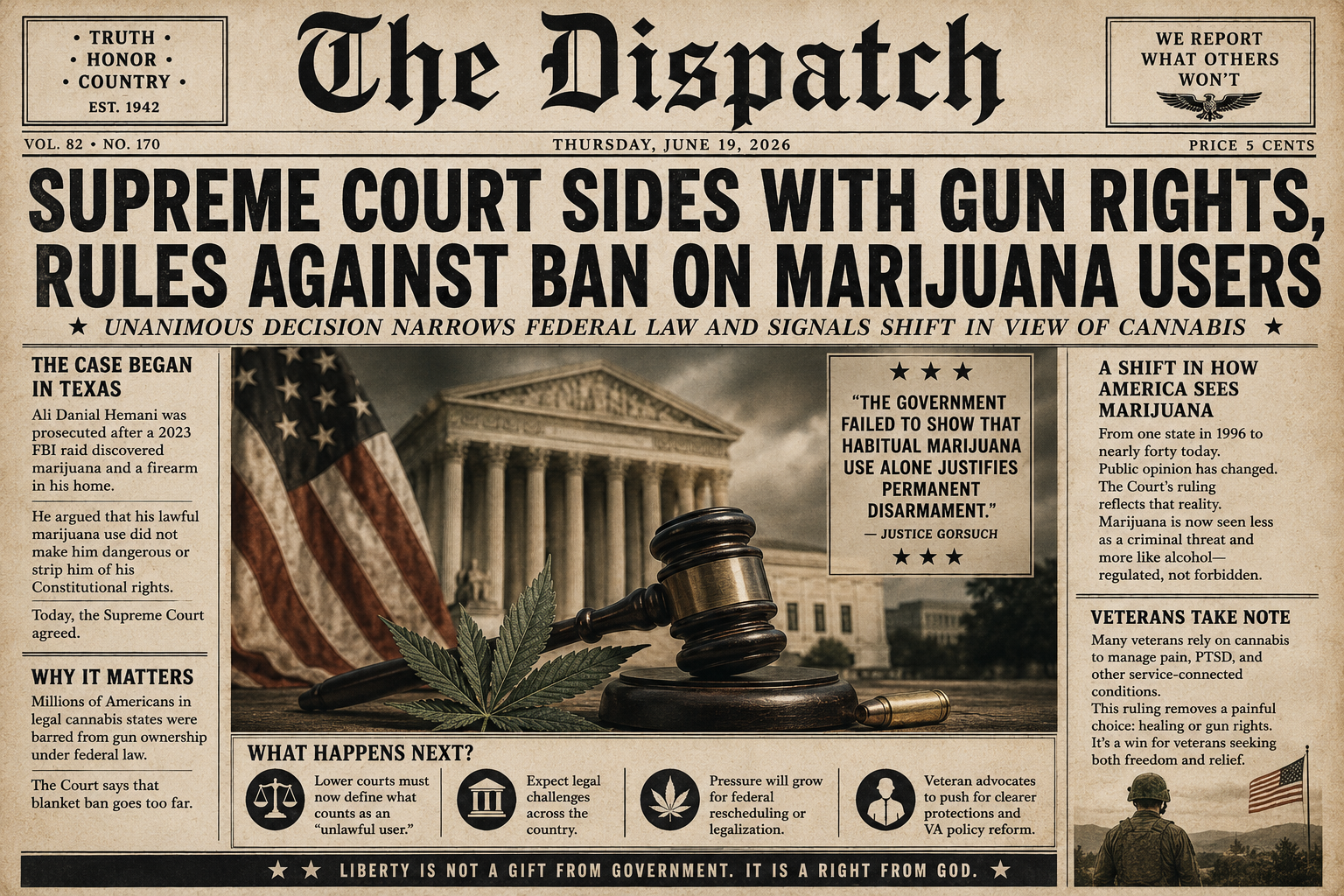
For decades, Americans who used marijuana lived under a hard federal rule: cannabis use and gun ownership could not legally coexist. Even in states where marijuana was legal for medical or recreational purposes, federal law still treated users as “unlawful users” of a controlled substance and barred them from possessing firearms.
On June 18, 2026, the Supreme Court changed the landscape. In a unanimous 9-0 decision in United States v. Hemani, the Court ruled in favor of Ali Danial Hemani, a Texas man prosecuted under 18 U.S.C. § 922(g)(3), the federal statute that prohibits firearm possession by anyone who is an unlawful user of, or addicted to, a controlled substance.
The Court did not erase the law entirely. Instead, it narrowed how the government may apply it. The ruling makes clear that the federal government cannot rely on a broad status-based ban to disarm someone simply because they use marijuana when there is no proof that they were intoxicated, dangerous, or misusing a firearm at the time.
How the Case Began
The case began in Texas after a 2023 FBI raid on Hemani’s home uncovered a firearm and marijuana. Federal prosecutors charged him under the Gun Control Act’s drug-user firearm restriction, arguing that his marijuana use made him a prohibited person under federal law.
Hemani challenged the charge, arguing that the law violated the Second Amendment as applied to him. His case moved through the federal courts after the Fifth Circuit sided with him, holding that the government had not shown a historical tradition that justified disarming a sober person based only on marijuana use.
The case arrived at the Supreme Court in the shadow of the Court’s modern Second Amendment decisions, especially New York State Rifle & Pistol Association v. Bruen. Under that framework, modern gun restrictions must be consistent with the nation’s historical tradition of firearm regulation.
The Government’s Argument
The federal government argued that drug use and firearm possession are a dangerous combination. It pointed to historical restrictions on intoxicated people and “habitual drunkards,” claiming those laws supported the modern restriction on unlawful drug users.
The problem for the government was fit. Historical restrictions generally targeted active intoxication, dangerousness, or misuse. Section 922(g)(3), by contrast, treated marijuana use as a continuing status that could trigger felony prosecution even when the person was not impaired while possessing the firearm.
The Court rejected the idea that marijuana use alone automatically places a person outside the protection of the Second Amendment. Justice Neil Gorsuch, writing for the Court, emphasized that the government had not shown enough historical support for disarming Hemani on that basis.
Why the Ruling Matters
The decision matters because it strikes at one of the biggest contradictions in American law. Marijuana remains illegal under federal law, but most states now allow some form of medical cannabis, and many allow recreational use. That conflict created a legal trap for millions of Americans.
A person could be following state law, using cannabis under a medical program, and still be treated as federally prohibited from owning a firearm. For gun owners, medical marijuana patients, and veterans, that conflict has never been theoretical. It has shaped real decisions about pain management, personal defense, hunting, sport shooting, and privacy.
The Supreme Court’s ruling does not legalize marijuana. It does not say that someone intoxicated by drugs or alcohol has a right to carry or use firearms. It does not give people permission to lie on federal firearms paperwork. But it does reject the idea that marijuana use alone is enough to permanently remove a constitutional right.
A Shift in How America Views Marijuana
This ruling also reflects a larger cultural shift. For decades, marijuana was treated as a serious criminal threat. Today, cannabis is increasingly viewed more like alcohol: still regulated, still capable of abuse, but not automatically proof that someone is dangerous.
That shift is visible in state legalization, medical cannabis programs, veterans’ advocacy, and federal debates over rescheduling. The Court’s decision does not settle those debates, but it recognizes that older assumptions about cannabis users are becoming harder to defend when constitutional rights are involved.
The ruling also places pressure on Congress and federal agencies to modernize the law. As long as marijuana remains federally illegal while states continue to legalize it, Americans will remain caught between conflicting legal systems.
Why Veterans Are Watching Closely
For veterans, this case lands directly in the middle of a real-world dilemma. Many veterans use cannabis to manage chronic pain, PTSD symptoms, anxiety, sleep problems, and other service-connected conditions. Some do so through state medical marijuana programs. Others live in states where recreational cannabis is legal.
The Department of Veterans Affairs cannot prescribe or recommend marijuana because cannabis remains illegal under federal law. However, VA policy states that veterans will not be denied VA benefits because of marijuana use and encourages veterans to discuss cannabis use with their VA providers so it can be considered in treatment planning.
That leaves many veterans in a gray zone. A veteran may be honest with a VA doctor about cannabis use, may be following state law, and may be using marijuana as an alternative to opioids or other medications. But under federal firearms law, that same veteran has long faced the possibility of being treated as a prohibited person.
Until now, many veterans faced an uncomfortable choice: use cannabis for relief and risk firearm rights, or preserve firearm rights and avoid a treatment that may help them function.
What Changed
The Court narrowed the government’s ability to apply a blanket firearm ban based only on marijuana use.
What Did Not Change
Marijuana remains illegal under federal law, and intoxicated or dangerous firearm possession can still be restricted.
Veteran Impact
The ruling helps challenge the idea that therapeutic cannabis use should automatically erase gun rights.
Next Fight
Lower courts, Congress, ATF policy, and federal cannabis reform will determine how far this decision reaches.
What This Does Not Mean
Veterans should be careful not to overread the ruling. This is not a blanket green light for every cannabis user to buy or possess firearms without risk. Federal marijuana law remains in place. Firearm purchase forms still require truthful answers. State laws may vary. And the ruling leaves room for the government to restrict firearm access when drug use is connected to active impairment, addiction, violence, or dangerous conduct.
The safest reading is this: the government can no longer assume that marijuana use alone is enough. It must show more. That distinction is a major victory for constitutional rights, but it is not the same as full federal legalization or complete protection for medical cannabis users.
What Happens Next
The next phase will likely happen in the lower courts. Judges will have to decide what counts as recent use, regular use, active impairment, addiction, or dangerousness. Those questions will shape how prosecutors apply § 922(g)(3) going forward.
Congress may also face renewed pressure to clarify federal law. Marijuana policy, firearm rights, and veterans’ medical care are now colliding in a way that cannot be ignored. If lawmakers do not act, courts will continue deciding the issue case by case.
Veteran advocacy groups may use this decision to push for clearer protections for medical cannabis users, especially those using marijuana under state law to manage service-connected conditions. The ruling could also strengthen arguments for VA-related cannabis reform and broader federal rescheduling.
The Bottom Line
The Supreme Court did not settle every question, but it sent a clear message: constitutional rights cannot be removed by broad labels alone. If the government wants to disarm someone, it must point to danger, impairment, or a historically grounded reason.
For veterans caught between pain relief, federal law, and personal liberty, that message matters. The legal wall between cannabis use and gun rights has not fallen completely, but after this ruling, it has cracked.
Sources and Further Reading
- Associated Press: Supreme Court sides with Texas man in marijuana gun-rights case
- Reuters: U.S. Supreme Court sides with marijuana user stripped of gun rights
- Supreme Court Docket: United States v. Ali Danial Hemani
- Cornell Law: United States v. Hemani case background
- VA Public Health: VA and Marijuana — What Veterans Need to Know
- VA Mental Health: Cannabis Use Disorder and Veterans