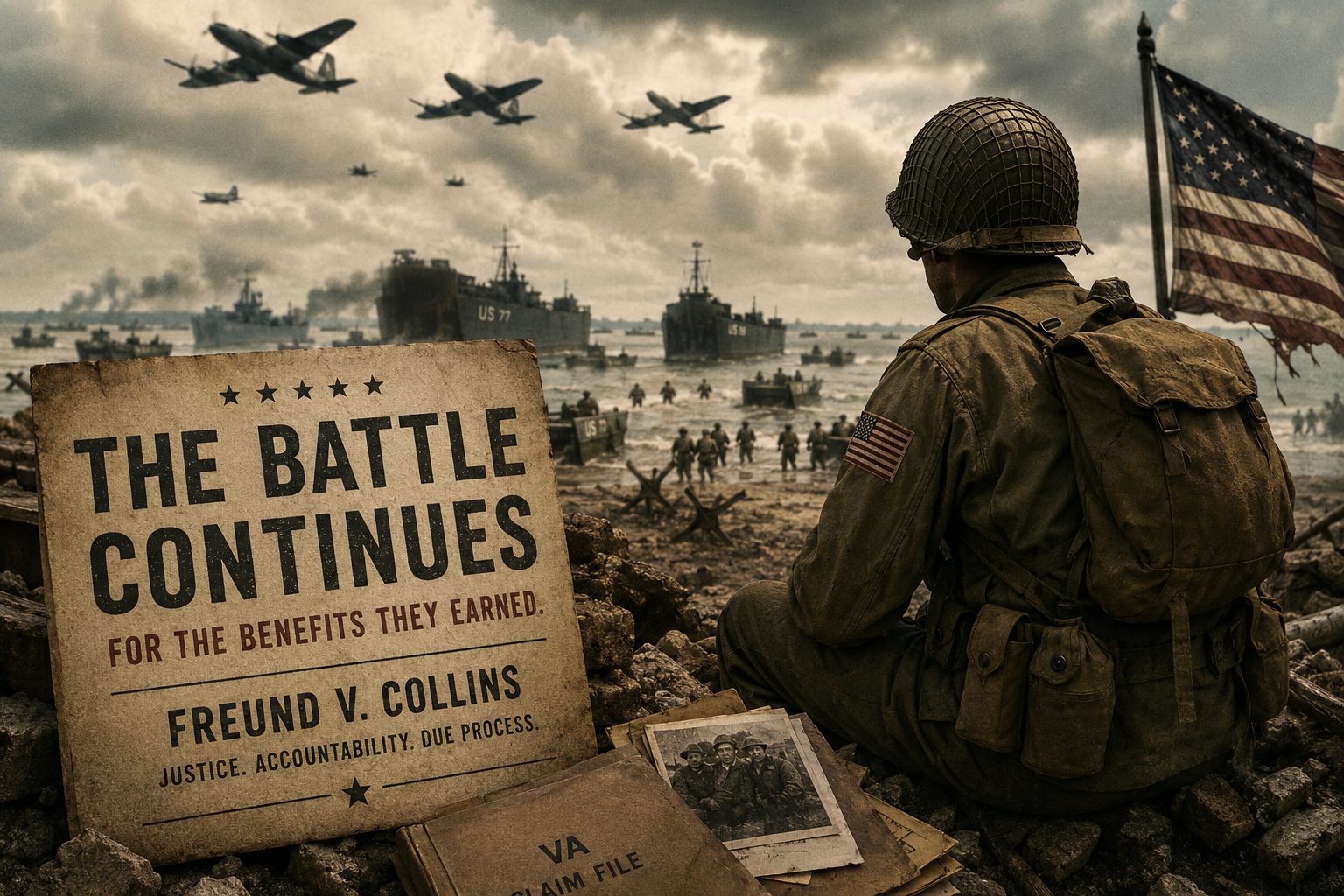
For generations of veterans, the fight for benefits has often felt like a second war—one fought in paperwork, waiting rooms, and endless appeals. But what if some of those battles were never actually lost? What if they were simply closed in the system before they were ever properly decided?
That is the question at the heart of Freund v. Collins, a major class-action case before the U.S. Court of Appeals for Veterans Claims. The lawsuit centers on legacy VA appeals that were closed in the Veterans Appeals Control and Locator System, known as VACOLS, because the system showed no timely Substantive Appeal. The problem is that some veterans may have filed the required paperwork on time, but their appeals were still closed without being processed to the Board of Veterans’ Appeals.
If the proposed settlement receives final approval, the VA will be required to review affected files, reactivate qualifying appeals, and notify claimants of next steps. For veterans and families who have waited years—or even decades—this case could mean more than a corrected record. It could mean restored effective dates, retroactive compensation, and a renewed chance at justice.
The Legacy Appeals System
Before the Appeals Modernization Act changed the process in 2019, many VA appeals moved through what is now called the legacy appeals system. A veteran who disagreed with a VA decision generally filed a Notice of Disagreement. The VA then issued a Statement of the Case, and the veteran had to file a Substantive Appeal, commonly known as VA Form 9, to continue the appeal to the Board of Veterans’ Appeals.
VACOLS was the VA database used to track these appeals. In theory, it helped the VA manage a large inventory of cases. In practice, the lawsuit alleges that some appeals were closed based on what the system showed rather than what veterans had actually submitted.
That distinction matters. If a veteran filed a timely appeal but the VA failed to process it correctly, the appeal should not have died in the system. An open appeal can preserve an earlier effective date, and effective dates are the foundation of back pay. Losing one can cost a veteran years of compensation.
How Freund v. Collins Took Shape
The case began with veterans challenging the VA’s handling of legacy appeals that had been closed in VACOLS. They alleged that the VA had improperly closed appeals for lack of a timely Substantive Appeal even though the required filings had been submitted. They also argued that claimants were not properly notified that their appeals had been closed.
On March 18, 2026, the Court of Appeals for Veterans Claims certified the lawsuit as a class action and appointed class counsel. The certified class includes claimants with an appeal file in VACOLS that was closed between December 12, 1990, and February 6, 2025, because of the lack of a timely filed Substantive Appeal, and which remains closed.
Class certification matters because it transforms the case from an individual dispute into a systemwide review. Instead of each veteran having to discover the problem and fight alone, the settlement process creates a structure for the VA to identify and address potentially affected cases.
What the Proposed Settlement Would Do
Under the proposed settlement, the VA would review certain legacy appeal files to determine whether they were wrongly closed. If the VA finds a timely Substantive Appeal in a file that was closed for lack of one, the agency would reactivate the appeal and notify the claimant of the next steps.
Public summaries of the proposed settlement describe two major groups. One group includes files the VA has already identified for manual audit. Another group includes additional claimants who may receive individualized notice and may be able to request VA review of their files. The exact rights and timelines depend on the court’s final approval and the settlement terms.
Importantly, this does not mean every affected veteran automatically wins the underlying disability claim. Reactivating an appeal means the veteran gets the appeal process back. The merits of the claim still have to be proven with evidence, law, and medical support. But for many veterans, simply getting the appeal reopened could be the decisive step that should have happened years ago.
Who May Be Affected
Claimants whose VACOLS appeal was closed between Dec. 12, 1990, and Feb. 6, 2025, for lack of a timely Substantive Appeal and remains closed.
Why It Matters
A reactivated legacy appeal may preserve an earlier effective date, which can affect years of retroactive compensation.
Family Impact
Surviving spouses, children, or eligible substitute claimants may also have rights if the original claimant has died.
Next Major Event
The fairness hearing is scheduled for Aug. 13, 2026, at 10:00 a.m. in Washington, D.C.
What This Could Mean for Veterans
The biggest impact may be the restoration of lost time. In VA benefits law, time is money. A claim granted today with a 2026 effective date is very different from a claim granted today with a 1996 effective date. If an appeal was wrongly closed and later reactivated, the original timeline may become central to determining how far back benefits should go.
For some veterans, this could mean modest back pay. For others, especially those involving high disability ratings, dependency benefits, or Total Disability based on Individual Unemployability, the amount could be life-changing. The key point is that no amount is guaranteed. The appeal still has to be reactivated, the claim still has to be won, and the correct effective date still has to be applied.
The case also matters for surviving families. If a veteran died while an appeal should have remained open, an eligible substitute claimant may be able to continue the fight. That could affect accrued benefits and, in some cases, related survivor benefits.
Signs a Veteran Should Pay Attention
Veterans and families should pay close attention if they remember filing a legacy appeal and never receiving a final Board decision. A case that went silent for years may not have been waiting in line. It may have been closed.
Warning signs include filing a VA Form 9 and never receiving a Board decision, being told years later that an appeal was closed without understanding why, or finding old paperwork that shows a Substantive Appeal was submitted but never acted on. Veterans should also watch their mail carefully for any VA notice connected to Freund v. Collins.
Anyone who believes they may be affected should consider contacting class counsel, an accredited Veterans Service Organization, or a VA-accredited attorney or claims agent. This article is not legal advice, and every case depends on its own record.
The Fairness Hearing
The next major step is the fairness hearing. The Court of Appeals for Veterans Claims has scheduled the hearing for Thursday, August 13, 2026, at 10:00 a.m. at 625 Indiana Avenue NW, Suite 900, Washington, D.C. At that hearing, the court will decide whether the proposed class settlement is fair, reasonable, and adequate.
If the court approves the settlement, the VA will begin carrying out the required review and notice process. If the court does not approve it, the parties may have to renegotiate or continue litigating. Either outcome will matter to veterans who may have been affected by these closures.
The Bigger Picture
Freund v. Collins is about more than a database. It is about accountability. Veterans are often told to trust the process, keep copies, wait their turn, and be patient. But when a system error closes an appeal without proper notice, patience becomes a trap.
This case is a reminder that administrative decisions can carry battlefield-level consequences in a veteran’s life. Benefits affect housing, medical care, family stability, debt, retirement, and dignity. A closed file is not just a closed file when it belongs to someone who earned the right to be heard.
For the veteran community, the message is simple: inspect what you expect. Keep records. Read every VA letter. Ask questions when something does not make sense. And if an old appeal disappeared without a final answer, do not assume the story is over.
For many veterans and families, the fight may not have ended. It may have only been paused.
Sources and Further Reading
- VA News: Freund v. Collins fairness hearing scheduled
- VA News: Notice of proposed settlement agreement for VA benefits claimants whose timely, substantive appeals have not been processed
- U.S. Court of Appeals for Veterans Claims: Freund et al., No. 21-4168
- MOAA: Was Your VA Appeal Denied? You Could Be Part of a Class-Action Settlement
- Freund VA Lawsuit information page