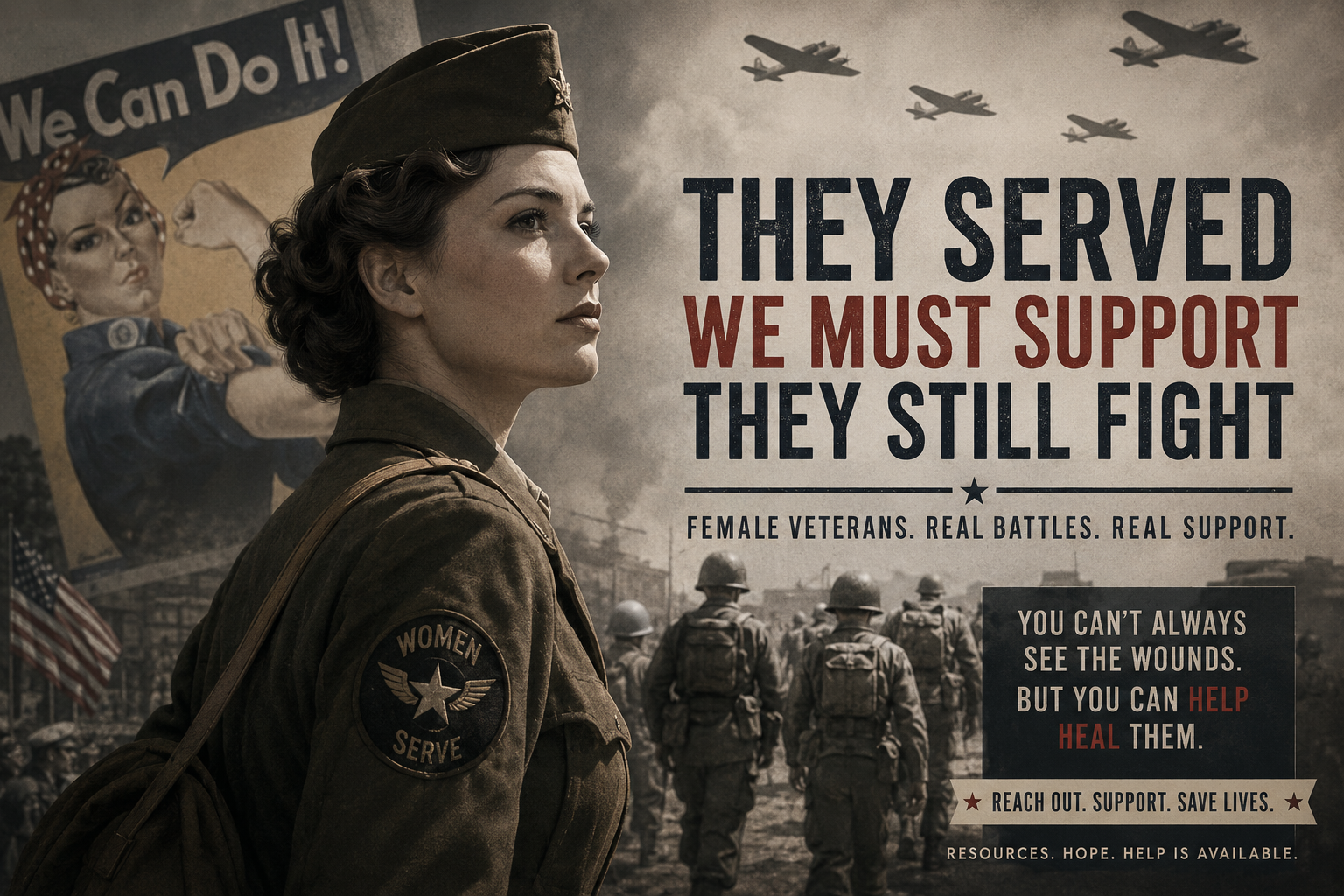
Veteran suicide is often discussed as a single national crisis, but the numbers tell a more specific and often overlooked story. Women veterans face a suicide risk that is sharply higher than women who never served. The latest VA suicide data page notes that the 2025 National Veteran Suicide Prevention Annual Report is based on national death certificate data through 2023, continuing the federal government's largest annual analysis of veteran suicide.
Earlier VA findings showed the depth of the disparity: after adjusting for age, the suicide rate among female veterans in 2022 was 92.4 percent higher than among female non-veteran U.S. adults. VA also reported that from 2021 to 2022 the age-adjusted suicide rate for female veterans decreased by 24.1 percent, while the rate for female non-veteran adults increased by 5.2 percent. That one-year improvement matters, but it does not erase the larger problem: women who served remain at substantially elevated risk.
Why the Risk Is Higher
There is no single cause behind the elevated suicide rate among female veterans. Researchers and VA clinicians point instead to overlapping pressures: military sexual trauma, post-traumatic stress disorder, depression, chronic pain, sleep problems, relationship strain, loss of identity after separation, and difficulty finding peer support that reflects the reality of women who served.
VA's Women Veterans Health Care program specifically warns that women veterans are at higher risk for suicide than non-veteran women and identifies service-related challenges such as readjustment issues, PTSD, military sexual trauma, sleep trouble, and physical injury as factors that may increase risk. Those risk factors do not always appear alone. A woman veteran may be managing trauma, family responsibilities, employment pressure, disability claims, childcare, isolation, and the burden of feeling unseen inside the broader veteran community.
Military Sexual Trauma and Institutional Betrayal
Military sexual trauma, or MST, is one of the most important female-specific risk factors in the research. VA defines MST as sexual assault or sexual harassment experienced during military service. For survivors, the trauma can be compounded by the fact that the harm happened inside an institution that depends on trust, unit cohesion, and chain-of-command accountability.
MST is associated with PTSD, depression, anxiety, substance use, relationship disruption, and suicidal thoughts. The impact can continue long after the service member leaves the military, especially when survivors believe they were not protected, not believed, or not supported when they came forward. For many women veterans, the transition out of uniform does not end the battle; it simply changes where the battle is fought.
PTSD, Transition, and Invisibility
PTSD in women veterans can be tied to combat, military sexual trauma, accidents, harassment, loss, or repeated exposure to high-stress operational environments. After service, the symptoms may collide with civilian expectations that women veterans simply move on, return to family roles, and handle everything quietly.
This invisibility matters. Many women veterans report that others do not immediately recognize them as veterans. Some feel out of place in veteran spaces that were historically built around male service members. That isolation can make it harder to ask for help, harder to find community, and harder to identify with prevention campaigns that do not speak directly to women who served.
Firearms and Lethality
Firearms are another major part of the female veteran suicide picture. VA's 2024 report found that the firearm suicide rate among female veterans in 2022 was 144.4 percent higher than among female non-veterans. RAND has also noted that a larger share of female veteran suicide deaths involved firearms compared with non-veteran women. This does not mean every veteran should be treated with suspicion. It means suicide prevention must include honest conversations about secure firearm storage, time and distance during crisis, and practical safety planning that respects veteran culture.
What Better Prevention Looks Like
Better prevention starts by recognizing that women veterans are not an afterthought. They need outreach that speaks directly to them, healthcare teams that understand their service, MST-informed care, peer groups where they are not the only woman in the room, and crisis planning that includes family, community, and lethal-means safety.
The hopeful part is that targeted care can work. VA's reported decline among female veteran suicides from 2021 to 2022 suggests that prevention efforts, access to care, outreach, and women-focused programming can make a difference. The job now is to expand that progress, not declare victory too early.
Female-Specific and Military/Veteran Resources
- Veterans Crisis Line: Dial 988, then press 1; text 838255; or use the online chat. It is available 24/7 and veterans do not need to be enrolled in VA care.
- VA Women Veterans Health Care: Connect with a Women Veterans Program Manager at a VA facility for help navigating primary care, mental health, reproductive care, maternity care, and MST-related services.
- VA Military Sexual Trauma Services: VA provides MST-related counseling and treatment. Veterans may be eligible even without a disability rating or documented report from the time of service.
- Beyond MST App: A free, private VA self-help app created to support MST survivors with coping tools and symptom-management resources.
- Vet Centers: Community-based counseling centers that support eligible veterans, service members, and families with readjustment counseling, MST counseling, bereavement support, and referrals.
- RAINN National Sexual Assault Hotline: 1-800-656-HOPE and online chat support for survivors of sexual violence.
- Cohen Veterans Network: Confidential mental health care for post-9/11 veterans, service members, and military families, regardless of discharge status in many cases.
- DAV Women Veterans Initiative: Advocacy, research, and assistance focused on the needs of women veterans, including mental health and suicide prevention.
The Dispatch Bottom Line
The female veteran suicide crisis is not separate from the larger veteran suicide crisis, but it does require a more precise response. Women veterans have served in every era, in every branch, and across every type of mission. They have carried the weight of deployments, trauma, leadership, loss, family separation, and transition. Too often, they have also carried the weight of being overlooked.
The path forward is clear: listen to women veterans, fund women-specific care, strengthen MST support, normalize help-seeking, build better peer networks, and treat suicide prevention as a mission that belongs to the entire veteran community. The wounds are not always visible. The service is not always recognized. But the responsibility to act is ours.
Sources and Further Reading
- VA: Veteran Suicide Data and Reporting
- VA News: 2024 Suicide Prevention Annual Report
- VA Women Veterans Health Care: Suicide Prevention
- VA Women Veterans Health Care: Military Sexual Trauma
- Veterans Crisis Line
- VA: Military Sexual Trauma, A Risk Factor for Suicide
- RAND: Suicide Among Veterans
- DAV: Women Veterans Study
- RAINN: National Sexual Assault Hotline