
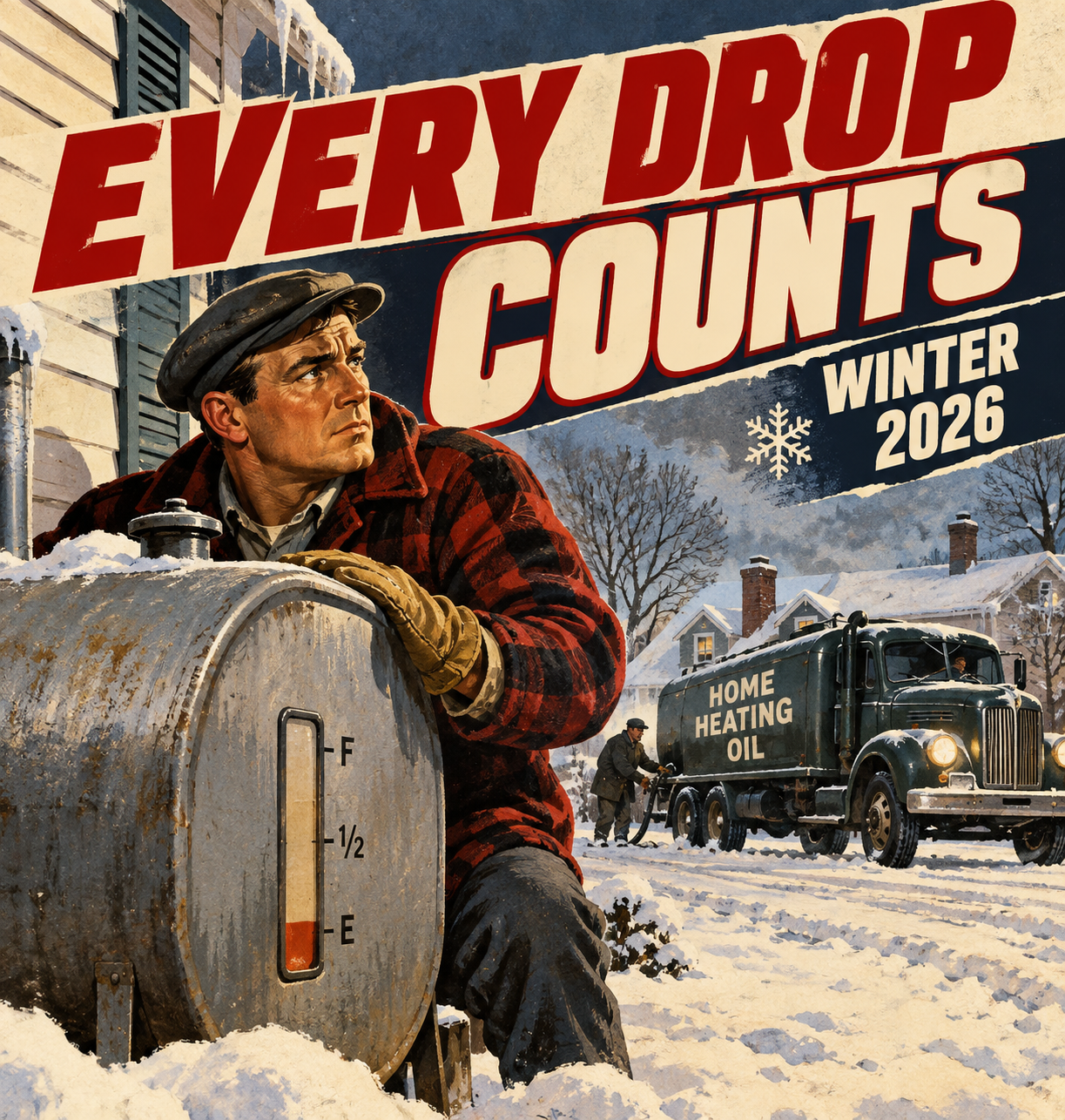
For millions of Americans, particularly those living across the Northeast, the first cold morning of the year brings more than the realization that winter is coming.
It brings the sound of the furnace kicking on.
And this year, that sound may as well be the sound of money leaving your bank account.
Home heating oil prices have climbed dramatically from where they stood last fall. According to the New York State Energy Research and Development Authority, or NYSERDA, the latest statewide monthly average is approximately $5.26 per gallon, compared with approximately $3.71 per gallon in August 2025. That represents an increase of roughly 42 percent in a year.
The situation is even more painful in some parts of the state. Recent NYSERDA averages put Long Island at approximately $5.48 per gallon, New York City at approximately $5.82, the Lower Hudson Valley at about $5.43, and much of upstate New York between roughly $5.05 and $5.19 per gallon.
Those are extraordinarily high prices, although they require an important qualification: they are not yet the highest prices ever recorded in New York. During the energy-price surge of 2022, NYSERDA reported statewide heating-oil prices above $6 per gallon, including a record weekly level during May of that year.
Still, telling a homeowner paying $5 or more per gallon that prices have technically been worse before offers little comfort.
A 275-gallon residential tank does not normally take 275 gallons during a delivery because homeowners rarely run it completely empty. But even a 200-gallon delivery at $5.25 per gallon costs $1,050.
At $5.50, it costs $1,100.
For a family that needs several deliveries through a cold Northeast winter, heating the house can suddenly become one of the largest expenses in the household budget.
That means efficiency is no longer simply an environmental discussion.
This winter, every gallon matters.
First: What Exactly Is Home Heating Oil?
Heating oil is a petroleum-based distillate closely related to diesel fuel. It is primarily used in furnaces and boilers to provide space heating and, in many homes, domestic hot water.
The U.S. Energy Information Administration notes that heating oil and diesel are closely related petroleum products known as distillates. Residential heating oil is generally dyed red because it is intended for non-highway use and therefore is treated differently from taxable highway diesel fuel.
Modern heating oil in much of the Northeast is also considerably cleaner than the fuel homeowners burned decades ago. New York requires ultra-low-sulfur heating oil, and similar standards have been adopted throughout much of the Northeast. Some suppliers also sell biofuel blends containing conventional heating oil mixed with renewable fuels.
Heating oil is especially important in the Northeast.
More than 80 percent of American homes that primarily heat with oil are located in the Northeast, according to the EIA. That concentration means events affecting Northeast inventories, refinery capacity, transportation or winter weather can have an outsized impact on families using oil heat.
And unlike electricity or pipeline natural gas, heating oil is something homeowners physically store on their property.
You have a tank.
Oil goes into it.
Your burner consumes it.
And eventually the truck has to come back.
That creates opportunities for homeowners to manage their costs—but it also creates risks.
Why Can Heating Oil Prices Change So Quickly?
The price coming out of the delivery truck reflects much more than the cost of producing a gallon of fuel.
Crude-oil prices matter. Refinery capacity matters. Distillate inventories matter. Transportation expenses matter. Global demand matters. Wars and geopolitical instability matter. Weather matters.
And Northeast supply conditions matter enormously.
The East Coast contains only a small fraction of America's refining capacity, meaning the region relies heavily on fuel moving into the market from elsewhere. The EIA has also noted that East Coast distillate inventories can influence heating-oil price uncertainty.
Then winter arrives.
A prolonged cold snap can rapidly increase consumption across millions of homes at approximately the same time.
That is why heating oil can behave differently from your electric bill. Instead of seeing relatively gradual changes, homeowners can sometimes watch retail oil prices move substantially over a matter of weeks.
It is also why homeowners should pay attention to prices before they desperately need fuel.
Your House Is Part of the Heating System
When people think about saving heating oil, they usually think about the furnace.
But your entire house is effectively part of the heating system.
Your boiler produces heat, but your walls, attic, windows, doors and foundation determine how quickly you lose it.
Imagine trying to fill a bucket that has holes drilled into the bottom.
You could install a bigger faucet.
Or you could plug the holes.
For many older Northeast homes, plugging the holes is one of the smartest investments available.
The Department of Energy estimates that reducing drafts through proper air sealing can potentially save roughly 5 to 30 percent per year, depending on the home.
Start with the obvious places.
Check exterior doors for drafts. Replace damaged weatherstripping. Install door sweeps. Caulk gaps around windows. Seal penetrations where pipes and wires enter the building. Inspect attic access panels. Look around basement windows and foundation penetrations.
Do not randomly seal combustion-air openings or furnace vents. Oil burners, wood stoves and other combustion appliances require proper ventilation and exhaust systems. When in doubt, have a qualified technician identify safe air-sealing opportunities.
Then look upward.
Heat rises, making the attic one of the most important areas of the house to inspect.
Poor attic insulation allows expensive heat to migrate through the ceiling and eventually escape through the roof. Improving attic insulation and properly air-sealing penetrations can significantly reduce that loss.
Basements and crawl spaces deserve attention as well, particularly around rim joists and other major leakage points.
Get the Burner Serviced
One of the worst strategies for saving money is skipping maintenance on the machine consuming thousands of dollars worth of fuel.
Oil-fired equipment should receive appropriate periodic professional maintenance.
A technician can inspect the burner, clean components, replace filters and nozzles where appropriate, verify combustion, examine the flue and identify problems that may be reducing efficiency.
A poorly operating burner does not merely waste fuel.
Improper combustion can create soot and carbon-monoxide hazards.
Have the system inspected before the coldest part of winter rather than waiting for it to fail during a January night.
The Department of Energy recommends professional maintenance of heating equipment and notes that heating represents a substantial portion of winter household energy consumption.
Turn Down the Thermostat—Intelligently
You do not have to turn your house into an Arctic survival school.
Small changes multiplied across hundreds or thousands of heating hours can matter.
The Department of Energy says households can save as much as approximately 10 percent annually on heating and cooling by lowering thermostat settings 7–10 degrees for eight hours per day.
That makes programmable and smart thermostats valuable tools.
Instead of heating an empty house to the same temperature you use while sitting on the couch, program setbacks around your family's actual schedule.
Lower the temperature while everyone is at work or school.
Reduce it overnight if appropriate.
Bring the temperature back up shortly before people wake or return home.
But homeowners with hydronic systems, heat pumps or specialized equipment should understand how their particular system responds to setbacks. Extreme thermostat changes are not necessarily optimal for every heating system.
The goal is not suffering.
The goal is avoiding unnecessary heating.
Don't Forget Hot Water
Many oil-fired boilers also produce domestic hot water.
That means every long shower may be consuming heating oil even when the house itself does not require much heat.
Fix leaking hot-water faucets. Install efficient showerheads. Insulate appropriate hot-water pipes. Run dishwashers and washing machines efficiently.
For conventional water heaters, the Department of Energy commonly recommends a setting around 120°F for many households, which can reduce energy consumption while also lowering scalding risk.
Follow the manufacturer's instructions for your particular system.
Use the Sun for Free Heat
Your house already has a massive heater available every clear day.
The sun.
Open curtains and blinds on sun-facing windows during the day and allow solar radiation to warm rooms naturally.
Close them when the sun goes down to help reduce heat loss through the glass.
Heavy curtains or insulated shades can be particularly useful in older homes.
It costs nothing.
Should You Heat With Wood?
For homeowners with access to inexpensive firewood, wood heat can dramatically reduce oil consumption.
A properly installed modern wood stove can heat a significant portion of a house, allowing the oil-fired system to serve as supplemental heat rather than the primary heat source.
Pellet stoves offer another alternative and can provide more controlled combustion and easier fuel handling.
But there is an enormous caveat.
Alternative heat must be used safely.
Saving $500 on heating oil is meaningless if you cause a chimney fire or expose your family to carbon monoxide.
The EPA recommends having wood-burning appliances, chimneys and vents inspected and serviced regularly. Wood should be dry and properly seasoned; EPA guidance recommends moisture content below approximately 20 percent for efficient burning.
Never burn garbage, plastic, pressure-treated lumber or other inappropriate materials in a wood stove.
Keep combustible materials away from the stove.
Have functioning smoke alarms and carbon-monoxide detectors throughout the home.
And understand that fireplaces are not automatically efficient heaters. Traditional open fireplaces can move enormous amounts of heated indoor air up the chimney.
A modern EPA-certified wood stove or insert is an entirely different appliance.
Be Extremely Careful With Portable Heaters
Electric space heaters can make sense when they allow you to heat one occupied area instead of maintaining a higher temperature throughout an entire house.
But they can also create serious fire hazards.
Keep combustible materials away from portable heaters. Plug them directly into an appropriate wall outlet according to manufacturer instructions rather than improvising with unsuitable extension cords. Turn them off when leaving the room or going to sleep unless the manufacturer's instructions explicitly permit otherwise.
EPA winter safety guidance specifically advises turning space heaters off when leaving a room or going to bed.
And never use an oven, outdoor grill, generator or other unvented combustion device as an improvised indoor heating system.
Carbon monoxide can kill without warning.
Shopping for Oil: Don't Automatically Call the Same Company
There is another major opportunity to save money that requires absolutely no insulation.
Shop.
Heating-oil prices can vary between dealers operating in the same region.
Before ordering, compare the delivered price, not simply the advertised price.
Ask whether there is a minimum delivery.
Ask about delivery fees.
Ask about credit-card surcharges.
Ask whether the advertised price is cash-only.
Ask whether emergency deliveries cost extra.
Ask about service requirements.
Then calculate the actual cost per gallon delivered to your house.
NYSERDA maintains regional heating-oil price data that consumers can use as a benchmark when comparing local offers.
That benchmark is powerful.
If the regional average is $5.25 and someone quotes $5.85, ask why.
If another reputable dealer offers $5.05, investigate the terms.
On a 200-gallon delivery, a 40-cent difference is $80.
Do that several times during the winter and the savings become meaningful.
COD Versus Full-Service Oil Contracts
Homeowners generally encounter several purchasing models.
COD—or cash-on-delivery—dealers typically focus on selling fuel at competitive market prices. Depending on the dealer, payment may actually occur by cash, debit or credit card rather than literal cash at the truck.
The attraction is simple.
You shop the current market and buy from a supplier offering an attractive price.
But the homeowner generally assumes more responsibility.
You may need to monitor your tank, schedule deliveries and separately arrange burner service.
Then there are full-service dealers.
These companies may provide automatic delivery, equipment maintenance, emergency service, service contracts and other benefits.
That convenience can cost more.
But comparing COD and full-service companies strictly on the posted price per gallon can be misleading because the products being purchased are not necessarily identical.
If your full-service agreement includes annual burner maintenance and 24-hour emergency service, those services have value.
The right question is:
What does my total annual heating package cost?
Fixed Price, Cap Price and Market Price
Some dealers offer seasonal pricing contracts.
A fixed-price contract locks in a predetermined price. If market prices rise, you are protected. If prices fall, however, you may remain obligated to pay the contracted price.
A price-cap arrangement may establish a maximum price while allowing the customer's price to decline if the market falls. These arrangements may include fees.
A market-price or variable-price arrangement allows the price to move with prevailing market conditions.
There is no universally superior option because nobody knows exactly where oil prices will move.
Instead, homeowners should think about risk.
If knowing your maximum winter fuel cost is extremely important to your household budget, price certainty may have value.
If you are comfortable accepting market volatility and shopping aggressively, COD purchasing may be attractive.
New York consumer guidance recommends carefully reviewing heating-fuel contracts for duration, per-gallon price, deposits, minimum-purchase requirements, billing terms, automatic-delivery provisions, maintenance coverage and restrictions involving the tank.
Budget Plans Can Help Even If They Don't Lower the Price
A $1,000 delivery arriving unexpectedly can destroy a monthly household budget.
Some suppliers offer budget billing.
Instead of paying huge amounts during winter and almost nothing during summer, the dealer estimates annual consumption and spreads the cost across monthly payments.
New York consumer guidance describes budget billing as estimated annual usage divided into regular payments, subject to adjustment for actual consumption.
You may not actually pay less for oil.
But predictable bills can be much easier to manage.
Don't Wait Until the Tank Is Empty
This deserves its own section.
Running an oil tank dry is not a money-saving strategy.
It can create additional problems, including sediment being drawn toward the fuel line, loss of heat, frozen pipes and potentially an emergency service call to restart the system.
During extreme weather, delivery companies can also become overwhelmed.
Monitor your tank.
If you manually order oil, establish your reorder point well before you reach empty.
Automatic delivery eliminates some of this responsibility, although homeowners should still periodically check their tank.
A quarter tank in October is an inconvenience.
A quarter tank with a major January storm approaching is a problem.
If You Cannot Afford Heat, Ask for Help Early
There is an important difference between trying to save money and facing a genuine heating emergency.
Nobody should be sitting in a dangerously cold house because they are embarrassed to ask for assistance.
The federal Low Income Home Energy Assistance Program, or LIHEAP, provides funding through states, territories and Tribes to help qualifying households with energy costs. Assistance can include heating bills, energy emergencies, weatherization and certain energy-related repairs.
Eligibility and benefit amounts vary by state.
The federal government also supports the Weatherization Assistance Program, administered through state and local agencies. Eligible households may receive improvements intended to permanently reduce energy consumption rather than simply paying another fuel bill. Both qualifying homeowners and renters can potentially participate.
That distinction is important.
Fuel assistance helps you buy another tank.
Weatherization can help make the next tank last longer.
Households should investigate both.
New Yorkers: Watch HEAP Closely
New York administers its energy assistance through the Home Energy Assistance Program, or HEAP.
Regular HEAP, Emergency HEAP and heating-equipment programs operate according to annual funding and opening dates, which means families should not assume last year's dates or benefits automatically apply to the 2026–27 heating season.
During the previous season, Emergency HEAP assistance could become available to qualifying households facing loss of heat, including households with less than one-quarter tank of heating oil, kerosene or propane.
Because program dates, eligibility rules and available funding can change, households should check the current New York State Office of Temporary and Disability Assistance information as the 2026–27 program opens rather than waiting for an emergency.
Veterans Have Additional Places to Turn
Veterans and military families should investigate general energy-assistance programs and veteran-specific programs.
In New York, the Veterans Emergency Housing Program can provide qualifying veterans facing immediate housing hardships with up to $2,000 for certain emergency needs. Covered situations can include missed utility payments caused by illness or emergency and repair or replacement of essential equipment such as a furnace or water heater. Eligibility requirements apply.
National organizations may also be able to help.
USA Cares operates its Military Assistance Response Program, which provides qualifying veterans and military families with emergency financial assistance for essential expenses that can include utilities, housing, transportation and food. Payments are generally made directly to vendors after approval.
Operation Homefront operates a Critical Financial Assistance program for qualifying military families. Eligible assistance categories can include utilities, home repairs, rent and mortgage expenses, food assistance and other critical needs. Eligibility depends on military status and other program requirements.
Veterans should also contact their state veterans agency, county or local Veterans Service Agency, and accredited Veterans Service Organizations. These organizations may know about state, county, nonprofit and emergency funds that are difficult to find through a normal internet search.
Do not wait until the house is already cold.
Start making calls when you realize the next delivery is going to be a problem.
Before Winter
Service the burner, inspect insulation, seal drafts, test smoke and carbon-monoxide alarms, and inspect chimneys or wood-burning appliances.
Before Buying Oil
Compare the delivered price, minimum order, fees, payment terms, service coverage and contract conditions—not just the advertised gallon price.
Before the Tank Gets Low
Set a reorder point and do not wait for an approaching storm or an empty tank to schedule a delivery.
If Money Gets Tight
Check LIHEAP or HEAP, weatherization programs, local assistance, and veteran-specific emergency programs before the situation becomes a heating emergency.
Build a Winter Heating Battle Plan
The best way to control heating costs is not one dramatic change.
It is layers.
Service the burner.
Seal the drafts.
Check the insulation.
Program the thermostat.
Use sunlight.
Reduce unnecessary hot-water consumption.
Consider safe supplemental heating where appropriate.
Monitor the tank.
Track regional oil prices.
Compare dealers.
Understand your contract.
Order strategically.
Apply early for assistance if you qualify.
A homeowner who reduces fuel consumption by 10 percent and simultaneously saves 20 or 30 cents per gallon when purchasing oil attacks the problem from both directions.
You are using fewer gallons and paying less for the gallons you use.
That is the strategy.
The Bottom Line: Every Gallon You Don't Burn Is a Gallon You Don't Buy
There is no trick that makes a Northeast winter cheap.
If outside temperatures plunge and stay there, your house is going to require energy.
But there is an enormous difference between heating your family and heating the outdoors.
At today's prices, seemingly small inefficiencies have become expensive.
A drafty attic is expensive.
A poorly tuned burner is expensive.
Heating an empty house to 72 degrees is expensive.
Buying oil without comparing prices is expensive.
Waiting until the tank is almost empty is risky and can become expensive.
This winter, homeowners cannot control crude-oil markets, refinery output, geopolitical events or the weather.
They can control how efficiently their homes use the fuel they purchase.
And when heating oil costs more than five dollars per gallon in parts of the Northeast, conservation stops being about pinching pennies.
It becomes about protecting hundreds—or potentially thousands—of dollars in the family budget.
So before winter settles in, walk through the house.
Check the windows.
Check the doors.
Look in the attic.
Service the burner.
Check the tank.
Compare suppliers.
Find your local assistance programs before you need them.
And if you have a fireplace or wood stove, get the chimney inspected before you light the first fire.
Winter is coming either way.
The objective is to make sure as little of your money as possible goes up the chimney.
Sources and Further Reading
- NYSERDA: Home Heating Oil Prices
- NYSERDA: Monthly Average Home Heating Oil Prices
- U.S. Energy Information Administration: Heating Oil Explained
- U.S. Energy Information Administration: Winter Fuels Outlook
- U.S. Department of Energy: Energy Efficiency and Home Energy Savings
- U.S. Department of Energy: Weatherization Assistance Program
- U.S. EPA: Winter Weather and Indoor Air Quality
- New York Department of State: Home Heating Oil and Propane Guide
- New York OTDA: Home Energy Assistance Program (HEAP)
- New York State Department of Veterans' Services: Veterans Emergency Housing Program
- USA Cares: Military Assistance Response Program
- Operation Homefront: Critical Financial Assistance