
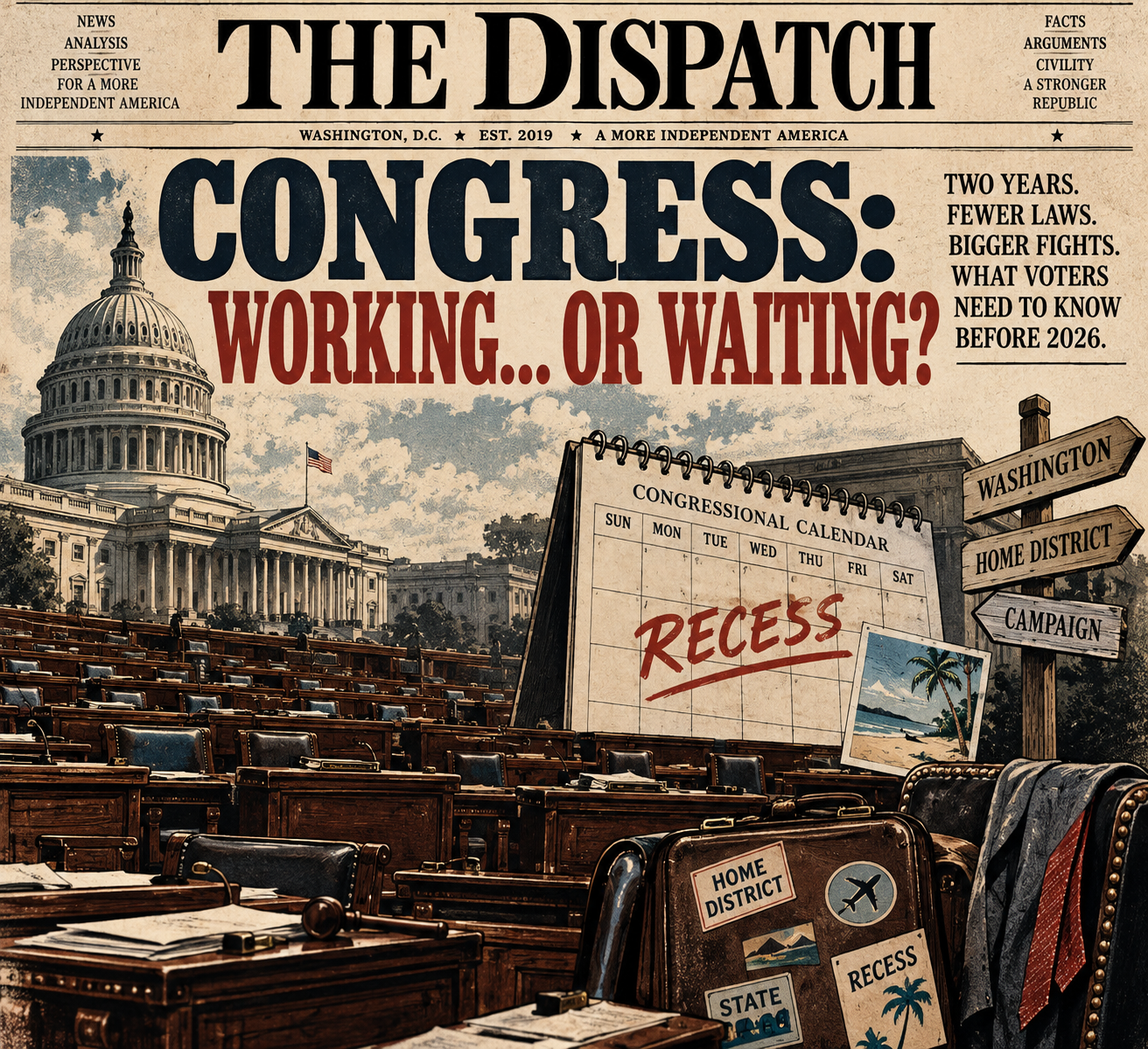
Americans have rarely been shy about criticizing Congress.
For decades, lawmakers have been accused of spending too much, accomplishing too little, fighting constantly, taking excessive vacations, protecting their own political careers and waiting until the last possible moment to perform the basic functions of government.
But as the country approaches the November 2026 midterm elections, one accusation has become particularly common: Congress isn't doing anything.
There is enough evidence behind that perception that it deserves serious examination. But the complete record of the 119th Congress — the Congress elected alongside President Donald Trump in November 2024 — is considerably more complicated.
Congress has passed relatively few laws. It has repeatedly struggled with appropriations. Major questions involving war powers, artificial intelligence, cryptocurrency regulation, federal spending and other issues have remained unresolved or partially resolved. As September 2026 draws to a close, lawmakers have once again resorted to temporary funding rather than completing the normal appropriations process.
At the same time, Congress has enacted legislation affecting taxes, Medicaid, SNAP, immigration enforcement, defense spending, veterans, cryptocurrency, fentanyl policy, government regulations and numerous other areas.
The result is an unusual Congress that can simultaneously appear remarkably inactive by one measurement and enormously consequential by another.
First, Which Congress Are We Talking About?
The 119th Congress officially began on January 3, 2025 and will end on January 3, 2027.
Republicans entered the Congress controlling both chambers and the White House, giving the party unified control of the federal government following the 2024 election.
That created expectations that Washington would be capable of moving legislation more easily than during periods of divided government.
But unified government does not automatically mean easy government.
The House Republican majority has been extremely narrow. The Senate's rules still require 60 votes for most legislation to overcome a filibuster. Republican lawmakers themselves have substantial ideological disagreements. And congressional leaders have increasingly relied on special procedures — particularly budget reconciliation — to move the most consequential legislation without needing substantial support from the minority party.
That distinction matters because much of the 119th Congress's impact has been concentrated into a relatively small number of very large pieces of legislation.
By the Numbers: Congress Really Has Passed Fewer Laws
The simplest measurement of congressional productivity is the number of laws enacted.
And by that measurement, the 119th Congress is running well behind many recent Congresses.
According to the National Archives, the first session of the 119th Congress produced 72 public laws.
Through September 2026, the second session had produced another 39 public laws, bringing the total to roughly 111 public laws at this point in the Congress.
That is substantially below the final totals of several recent Congresses.
The 118th Congress, covering 2023 and 2024, ultimately enacted 274 public laws.
The 117th Congress, covering 2021 and 2022, enacted 362.
The 116th Congress enacted 344.
Go farther back and the difference becomes even larger. The 115th Congress enacted 442 public laws, while the 110th Congress enacted 460.
But there is an enormous caveat.
Counting laws is an imperfect way of measuring Congress.
A law renaming a federal building counts as one law.
A thousand-page reconciliation package restructuring trillions of dollars in taxes and spending also counts as one law.
That means raw legislative totals can tell us how frequently Congress is legislating without necessarily telling us how important that legislation is.
And that distinction is critical when examining the 119th Congress.
Congress Has Done Some Very Big Things
The strongest argument against the “do-nothing” label is that several laws passed by this Congress have enormous economic and policy consequences.
The centerpiece was the sweeping reconciliation package signed into law in July 2025, commonly called the One Big Beautiful Bill Act by its Republican supporters.
The legislation extended and modified major portions of the federal tax code, altered Medicaid and SNAP requirements, expanded immigration and border-enforcement funding, changed energy policy, modified student-loan programs and increased defense and homeland-security spending.
Whatever Americans think of those policies, describing them as insignificant would be inaccurate.
The Congressional Budget Office later estimated that legislation enacted during the first session of the 119th Congress would collectively increase cumulative federal deficits by approximately $3.5 trillion between 2025 and 2034, before accounting for additional interest costs.
That is not the footprint of a Congress that literally accomplished nothing.
It is the footprint of a Congress that concentrated much of its policymaking into a relatively small number of very large bills.
Other significant legislation included the Laken Riley Act, the TAKE IT DOWN Act, the HALT Fentanyl Act, cryptocurrency legislation including the GENIUS Act, a rescissions package, veterans legislation and the annual National Defense Authorization Act.
Congress has also used the Congressional Review Act and other mechanisms to reverse or alter regulations established during the Biden administration.
So the better description may not be that Congress has done nothing.
It may be that Congress has done fewer things, with several of those things being very large.
Then Why Does Congress Feel So Inactive?
Part of the answer is visibility.
Americans see congressional dysfunction far more easily than they see committee work.
A failed vote becomes breaking news. A government shutdown dominates television coverage. A screaming match during a hearing becomes a viral video. Months of negotiations over legislative language rarely receive the same attention.
But Congress has also created some of this perception itself.
One of the clearest examples is the federal appropriations process.
Congress is supposed to pass 12 regular appropriations bills funding the federal government before the beginning of each fiscal year.
That process has increasingly broken down.
In September 2026, Congress again relied on temporary funding to prevent another shutdown rather than completing the normal appropriations process. The stopgap legislation extended funding through December 11.
At the time, Congress had not completed any of the 12 regular spending bills for fiscal year 2027.
That sounds extraordinary. Historically, however, it isn't.
Research compiled by the Pew Research Center shows that Congress has failed to enact all regular appropriations bills on time for decades.
Congress last completed every regular appropriations bill on time in 1997.
For fiscal years 2020 through 2025, Congress enacted none of the regular appropriations bills on time.
So today's budget dysfunction is serious — but it is not new.
The difference may be that Americans now watch that dysfunction unfold continuously through cable television, podcasts, X, Facebook, TikTok, YouTube and other platforms.
Congressional dysfunction has become content.
How Much Time Does Congress Actually Spend in Washington?
Few subjects irritate taxpayers more than congressional recesses.
Members of Congress regularly leave Washington for what the House calls district work periods and the Senate calls state work periods.
Those periods can look like vacations on a calendar.
Sometimes they undoubtedly include personal and political activity. But officially they serve another purpose.
Members are expected to return home, meet constituents, visit businesses and government facilities, hold town halls, perform casework, meet local officials and maintain connections with the districts or states they represent.
That is actually part of the constitutional design of the House in particular.
Representatives face voters every two years precisely because the House was intended to remain closely connected to public opinion.
Still, the amount of time lawmakers spend away from Washington can be striking.
The Senate's 2026 calendar included extended state work periods around Easter, Memorial Day, Independence Day and Thanksgiving, along with a particularly long summer period scheduled from August 10 through September 11.
Another extended state work period is scheduled from October 5 through November 6, encompassing the election.
The 2025 schedule contained similar breaks, including an August recess lasting roughly a month.
But this pattern is not unique to the current Congress.
The House's own historical office notes that modern representatives generally gather at the Capitol only three or four legislative days per week, allowing members to spend the remaining time in their districts.
That arrangement has existed for years.
A congressional workweek frequently looks something like this: members travel to Washington Monday; votes begin Monday evening; committees and floor votes take place Tuesday and Wednesday; additional business occurs Thursday; members then return to their districts.
From the perspective of someone working five days a week at the same location, that schedule can look remarkably generous.
From Congress's perspective, however, Washington is only one of its workplaces.
But Being “In Session” Doesn't Necessarily Mean Legislating
There is another important complication.
Congress can technically be in session without conducting substantial legislative business.
Likewise, members can be outside Washington while congressional staff continue drafting legislation, negotiating agreements, conducting constituent services and preparing committee work.
The first session of the 119th Congress covered 172 calendar days in the House's historical session accounting, roughly comparable with recent Congresses.
The first sessions of the 117th and 118th Congresses recorded 172 and 183 days respectively.
In other words, the current Congress has not simply abandoned Washington at some historically unprecedented rate.
The more important question is: What has Congress accomplished with the time it has been there?
And here the record becomes more difficult to defend purely through scheduling.
Major legislation has frequently stalled. Annual appropriations repeatedly become emergency negotiations. Congress has struggled to develop durable bipartisan legislation on several major emerging issues. And major decisions involving tariffs, military action and executive authority have increasingly been driven by the White House rather than Congress.
That raises a larger institutional question than simply how many days lawmakers work.
Congress May Be Doing Less Because Presidents Are Doing More
One of the most important political developments of the modern era has been the expansion of presidential power.
When Congress cannot agree, presidents increasingly act through executive orders, emergency authorities, regulatory agencies and interpretations of existing statutes.
That trend did not begin with Donald Trump.
Presidents from both parties have increasingly relied on executive authority when legislation became difficult.
But the pattern has become particularly visible during Trump's second administration.
The result creates a political cycle.
Congress fails to reach agreement. The president acts. Supporters of the president defend the action. Opponents challenge it in court. Congress becomes even less central to the policy debate. And the courts increasingly become the referee between the legislative and executive branches.
That can make Congress appear irrelevant even while enormous changes in federal policy are occurring.
The Senate Has Another Job Americans Often Overlook
Legislation is only part of the Senate's workload.
The Senate also considers presidential nominations for judges, Cabinet officials, ambassadors and other federal positions.
A Congress could therefore enact relatively little legislation while simultaneously processing hundreds of nominations.
Committee investigations and oversight are another difficult-to-measure responsibility.
Congressional committees conduct hearings, issue subpoenas, question administration officials, investigate federal agencies and produce reports.
Whether individual hearings represent serious oversight or political theater is often a matter of political disagreement.
But those activities are part of Congress's constitutional role and cannot be measured simply by counting bills signed by the president.
Compared With Previous Congresses, Is This One Really Different?
In some ways, yes. In other ways, not nearly as much as Americans might believe.
What Is Unusual?
The number of public laws enacted so far is low compared with many recent Congresses. A remarkably large amount of policymaking has been compressed into a handful of major bills. Executive power has played an enormous role in national policy, and the narrow House majority has made internal party disagreements unusually important.
What Isn't Unusual?
Long congressional recesses, three- and four-day Washington workweeks, missed appropriations deadlines, partisan gridlock, large omnibus legislation and presidents attempting to expand executive authority when Congress stalls all predate the 119th Congress.
The 119th Congress therefore looks less like an unprecedented collapse of the legislative branch and more like an intensified version of trends that have been developing for decades.
The Hidden Problem: Congress Measures Activity Better Than Results
Imagine Congress introduces 10,000 bills but passes only 100. Was that productive?
Imagine another Congress passes 400 laws, but most rename post offices, authorize studies or make technical corrections. Was that more productive?
Now imagine Congress passes only 75 laws, but one restructures the tax code, another changes health-care spending and another fundamentally alters immigration enforcement.
Which Congress accomplished more?
There is no objective answer because legislative productivity is partly qualitative.
Citizens should therefore be skeptical when either political party uses raw bill counts to prove Congress is working — or not working.
Better questions include: Did Congress pass budgets responsibly? Did it conduct meaningful oversight? Did it address major national problems? Did lawmakers debate consequential decisions publicly? Did Congress exercise its constitutional authorities? Did representatives actually vote on controversial issues?
And perhaps most importantly: Can voters identify what their individual representative and senators actually did?
The Congressional Report Card Citizens Should Use
That last question may be the most useful one heading into November.
Americans do not technically vote for “Congress.” They vote for individual representatives and senators.
A voter evaluating an incumbent can look beyond campaign advertisements and ask several straightforward questions.
Voting & Legislation
How often did the member vote? Which major bills did the member support or oppose? Which legislation did the member personally sponsor, and did any of it advance?
Committee Work
What committees did the member serve on? Did the member participate seriously in committee work and congressional oversight?
Constituent Service
How accessible was the member? Did the office successfully handle casework involving the VA, Social Security, Medicare, passports, immigration or other federal agencies?
Accountability
Did the member explain controversial votes? Did the member behave in Washington the way he or she promised during the previous campaign?
Those questions can provide voters with information beyond party labels or viral congressional hearing clips.
What Congress Has Not Finished
As of late September, Congress still has significant unfinished business.
Annual appropriations remain unresolved beyond temporary funding.
Major debates surrounding artificial intelligence regulation remain unsettled.
Questions involving federal debt and long-term entitlement spending remain largely untouched.
Congress continues debating the scope of presidential war powers amid the conflict with Iran.
And lawmakers continue wrestling with how much authority Congress should reclaim from an increasingly powerful executive branch.
That final issue may eventually prove more historically important than the number of bills passed.
The Constitution created Congress as the branch responsible for taxation, spending, legislation and declarations of war.
If Congress gradually allows presidents to exercise more of those functions through emergency authority, executive orders and expansive interpretations of existing law, then the long-term question is not simply whether Congress is productive.
It is whether Congress is surrendering its own relevance.
The 2026 Election Could Change Everything
This is where the upcoming midterm election becomes especially important.
As of September 2026, national polling has shifted noticeably toward Democrats.
The RealClearPolling generic congressional ballot average covering September 8–22 showed Democrats at 50.6 percent and Republicans at 41.9 percent, an 8.7-point Democratic advantage.
A September Reuters/Ipsos survey similarly found registered voters favoring Democratic congressional candidates by 43 percent to 35 percent.
Individual polls vary considerably, and generic congressional ballots do not translate directly into House seats because elections occur district by district.
The Senate is even more complicated because only one-third of Senate seats are contested and the specific state matchups matter far more than the national popular vote.
Prediction markets have also moved substantially during September.
On September 17, Kalshi reported market prices implying approximately an 89 percent market-implied chance of Democratic House control and 57 percent for Democratic Senate control at that moment.
Those numbers are not election results, and they are not guarantees. Prediction markets can change quickly as polling, campaign developments, turnout expectations and new information change.
They are best understood as snapshots of what traders were collectively pricing at a particular moment.
Scenario One: Republicans Retain Congress
If Republicans maintain control of both chambers, Washington would continue under unified Republican government during the final two years of Trump's term.
That would make additional tax, immigration, energy and regulatory legislation more feasible, particularly if Republicans could again use reconciliation procedures.
But the same narrow-majority problem would remain.
A Republican Congress could still struggle to move legislation if factions within the party disagree.
Unified government does not eliminate gridlock when the majority itself is divided.
Scenario Two: Democrats Win the House but Republicans Keep the Senate
This would produce divided government.
A Democratic House could control committees, investigations, subpoenas and the House legislative agenda.
The Senate could remain under Republican control, allowing Republicans to control Senate committees and the confirmation process.
Large partisan legislation would become much harder to enact.
Oversight of the Trump administration would likely increase substantially from the House.
Budget negotiations could become even more confrontational because spending legislation would require agreement among a Democratic House, Republican Senate and Republican president.
This arrangement would likely shift Washington away from large partisan legislative packages and toward negotiation over legislation that can attract support across institutional and party lines.
Scenario Three: Democrats Control Both Chambers
A Democratic House and Senate confronting a Republican president would create a very different final two years of the Trump administration.
Congress could conduct substantially more aggressive oversight.
Democratic committee chairs could investigate executive agencies and administration policies.
Legislation passed by Congress could still face presidential vetoes, meaning Democrats would generally need Republican support to enact measures over presidential opposition.
Appointments could also become a major battleground if Democrats controlled the Senate.
The result could be fewer major laws but considerably more congressional oversight and institutional conflict between Congress and the White House.
Again, however, current polling and prediction markets cannot tell voters with certainty which of these arrangements will exist in January.
The election will.
So Is This Really a “Do-Nothing Congress”?
The evidence produces a more complicated conclusion than the slogan.
By raw legislative count, the 119th Congress has enacted relatively few public laws compared with many recent Congresses.
By fiscal governance, Congress continues the modern pattern of failing to complete appropriations on schedule.
By institutional standards, Congress has often allowed major national policy questions to migrate toward presidential authority and the courts.
Those are legitimate reasons for voters to question congressional performance.
But Congress has not literally done nothing.
It passed one of the most consequential tax-and-spending packages in years.
It enacted major changes involving immigration enforcement, Medicaid, SNAP, defense, cryptocurrency, fentanyl policy and federal regulation.
It passed veterans legislation and defense authorization legislation.
The contradiction is important.
The Bigger Question for November
Perhaps Americans have been asking the wrong question.
Instead of asking, “Did Congress do enough?”, the more useful questions may be: What did Congress do? What did it choose not to do? What powers did it exercise? What powers did it leave to the president? And did your representative actually represent you?
Congress was deliberately designed to move slowly.
The House represents population. The Senate represents states. Committees examine legislation. Two chambers must agree. The president must sign legislation or Congress must possess enough votes to override a veto.
That friction was intentional.
But there is a difference between deliberate government and dysfunctional government.
Determining where one ends and the other begins is ultimately something voters must decide for themselves.
And on November 3, 2026, every House seat and roughly one-third of the Senate will once again be placed before them.
The most important congressional report card will not come from a cable-news host, a political party, a prediction market or a social-media algorithm.
It will come from voters.
And this time, voters have nearly two years of evidence to examine.
Sources and Further Reading
- National Archives: Public Laws — 119th Congress, First Session
- National Archives: Current Public Laws
- U.S. House of Representatives History: Congressional Workweeks and Weekend Sessions
- U.S. Senate: 2026 Tentative Legislative Schedule
- Pew Research Center: Congress Rarely Passes All Spending Bills on Time
- Congressional Budget Office: Federal Budget and Legislative Cost Analysis
- RealClearPolling: Generic Congressional Vote
- Reuters: 2026 Congressional Polling and Federal Funding Coverage
- Kalshi: September 2026 Midterm Election Market Update
- Congress.gov: Legislation and Congressional Activity