For decades, Attention Deficit Hyperactivity Disorder has been explained mostly by what it makes difficult: focus, organization, time management, emotional regulation, impulse control, and follow-through. Those challenges are real. But they are not the whole story. Another way to look at ADHD is through the lens of environment. The same traits that can make modern office life feel like a daily ambush may have once helped human beings survive in a world built on movement, danger, opportunity, and fast decisions.
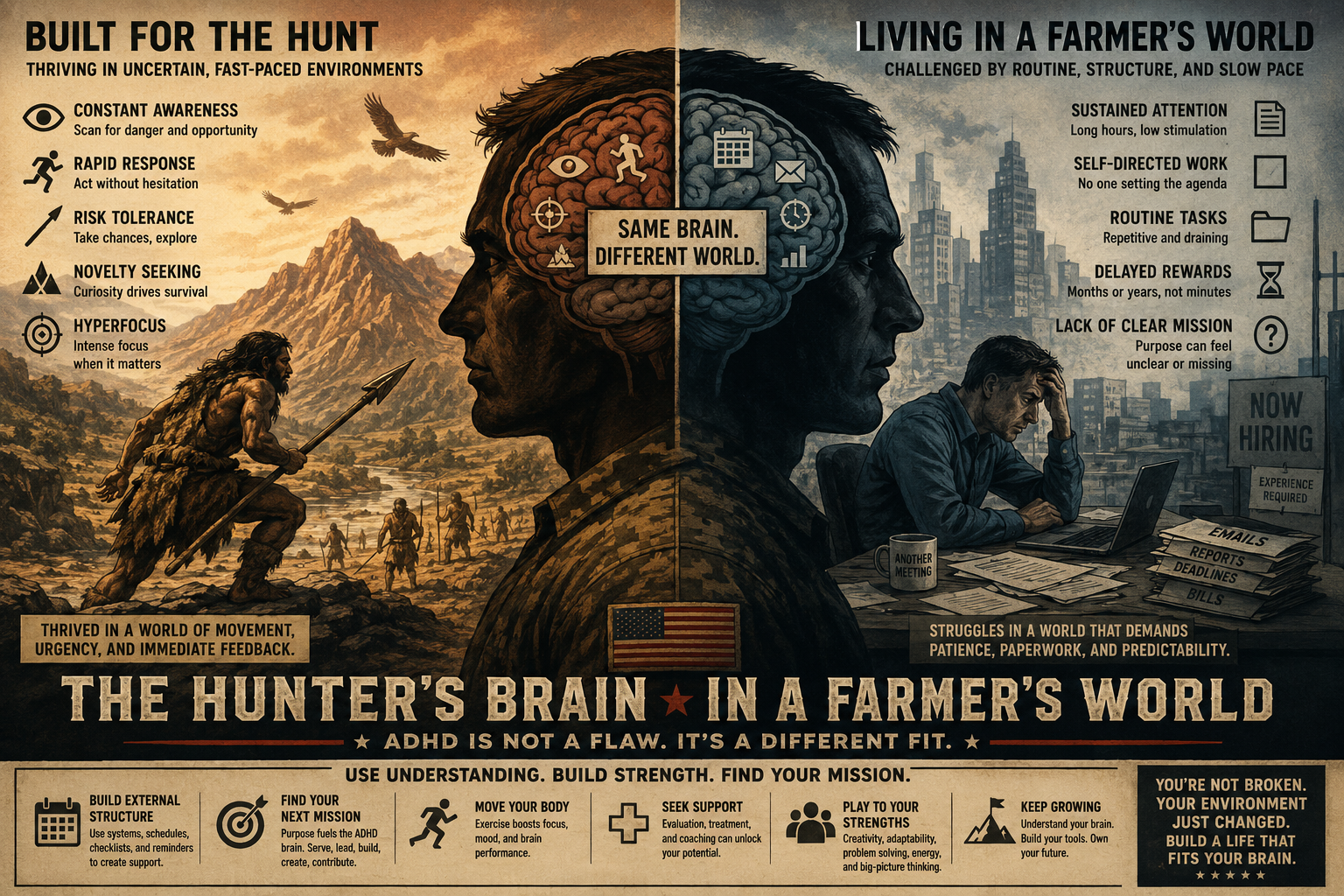
This idea is often called the hunter-gatherer hypothesis. It suggests that traits commonly associated with ADHD — constant scanning, novelty-seeking, quick reaction, risk tolerance, physical restlessness, and bursts of intense focus — may have been useful in prehistoric environments. In a world where survival depended on tracking movement, noticing threats, reacting quickly, exploring new ground, and acting before opportunity disappeared, a restless and highly alert brain could be an asset.
Modern life asks for something different. It rewards long periods of sitting, delayed rewards, repetitive tasks, predictable schedules, and self-directed administrative discipline. In other words, many modern systems are built around the patience of the farmer, not the instincts of the hunter. That does not mean ADHD is simply a gift or that it should be romanticized. It does mean that context matters.
Why Military Service Can Fit the ADHD Brain
Military life is not easy, but it does provide many of the things that people with ADHD often need to perform well: structure, accountability, movement, clear expectations, immediate consequences, defined roles, and a mission. The service member does not have to invent the system from scratch. The system is already there.
There is a time to wake up. There is a uniform to wear. There is a formation to attend. There is a team watching. There is a mission to complete. Standards are visible. Feedback is immediate. Physical activity is built into the culture. For many people with ADHD, that external structure can compensate for executive function challenges that may otherwise be exhausting to manage alone.
Military environments also reward traits that overlap with ADHD strengths. Situational awareness matters. The ability to move quickly matters. Adaptability matters. Energy matters. Creativity under pressure matters. The person who gets bored in a slow meeting may come alive during a fast-changing operation. The person who struggles with routine paperwork may be the first to notice when something is out of place on patrol, in the motor pool, on the flight line, or during an emergency response.
This is one reason some service members with ADHD can succeed in uniform even if school or civilian work never seemed to fit. The military can turn scattered energy into directed energy. It can turn restlessness into readiness. It can turn constant scanning into situational awareness. It can turn intensity into performance.
The Transition Shock
The problem often appears when the uniform comes off. Transition removes the external structure that helped hold everything together. Suddenly, the veteran is expected to manage appointments, resumes, job applications, school enrollment, benefits paperwork, family obligations, finances, networking, medical care, and a new identity without the same daily scaffolding.
The civilian world can feel slower and more vague. The mission is not always clear. The chain of command disappears. Feedback may be delayed for weeks or months. Success may depend less on urgency and more on consistency. Instead of immediate action, the veteran may face long applications, online portals, meetings, emails, and tasks that provide little stimulation and no instant reward.
For a veteran with ADHD, that change can feel like being dropped behind enemy lines without a map. A person who once handled pressure, responsibility, and danger may now struggle to return a phone call, finish a resume, show up to a slow class, or sort through VA paperwork. That gap can create shame. Veterans may ask themselves, "How could I handle military life but not this?" The answer may not be weakness. It may be a mismatch between brain, environment, and support systems.
What Research Is Showing
Research on ADHD and military populations is still developing, but several themes are important. Studies involving U.S. Army soldiers have found that ADHD can be associated with higher risk for post-deployment mental health challenges, including PTSD, depression, and anxiety. Other research on Post-9/11 veterans has found that adult ADHD symptoms are common in veteran populations and can overlap with PTSD, traumatic brain injury, sleep problems, and mood disorders.
That overlap matters because symptoms can look similar from the outside. Difficulty concentrating may be ADHD, PTSD, depression, poor sleep, traumatic brain injury, or some combination of all of them. Irritability may be emotional dysregulation, hypervigilance, stress, or burnout. Forgetfulness may be an executive function problem, a sleep problem, or a trauma-related issue. Without a good evaluation, veterans may end up treating the wrong problem or blaming themselves for symptoms that have a clinical explanation.
Studies on military-to-civilian transition have also consistently pointed to the importance of identity, purpose, social support, and structure. Veterans who lose their sense of mission or feel disconnected from civilian society may face increased risk of isolation, risky behavior, depression, and poor adjustment. For veterans with ADHD, the loss of structure and identity can hit even harder because those systems may have been helping regulate daily life.
Future research will likely focus more directly on adult ADHD in veterans, how ADHD interacts with PTSD and TBI, and what kinds of coaching, technology, therapy, medication, and transition programs work best. The veteran community would benefit from more studies that do not simply ask whether ADHD is a problem, but when it becomes a problem, when it becomes an advantage, and how support systems can make the difference.
Understanding the Brain Helps Veterans Win
Understanding ADHD does not remove responsibility. It gives the veteran better intelligence on the battlefield. A service member would never be expected to operate unfamiliar equipment without training, maintenance, and a manual. The brain deserves the same respect.
When veterans understand how their brain works, they can stop relying on shame as a strategy. Shame does not build calendars. Shame does not finish paperwork. Shame does not create purpose. Systems do. Support does. Treatment does. Training does.
For many veterans, the breakthrough is realizing that they do not need to become a completely different person. They need to build an environment that allows their strengths to show while protecting against predictable weaknesses. A hunter's brain can live in a farmer's world, but it needs tools.
Build External Structure
Use calendars, alarms, checklists, whiteboards, task apps, and accountability partners. Do not rely on memory when a system can carry the load.
Create a Mission
Turn transition into an operation: employment, education, fitness, family, service, and purpose all need clear objectives.
Move the Body
Exercise can improve attention, mood, sleep, stress tolerance, and emotional control. Movement is not optional maintenance for many ADHD brains.
Use Support
Evaluation, therapy, coaching, medication, peer support, and VA care can help veterans identify what is really happening and what actually works.
How to Use the Hunter Brain After Service
The first step is to rebuild structure before life collapses into chaos. Veterans should create a daily battle rhythm that includes wake time, physical training, work blocks, admin time, family time, meals, and sleep. The goal is not to make civilian life feel exactly like the military. The goal is to replace the missing scaffolding with something that works.
The second step is choosing work and purpose with the brain in mind. Many veterans with ADHD may thrive in fields that include movement, urgency, problem-solving, hands-on work, crisis response, leadership, entrepreneurship, skilled trades, emergency services, fitness, logistics, security, coaching, advocacy, or mission-driven nonprofit work. A quiet desk job may work for some, but for others it may require additional systems to stay engaged.
The third step is reducing friction. Put important items in the same place every day. Use automatic payments when possible. Break paperwork into short timed blocks. Schedule appointments before leaving the office. Use body doubling — working near another person for accountability. Keep a written list of the next three actions, not the next thirty. Make the right action easier to start.
The fourth step is getting evaluated when symptoms interfere with life. Veterans should not assume every concentration problem is ADHD, and they should not assume every challenge is PTSD. A proper evaluation can help identify ADHD, PTSD, TBI, depression, anxiety, sleep disorders, substance use, or other issues that may be interacting. The right diagnosis can change the entire plan.
The Bottom Line
ADHD is not a character failure. It is not laziness. It is not a lack of discipline. For many veterans, it is a different operating system that may have worked well inside a mission-focused, structured, high-stimulation environment and then struggled when placed into a slower, less defined civilian world.
The answer is not to pretend the challenges are not real. They are real. Missed deadlines, emotional blowups, unfinished paperwork, job instability, relationship stress, and financial disorganization can cause serious damage. But the answer is also not to ignore the strengths: energy, creativity, courage, adaptability, crisis performance, big-picture thinking, and the ability to act when others freeze.
The mission after service is to understand the brain, build the systems, seek the support, and find the environment where those strengths can be used again. The hunter's brain was never broken. It may simply need a new mission.
Sources and Further Reading
- Army University Press: Leading Soldiers with ADHD
- Journal research: ADHD and post-deployment mental health risk in U.S. Army soldiers
- Research: Military-to-civilian transition, identity, and adjustment outcomes
- Columbia Psychiatry: Evolutionary psychiatry and ADHD
- VA Academic Detailing: ADHD Clinician Guide